
Most parents put fun first and safety second, if at all.
But the structure your kids play on every day carries real risks, and you won’t spot them without knowing what to look for before you buy.
I’ve seen it happen with so many families, choosing the most colorful or exciting equipment without considering the safety features that truly matter.
It’s easy to get swept up in how cool a playset looks and forget about stability or proper installation.
Taking a moment to assess safety can make all the difference in ensuring your children enjoy their playtime without accidents.
And honestly, a well-chosen, well-placed playset can do more than keep kids safe.
It can become one of the most charming and intentional features of your outdoor space.
1. Fall Zone Clearance and Impact-Absorbing Surfaces
The ground beneath any playground set is where safety either lives or dies, yet plenty of families skip the surface material question until after they’ve already installed everything.
Backyard playground sets for outdoor family fun can point you toward decent options if you’re just starting out.
The Consumer Product Safety Commission (CPSC) recommends a fall zone extending at least six feet in every direction from the outer edges of any play structure.
Swings demand more, and you’ll need space in front and behind equal to twice the suspension point’s height.
The surface material underneath matters just as much as clearance.
Engineered wood fiber, rubber mulch, and poured-in-place rubber all provide measurable fall protection, each rated in inches of depth.
A bare lawn or compacted dirt? Nearly useless.
Plan for at least 12 inches of loose-fill material, like wood chips or pea gravel, if the budget’s tight.
You’ll need to top it off regularly since it compacts and scatters with use.
That’s the real catch here: maintenance never stops.
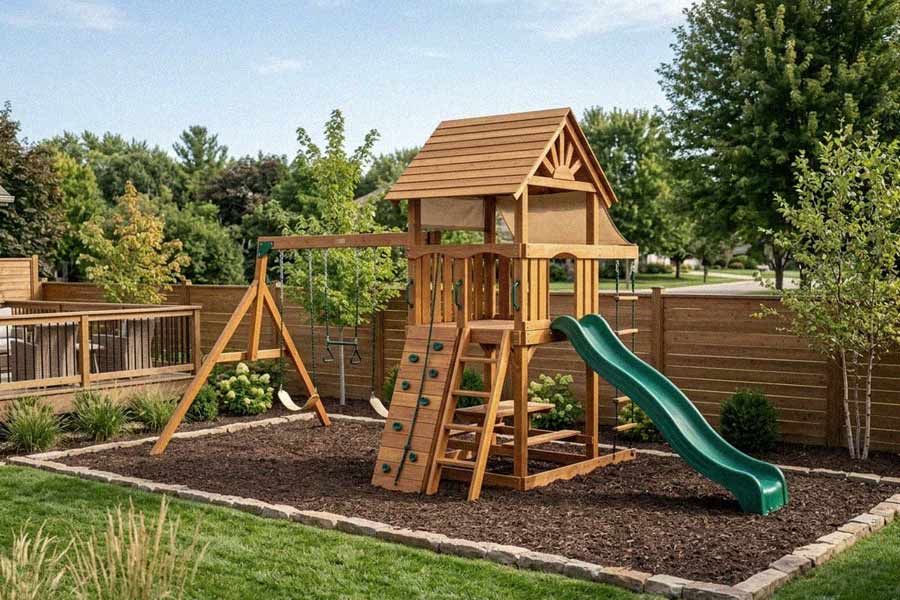
I’d also add that the right surface material, like smooth rubber mulch or cedar chips, can actually look quite attractive and tie your yard together visually when framed with clean border edging or natural stone.
2. Structural Stability and Hardware Quality
How well a playground resists movement, swaying, and long-term weather damage depends almost entirely on the hardware.
Look for galvanized or stainless steel bolts, brackets, and connectors, and skip standard zinc-coated fasteners, which rust and weaken faster outdoors.
Rust isn’t just ugly.
It compromises the load-bearing joints that keep everything upright when multiple kids are climbing and jumping.
Before you buy, check if the manufacturer specs include ground anchors.
These prevent tipping or shifting during active play, which is especially important on sloped yards or in windy areas.
Wood frame sets should use pressure-treated or naturally rot-resistant lumber with factory-sealed cut ends, not raw.
And poly or vinyl sets avoid the rot problem, but make sure their joint systems use reinforced connectors rather than simple snap-together parts that loosen over time.
A structurally solid playset also tends to look more substantial and intentional in your yard, the kind of feature that adds to your outdoor space rather than clashing with it.
3. Entrapment and Entanglement Hazards
Entrapment happens when a child’s head, neck, or body gets caught in an opening that’s big enough to trap but too small to pass through.
The CPSC has documented these incidents, and ASTM International standard F1148 sets specific guidelines for opening sizes in residential equipment.
Here’s the thing: any gap between 3.5 inches and 9 inches in diameter qualifies as a potential head-entrapment zone.
It shouldn’t exist on properly designed equipment.
Inspect ladder rungs, deck railings, and any openings in panels or walls before you commit.
Entanglement is separate but just as serious.
Steer clear of sets with protruding bolt ends, open S-hooks on swing chains, or ropes tied in loose loops.
Drawstrings catch on these projections constantly, and neck entanglement from loose cords ranks among the leading causes of serious playground fatalities in young children.
Fully crimped, closed S-hooks and recessed bolt caps cost almost nothing but eliminate both risks.
4. Age-Appropriate Design and Weight Ratings
One-size-fits-all doesn’t work for playgrounds.
A set built for ages 5 to 12 has platform heights, rung spacing, and climbing challenges that’ll be all wrong for a toddler.
A toddler set won’t hold up when older kids exceed weight limits and play more aggressively.
Quality sets publish weight ratings per component, not just a system total.
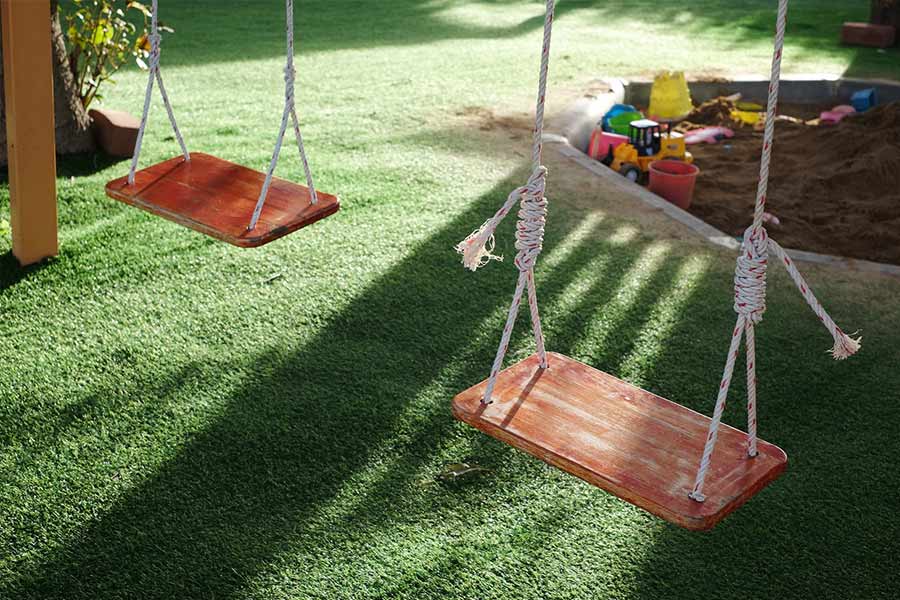
Swings carry individual limits, often 100 to 250 pounds depending on construction, and those limits matter.
If you exceed them, you stress the suspension hardware beyond tolerance.
Age labels from the manufacturer should match actual developmental ability, not just size.
Look for ASTM F1148 certification, which confirms the product was designed and tested against current US standards for residential equipment.
Certified sets give you a documented baseline, and sets without it shift more of the verification burden onto you.
5. Finish Quality and Toxic Material Safety
Paint, stain, preservatives, and base materials all touch children who climb, touch, and sometimes chew on equipment, especially younger kids.
Lead-free paint became the baseline requirement in the US after 2008, but some imported sets sold on non-authorized marketplaces still carry finishes that don’t meet current standards.
Pressure-treated lumber in wood sets should use alkaline copper quaternary (ACQ) treatment, not older chromated copper arsenate (CCA) formulas.
Those are banned for residential use but occasionally pop up in cheaper imports.
Vinyl and poly sets avoid most of this since color runs through the material rather than sitting on top, so they don’t need staining or sealing.
Check plastic components for UV stabilization ratings.
Unstabilized plastics crack and splinter when exposed to the sun, creating sharp edges that weren’t there the day you bought it.
From a purely visual standpoint, I’ve found that natural wood sets with quality finishes tend to blend beautifully into a backyard landscape, especially when the stain tone complements your fence, deck, or garden borders.
It’s one of those details that makes your whole outdoor space feel cohesive and intentional rather than thrown together.
A Backyard Worth Playing in and Being Proud of
Checking all five of these safety features takes less than an hour.
Fall zone clearance, structural hardware, entrapment risks, age-appropriate design, and material safety each address different ways things can fail.
Hit all five, and you’ll bring home a structure built for how kids actually play.
And when it’s the right fit for your yard, it won’t just be safe.
It’ll be something your whole family genuinely loves coming home to.

Leave a comment