
There’s a particular kind of room that disappears without anyone deciding it should.
Nobody announces that the patio is closed.

You just stop carrying your coffee out there, then you stop suggesting dinner outside, and eventually the table becomes the place where the empty pots live.
I’ve watched this happen in genuinely lovely homes, and it’s almost never a design failure.
Your setup and the furniture you chose are still good.
The problem is that the floor and walls of that room have gone gray and streaked, and no cushion, lantern or planter can carry a space whose surfaces read as neglected.
Indoors you’d never style a room over a filthy floor, and the same rule holds outside.
Which brings you to the pressure washer sitting in the garage or waiting at the rental counter.
It’s the fastest way I know to get that outside “room” back!
But it’s also the fastest way I’ve seen people wreck a deck, soften old mortar or drive water behind painted boards.
So let’s get the machine right first, then talk about the room.
Read the Surface before You Pull the Trigger
Walk the space slowly before you plug anything in.
I’d look for what’s actually causing the discoloration, since dirt, algae, mildew and weathering all look similar from a standing position and respond to completely different treatments.
Black streaking on north-facing surfaces is usually algae or mildew, which needs a detergent and dwell time rather than force.
A uniform dullness across timber is oxidation, meaning the surface fibers have weathered and no amount of pressure will fix what a light sand and a fresh finish will.
Crouch down and check the joints too.
Crumbling mortar, lifting boards and soft timber around fixings are all reasons to slow down, because water at pressure finds every weakness you didn’t know you had.
Understanding Pressure, Nozzles, and Distance
Most consumer electric machines run somewhere between 1,300 and 2,000 PSI, while gas units commonly reach 2,500 to 3,300.
Flow rate matters just as much, since gallons per minute is what actually carries debris away.
Your nozzles do more work than the machine’s rating does.
The red 0 degree tip is a pencil-thin jet that has almost no place in residential work, and I’d genuinely suggest leaving it in the box.
Yellow at 15 degrees suits hard masonry and concrete.
Green at 25 degrees handles most general cleaning.
White at 40 degrees is your safe default for anything painted, sealed or soft.
Black is the low pressure soaping tip, used for applying detergent rather than rinsing.
Distance is your real control dial.
Moving from six inches to eighteen inches away dramatically reduces the force hitting the surface, so test in a hidden corner and work outward from the gentlest setting that does the job.
How Different Materials Actually Respond
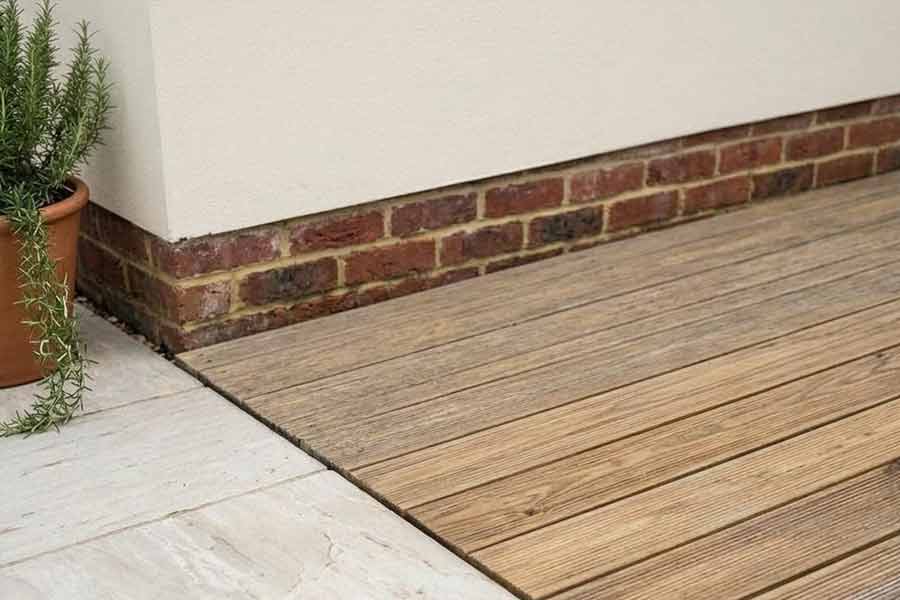
This is where most weekend projects go wrong, because the same technique produces very different results depending on what you’re standing on.
Timber decking is soft and directional.
Stay under roughly 1,500 PSI with a 40 degree tip, keep the wand moving with the grain, and never pause in one spot.
Stopping is what carves those faint stripes you’ll see forever once the light hits them low in the evening.
Limestone and other soft natural stone deserve real caution.
These surfaces erode under pressure and lose the mellow, slightly chalky texture that made you choose them, so a pH-neutral cleaner and a soft brush will serve you far better than a wand.
Painted weatherboard needs low pressure and patience.
Water driven upward slips behind the boards and stays there, and you’ll be looking at blistered paint by midsummer rather than the crisp trim line you were after.
Render varies enormously by age and quality.
Sound modern render tolerates moderate pressure, while older or patched work can shed its surface in sheets, taking your carefully chosen exterior color with it.
Roof tiles are the one I’d simply skip.
The combination of height, water forced under laps and dislodged protective granules makes this a genuinely poor risk.
Mortar joints in older brickwork are frequently the weakest thing on your property.
Aim a strong jet at soft lime mortar and you’ll wash out the joints, which is expensive to repoint and often changes the character of a wall you loved.
When Soft Washing Is the Smarter Choice
Soft washing applies a cleaning solution at garden hose pressure, lets it sit for ten or fifteen minutes, then rinses gently.
It treats organic growth biologically rather than blasting it away, which means the algae doesn’t return in eight weeks the way it does after a pressure-only clean.
For render, painted surfaces, soft stone and anything shaded, this is usually the correct answer.
I’ve come to think of it the way I think about cleaning a good linen sofa cover.
The gentle method takes longer and looks less impressive while you’re doing it, but the thing you love survives it intact.
Knowing When to Hand It Over
There’s no shame in outsourcing the risky portion of a project you otherwise want to do yourself.
Two-story elevations, aging mortar, large render walls and anything requiring a ladder are all reasonable places to stop.
If your property has surfaces you’d rather not gamble with, bringing in a crew that does power washing for a single day gives you a clean canvas.
From there you can spend your own weekends on the parts that are genuinely enjoyable, like sanding, staining, planting and styling.
That split has always felt like the sensible version of DIY to me.
Seeing the Space Honestly Again
Let everything dry fully, then go back out and look.
Clean surfaces are unforgiving in the best way, because now you can see which boards are actually failing, where the pavers have settled and which section of fence has been quietly rotting behind the jasmine.
You’ll also see true color for the first time in years.
Stone that read as muddy brown often turns out to be warm honey, and once you know that, choosing cushion fabrics and planter glazes gets far easier.
I’d hold off on buying anything until after this moment.
Shopping for an outdoor room based on how it looked dirty is how people end up with a scheme that never quite settles.
Styling the Room You Just Got Back

Now comes the part that actually determines whether you use the space.
A washed patio with four upright chairs around a table is still a place you eat quickly and leave.
Comfort is what makes people stay.
Deep seating with cushions you can sink into, an outdoor rug to define the floor, shade that makes early afternoon bearable, and lighting soft enough to keep people there after sunset.
Overhead light matters more than almost anything else out here.
String lights or a couple of lanterns give you the same effect a lamp gives a living room, which is a pool of warmth that says the evening isn’t over yet.
Layer in the small things you’d bring to an indoor room.
A side table within arm’s reach of every seat, a tray for glasses, potted herbs near the door where you’ll actually cut them, and one or two pieces with real texture like a woven basket or an aged terracotta pot.
Why the Effort Keeps Paying You Back
Give the space a gentle rinse a couple of times a year and treat shaded areas before growth takes hold.
Maintenance is far easier than recovery, and it protects the seals and finishes you’ve invested in.
What you’ve really done here isn’t cleaning.
You’ve added a room to your home for the cost of a Saturday, and rooms that feel good get used, which is the only measure of a successful space that has ever mattered.

Leave a comment