
Most of us spend months agonizing over a paint color for the front door and almost no time thinking about the largest surface on the outside of the house.
Your roof can account for up to forty percent of what someone sees when they pull up to your home.
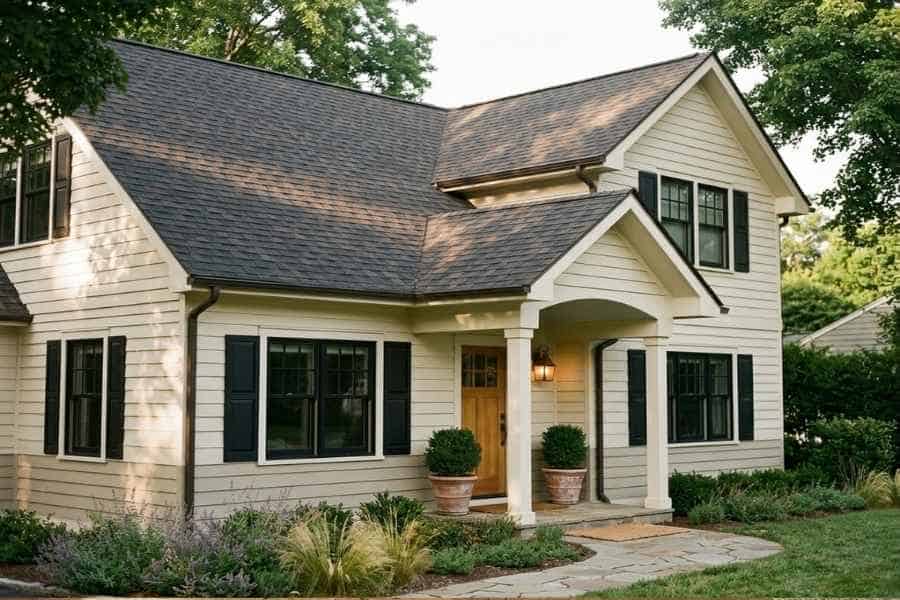
That’s a bigger visual footprint than your siding, your windows, and your landscaping put together in many cases.
So when your exterior palette feels slightly off and you can’t figure out why, I’d start by looking up.
Why Your Roof Sets the Palette for Everything Below It
I think of a roof the way I think of a mat around a piece of artwork.
It’s not the subject, but it decides how everything inside it reads.
A warm cream house under a cool blue-gray roof will always look a little mismatched, even when the paint color itself is lovely.
The same house under a soft charcoal or weathered brown roof suddenly feels settled and intentional.
Your shingles carry more color than you’d think, since most are a blend of several tones rather than a flat single shade.
Hold one up close and you’ll often find flecks of brown, copper, green or violet mixed into what looked like plain gray from the street.
Those undertones are what quietly fight with or flatter your siding, and they’re the reason two homeowners can pick the same “gray” roof and get completely different results.
Matching Your Roof Color to Your Exterior Palette
The simplest rule I follow is to keep warm with warm and cool with cool.
If your exterior leans toward cream, putty, greige, or any of the warm whites you’ve probably been comparing samples of, you want a roof with brown, taupe, or warm charcoal in its blend.
If your siding leans cool, with true grays, slate blues, or crisp bright whites, a cooler gray or black roof will feel right at home.
Where people get into trouble is choosing a roof color in isolation, usually from a small sample board under bright showroom lighting.
Shingle color shifts dramatically depending on light, and a blend that looks rich indoors can read flat and washed out under full sun.
Ask for full-size sample boards you can prop against your actual siding and look at in your own morning and evening light.
I’d look at those samples at least twice in one day, once around ten in the morning and once near dusk.
It’s the same thing you already do with paint swatches taped to a living room wall, just on a larger scale.
Let the Roof Be the Anchor, Not the Star
Your roof should be one of the quieter elements in your exterior scheme.
When it demands attention, everything else has to compete with it, and your beautiful front door color ends up as an afterthought.
A grounded, slightly darker roof does the same job as a large sisal rug in a living room, giving your eye somewhere restful to land so the details can shine.
That’s the real reason this matters to you, since the whole point of a considered exterior is that guests feel welcomed rather than visually busy before they’ve even knocked.
The Details Most People Overlook
Once your shingle color is settled, a handful of smaller decisions do a surprising amount of work.
Gutters and downspouts are the biggest one, and painting them to match your trim or fascia instead of leaving them builder-white makes a facade look instantly more custom.
Drip edge and flashing are worth asking about too, since a bright unfinished metal line at your roof’s edge can cut across an otherwise soft palette.
Fascia and soffit color deserve real thought, because that band sits directly between your roof and your siding and acts as the transition between them.
Painting it a shade pulled from your trim ties the two together, while leaving it mismatched creates a visual seam you’ll notice forever once you’ve seen it.
Dormers, skylights and chimney caps all read as part of the roofline from the curb, so their finishes should feel like they belong to the same family.
When a Tired Roof Undercuts Everything Else
Color is only half the story, since condition shows from the street just as clearly.
Dark algae streaking, patchy repairs in a slightly different shade, sagging gutter lines, and moss along the north-facing slope all register instantly, even to people who couldn’t tell you why the house looks neglected.
Here’s the frustrating part for you, that a streaked or patched roof makes fresh landscaping and a newly painted door work twice as hard for half the payoff.
You end up spending money on the details while the largest surface quietly argues with them.
I’ve seen homes where a straightforward roof cleaning did more for curb appeal than a full front-yard redesign would have.
If yours is patched in mismatched shingles from an old repair, that’s worth raising early, since a local San Francisco roofer can often tell you whether the patchwork can be blended or whether you’re better off waiting and replacing the slope outright.
Thinking about Your Roof in Terms of Style
Deep charcoal and true black pair naturally with farmhouse board-and-batten, modern exteriors, and crisp white siding with black window frames.
If you love that look but worry about heat, it’s worth knowing that darker shingles no longer have to mean a hotter house.
Manufacturers now make roofing that reflects sunlight while staying dark, using deep pigments engineered to bounce back the invisible infrared part of sunlight rather than absorb it.
That means you can keep the moody charcoal you wanted without the heat penalty that used to come with it.
Mid-tone grays and weathered slate blends feel right on traditional colonials and transitional homes where you want the roof to recede politely.
Giving Your Home a Facade That Agrees with Itself
If you’re planning a roof replacement in the next few years, pull it into your exterior color planning now rather than treating it as a separate project.
Decide on your siding and trim direction first, then choose a shingle that flatters it, and your whole facade will finally read as one idea instead of several.
That’s what people are actually responding to when they say a house has great curb appeal.
Not any single element, but the quiet sense that every part of it was chosen with the others in mind.

Leave a comment