
A big empty wall is the one decorating problem that gets worse the longer you look at it.
Most people respond by buying something small, hanging it dead center, and hoping the rest of the room distracts from it.
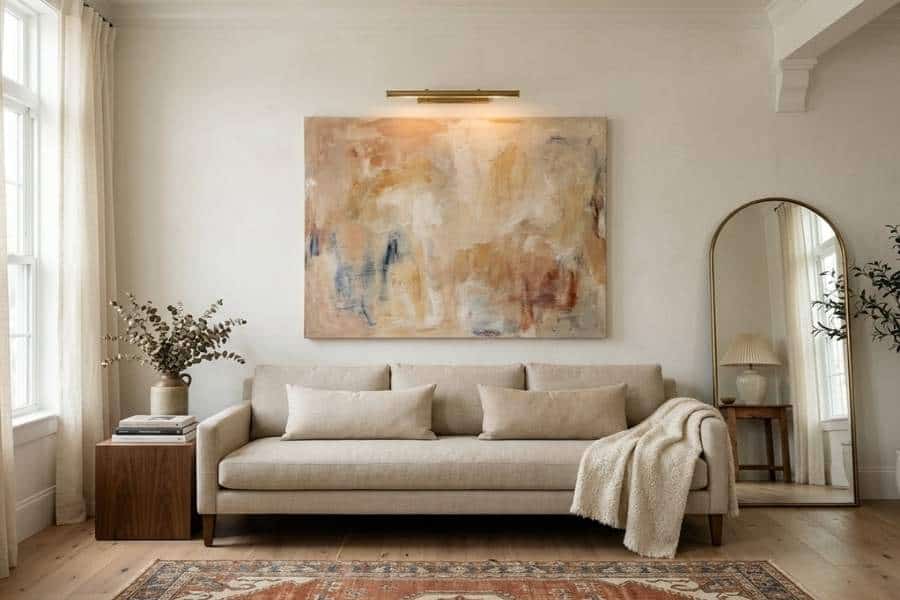
It never does.
The good news is that your blank wall is blank for one of about three reasons, and all of them have solutions.
Here are ten that actually work.
Hang One Oversized Piece Instead of a Scatter of Small Ones
This is the fix for almost every failed blank wall I’ve seen.
Small pieces spread across a big surface read as clutter, not as a composition.
One large piece looks more deliberate.
The number I work with is two-thirds.
Your artwork, or the full group treated as one unit, should span roughly 60 to 75 percent of the usable wall width.
Anything under about half the wall starts to look accidental, and on a wall that runs eight feet or more, that usually means a single piece 40 inches wide at minimum.
On tall walls, the same logic applies vertically.
If your room already has height, a piece scaled to match it works with that quality instead of shrinking against it.
There’s something calming about a wall that feels resolved, and I think that’s the real reason scale matters so much to how a room feels when you walk in.
Where to Find Art That Actually Fits
“Oversized” used to mean “custom-order expensive,” which is why so many of us gave up and bought three small prints instead.
That’s changed, with more large-format options now available in sizes that suit wider walls.
Crib of Art’s XL+ paintings run past the 48-inch mark that most standard retail stops at, which is the range you actually need for a wall like yours.
That extra width makes it easier to fill your space without adding more pieces.
Measure your wall first.
Then shop to that number, not to what happens to be in stock.
Use a Triptych or Panorama on Long Walls
Long horizontal walls, the kind you get behind a sectional or along a hallway, are a different problem from tall ones.
A single square piece looks stranded on them.
A triptych or a panoramic image follows the shape of your wall instead of fighting it.
Three panels with 2 to 3 inches between them span far more width than one canvas at the same price point.
I like what a horizontal piece does to a seating area too, since it draws your eye sideways and makes the whole arrangement feel more gathered and settled.
Weight is the practical constraint on very large pieces.
Retailers like BIG Wall Décor print onto fabric stretched into lightweight frames, precisely because a canvas of that size becomes awkward to ship and hang.
If your wall is over ten feet, measure it and commit to the number.
Splitting the difference is what leaves you with something that looks almost right.
Print It Yourself at Scale
Large art doesn’t have to mean a large invoice.
Digital downloads let you buy the file and handle the printing yourself, which removes the shipping cost that makes oversized art expensive in the first place.
Juniper Print Shop sells its prints in sizes matched to the IKEA Björksta frame, which is the cheapest route I know to a genuinely big framed piece.
I’d take the file to a local print shop rather than your home printer.
You want a real inkjet on decent paper stock at that size.
One tip worth the extra step is to ask for matte rather than gloss.
A large glossy piece catches every lamp in your room and you end up seeing reflections instead of the image.
Matte also holds onto lamplight more softly, which matters if you’re the kind of person who wants a room to feel warm at night rather than lit.
Set the Height before You Set the Hook
Art hung too high is the second most common mistake I see, and it’s the easiest one to fix because it costs nothing.
The gallery standard is 57 inches from the floor to the center of the piece, not the top and not the hook.
That number tracks average adult eye level, which is why art hung to it feels settled, even if your guests can’t say why.
Two Exceptions to the 57-Inch Rule
Two exceptions matter.
If furniture sits underneath, the furniture takes over as your reference point, so leave 6 to 8 inches between the top of the sofa back and the bottom of the frame.
And in rooms where people are mostly seated, like your dining room or home office, dropping to 53 or 54 inches reads better.
It’s a small thing, but hanging art to the height of a seated guest is a quiet form of hospitality most people never notice and always feel.
Group Small Pieces into One Big Rectangle
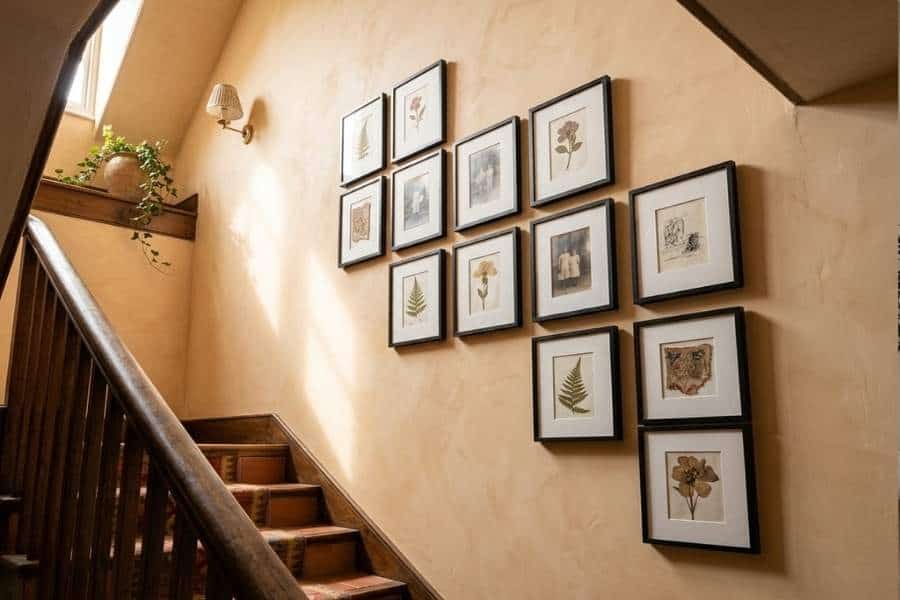
If you already own a pile of small art, you don’t have to replace it.
You just have to arrange it so it behaves like one large piece.
Pick a consistent frame color and keep the gaps tight, 2 to 3 inches between pieces.
Then treat the outer edge of the whole arrangement as your artwork boundary and apply the two-thirds rule to that.
I’d lay it out on the floor first.
Cut paper templates to size, tape them to your wall, and live with the layout for a day before you pick up a hammer.
Repetition is what makes this work.
Uniform frames and uniform spacing turn ten objects into one, and the same principle applies to geometric pieced wood wall art, where dozens of individual segments read as a single graphic because the rhythm never breaks.
It’s also the most personal option on this list, since a tight grid lets you keep the photographs and small prints that actually mean something to you without the wall looking scattered.
Lean a Large Mirror Instead of Hanging It
A tall mirror leaned against a blank wall solves two problems at once.
It fills the vertical space, and it bounces whatever light your room has back into it.
Leaning also sidesteps the hardware problem entirely, which matters if the piece is genuinely large and heavy.
Angle it so it reflects something worth looking at, like a window or a lamp, rather than a doorway into a dark hallway.
A well-placed mirror is one of the few decorating moves that makes a room feel both larger and softer, since borrowed light always reads warmer than another fixture would.
Treat the Wall Itself as the Art
Sometimes the answer is not hanging anything.
Board and batten, vertical slats, picture-frame molding, or a limewashed color block all turn your wall from a surface into a feature.
Then the wall no longer needs any additional decoration, since it has become the decoration itself.
This is the most budget-friendly route for very large walls, since the cost scales with square footage rather than with the price of a single big object.
There are plenty of creative ways to add dimension to your walls that a reasonably confident DIYer can finish in a weekend.
Texture is also what keeps a large room from feeling hollow, and a wall you can see shadow move across gives your eye something to rest on all day.
Don’t Let Two Focal Points Fight
One caution.
If you go this route, keep whatever you hang on top of it minimal.
A textured wall plus a busy gallery wall is two focal points competing for the same spot.
Bring in Texture with Textiles
Fabric covers a lot of wall for very little money, and it does something hard surfaces can’t.
A vintage quilt, a flatweave rug, a woven wall hanging, or a large tapestry adds softness and absorbs sound, which is genuinely useful in rooms with high ceilings and hard floors.
That’s worth more than it sounds, since a room that echoes never feels comfortable no matter how well you’ve furnished it.
Hang it from a slim rod or a cleat rather than stapling it, so the weight is distributed along the top edge.
Textiles also read as personal in a way a mass-market print doesn’t, especially if the piece has some history to it.
Add a Ledge So the Wall Earns Its Keep
Picture ledges are the flexible option.
A pair of ledges running most of your wall width gives you a place to layer framed pieces, lean smaller art in front of larger art, and swap things out seasonally without putting another hole in the drywall.
I love them for exactly that reason, since a wall you can change with the seasons keeps a room feeling current without a single new purchase.
Keep the ledges the same length and stack them 16 to 20 inches apart so the pair reads as one block.
Then overlap what you put on them.
Layering is what keeps a ledge from looking like a shelf with things on it.
Light It Properly, and Watch the Light It Already Gets
A large piece without dedicated light looks flat after sunset, which is when most of us are actually in the room.
A picture light, an adjustable wall sconce, or a floor lamp angled across the surface will do it.
Side lighting is better than straight-on, because grazing light picks up texture that flat light erases.
Lighting your art is really lighting your evenings, and a lamp aimed at a wall does more for how a room feels than another overhead fixture ever will.
The Sun Your Wall Already Gets
The flip side matters more than most people realize.
Light damage to art is cumulative and permanent, and the Canadian Conservation Institute notes that deterioration scales directly with intensity multiplied by exposure time.
At typical office light levels of 500 lux, highly sensitive pigments can show noticeable fading within a few months to two years, while average daylight at 30,000 lux can do it in days.
So if your blank wall sits opposite a south-facing window, put the expensive piece somewhere else, or glaze it with UV-filtering acrylic.
Frequently Asked Questions
How big should art be on a large blank wall?
Aim for artwork that covers 60 to 75 percent of your usable wall width.
On a wall with furniture below it, measure against the furniture instead and make the art about two-thirds to three-quarters as wide as the sofa or console.
Anything smaller than half the wall tends to look undersized.
How high should I hang art on a tall wall?
Keep the center at 57 inches from the floor, even when your ceiling is high.
Raising art to “match” a tall ceiling is the single most common mistake I see, and it disconnects the piece from the furniture below it.
If the wall still looks empty above, add a second piece rather than pushing the first one up.
Is one big piece better than a gallery wall?
For a genuinely large blank wall, one big piece is usually easier to get right.
A gallery wall can work, but only if it’s arranged tightly enough to read as a single block.
If you’re unsure, start with the single piece.
What can I put on a big wall besides art?
Mirrors, textiles, picture ledges, wall paneling, and architectural molding all fill large walls well.
Wall treatments are often the cheapest option on very big surfaces because the cost scales with square footage rather than the price of a single object.
How do I decorate a large blank wall on a budget?
Buy a digital download and have it printed locally in a large format, then use an inexpensive oversized frame.
DIY wall treatments like board and batten are the other budget route.
Both cost a fraction of a custom-framed original at the same scale.
How much space should I leave between framed pieces?
Two to three inches for a tight gallery arrangement, three to four for a looser line.
Keep the spacing identical throughout, because inconsistent gaps are what make a grouping look unplanned.
Should art be centered on the wall or on the furniture?
Center it on the furniture.
Your eye reads the art and the furniture as one composition, so a piece centered on the wall but off-center over the sofa will look wrong even when the measurements are technically correct.
How do I hang a heavy oversized piece safely?
Find the studs and anchor into them wherever possible.
For pieces that don’t line up with studs, use rated heavy-duty anchors or a French cleat, which spreads the load across a wider span.
Check the weight rating against the actual weight of your piece, including the frame and glazing.
Will sunlight damage my wall art?
Yes, and the damage is cumulative and can’t be reversed.
Direct sun will fade sensitive pigments and dyes within months.
Keep valuable pieces off walls that get direct sun, or use UV-filtering glass or acrylic.
What size art works above a sofa?
The artwork should be roughly two-thirds to three-quarters the width of your sofa, with its bottom edge hung 6 to 8 inches above the back of the sofa.
For a standard 84-inch sofa, that means a piece somewhere between 56 and 63 inches wide.
Measure First, Then Fall in Love with Something
A blank wall is mostly a measuring problem that pretends to be a taste problem.
Get the width right, get the height right, and give it some light, and almost any piece you genuinely like will look like it belongs there.
That’s the part I’d hold onto, since a wall that finally feels finished changes how the whole room welcomes you.
Start with the tape measure before you start browsing.
It’ll save you from the pile of small frames in the closet that nearly all of us accumulate first.

Leave a comment