
Commercial-style appliances keep showing up in beautiful residential kitchens for a reason.
That brushed steel, the heavy bar handles, the squared-off edges, all of it carries a kind of visual weight that a standard slide-in range just doesn’t have.

It reads as serious, and it anchors a room the way a good piece of furniture does.
But bringing pro-grade equipment into a home kitchen changes more than the look.
It changes how you plan your cabinetry, your ventilation, your finishes, and your upkeep.
Here’s how to design around it so the result feels warm and lived in rather than like a stainless prep line.
Why Pro-Grade Reads as Beautiful
Stainless steel works in a kitchen for the same reason marble does.
It’s a real material with real depth, and it changes as the light moves across it.
A brushed finish picks up warmth from a pendant in the evening and cools down under morning light from a window.
Pro-grade pieces also tend to have honest proportions.
The handles are thick because they need to be, the vents are exposed because they have to breathe, and nothing is hidden behind a decorative panel.
That functional clarity is what gives these appliances their appeal, and it’s why they sit so comfortably next to unfinished wood, honed stone, and plaster walls.
Keeping the Look from Going Cold
Here’s where a lot of these kitchens go wrong.
Steel next to steel next to steel stops feeling intentional and starts feeling institutional.
The fix is to treat it as one material in a larger palette rather than the whole palette.
I’d limit your steel to two or three visible runs at most.
A range and a hood, or a range and a refrigerator, gives you the look without tipping the balance.
Consider a panel-ready dishwasher and refrigerator so those fronts disappear into your cabinetry and let the range carry the story alone.
Then bring in what steel can’t give you.
Warm woods on the cabinetry or an island, unlacquered brass on the faucet and pulls so it patinas over time, and something soft underfoot like a runner or a flatweave rug.
Open shelving with ceramics, cutting boards, and a few plants breaks up the hard lines better than almost anything else.
Lighting matters more here than in most kitchens.
Warm bulbs at around 2700K keep steel looking rich, while cool bulbs make it look blue and clinical almost immediately.
Planning for Service Before You Build
This is the part that almost never comes up during a renovation, and it’s the part people regret.
Commercial-grade appliances are built to last, but built to last isn’t the same as maintenance-free.
These machines have pumps, seals, heating elements, and control boards, and every one of those is a wear part.
The difference is that pro equipment is designed to be repaired rather than replaced, which is genuinely good news for both your budget and your kitchen.
The catch is that a technician has to be able to reach it.
If your cabinetry is scribed tight to a pro-grade dishwasher with no way to slide it forward, a routine pump repair turns into pulling apart a custom install.
Ask your cabinetmaker to leave a service gap and to make the surrounding panels removable rather than fixed.
Confirm your electrical and water connections are reachable without demolition.
It’s also worth knowing who services your specific equipment before you buy it, since pro-grade lines often need a specialist rather than a general appliance shop.
A company handling commercial kitchen dishwasher repair can tell you what access a given model actually requires, and that conversation is far cheaper before your cabinets go in than after.
Keeping the Finish Looking New
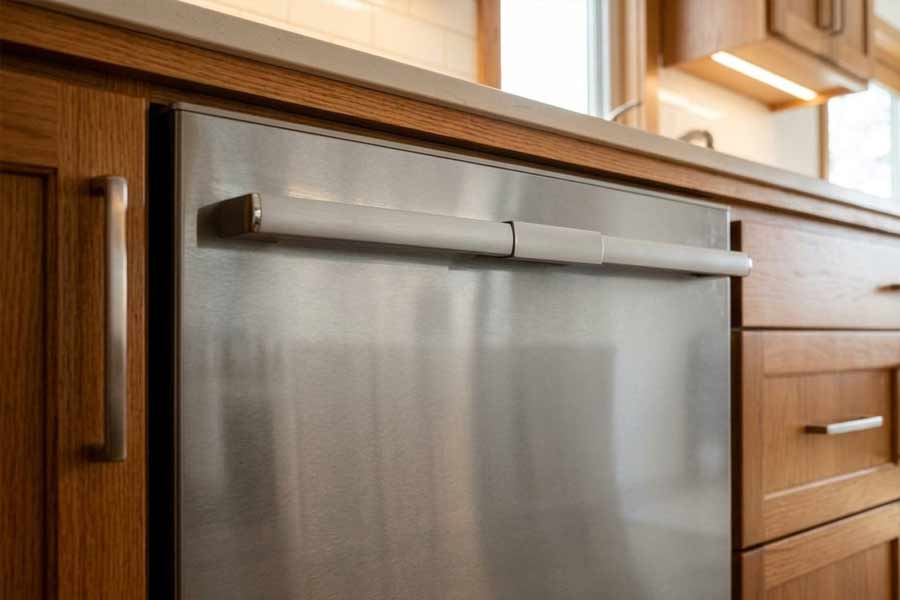
The fastest way a steel kitchen starts looking tired is water.
Hard water leaves mineral spotting on steel fronts and chalky scale inside your dishwasher, and both dull the finish you paid for.
Wipe your steel with the grain rather than in circles, using a barely damp microfiber cloth and then a dry one.
Skip anything abrasive and skip anything with chlorine, both of which will permanently mark the surface.
If you’re on hard water, a softener or an inline filter protects your appliances and your fixtures at the same time.
You’ll notice the difference on your glassware and your faucet before you notice it anywhere else.
Inside the dishwasher, run the cleaning cycle your manufacturer recommends and clear the filter regularly.
Scale doesn’t just hurt performance, it eventually shows up as a haze on everything the machine touches.
Watch For These Before They Become Projects
A few small signals tell you something needs attention while it’s still a service call rather than a renovation.
- Glassware coming out cloudy or filmed
- Water sitting in the bottom after a cycle
- Cycles running noticeably longer than they used to
- Grinding or buzzing you haven’t heard before
- Visible scale around the door seal
- Any moisture on the floor near the base
That last one matters most in a beautiful kitchen.
A slow leak behind a panel-ready front will find your hardwood or your cabinet toe kick long before you find the leak.
Build It So It Lasts
Pro-grade appliances earn their place in a home kitchen because they look substantial and they’re built to be kept.
Design around them with warmth, plan the access before the cabinetry goes in, and stay ahead of the water.
Do that, and the kitchen you finish this year still looks like the kitchen you wanted a decade from now.

Leave a comment