
Most of these calls start the same way.
Somebody noticed something on a tree and can’t tell what.

Usually, it’s little brown cones on your arborvitae that look like seed pods, or a pecan limb vanished into gray webbing around Labor Day.
Around Allen, this is the question our tree care in Allen, TX crews field most of the summer.
Before you make any purchases, I’d tell you to sort out bagworms from webworms first, because one of them will truly destroy a juniper.
Those evergreens are also doing real work for your home, framing your entry and screening your windows, so losing one changes how the whole front of your house reads.
What Are Bagworms and Webworms?
A bagworm builds itself a silk case and then glues pieces of your tree to the outside of it.
Needles, leaf scraps, twig bits, whatever’s handy.
It hauls the case around while it eats, leaning out the top to chew and yanking back inside when anything touches the branch.
One caterpillar per bag, and it never comes out.
Webworms don’t build anything on their own.
They hatch in a batch, throw a tent over the end of a branch, and feed inside it where the birds can’t get at them.
Strip the leaves in there, and the tent gets bigger.
Go out Friday, look again Monday, and they’re twice the size.
I think of it the way you’d think about your shade patterns, since one of these pests thins a hedge permanently and the other just messes up a canopy for a season.
What Is the Difference between Bagworms and Webworms?
One insect is in a bag it carries around, or a colony inside a tent they built together.
That’s the difference between bagworms and webworms, and the rest follows from it.
Bagworm cases are small, an inch or two, dangling off your twigs.
Check your junipers first.
Arborvitae, Leyland cypress, and cedar take a beating too.
Those are the same plants people use for privacy and for the tall green lines that hold a front bed together, and a bare patch in one doesn’t grow back.
Webworms want hardwoods.
The most common trees around here are persimmon, pecan, and mulberry, and their nests always sit near the tops of branches rather than in the middle.
In the spring, a different insect, the eastern tent caterpillar, weaves in a limb’s crotch.
How Can You Tell if Your Tree Has Bagworms?
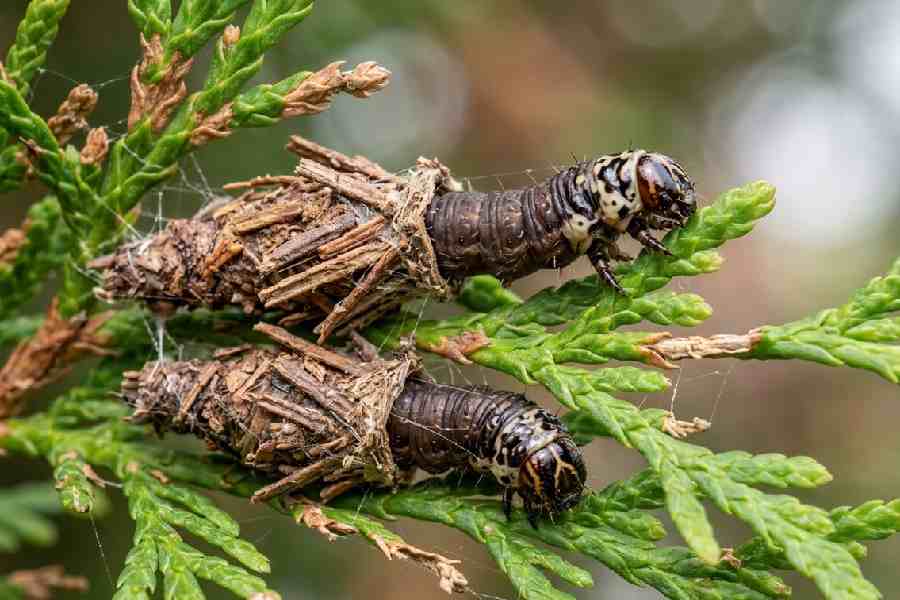
Get close to the twigs.
People walk past these for weeks because they look like part of the plant, and by the time they’re obvious, you’ve got a couple hundred.
May is when they hatch here.
The bag grows along with the caterpillar, a grain of rice in spring and an inch and a half by August.
Before you panic, pull one apart.
Old bags stay glued on for a year after the caterpillar’s gone.
If the inside is hollow and dry, you missed everything, and there’s nothing left to fix.
I’d give your evergreens the same once-over you give a room when guests are coming, close enough to catch the small stuff before it becomes the thing everybody notices.
How Can You Tell if Your Tree Has Webworms?
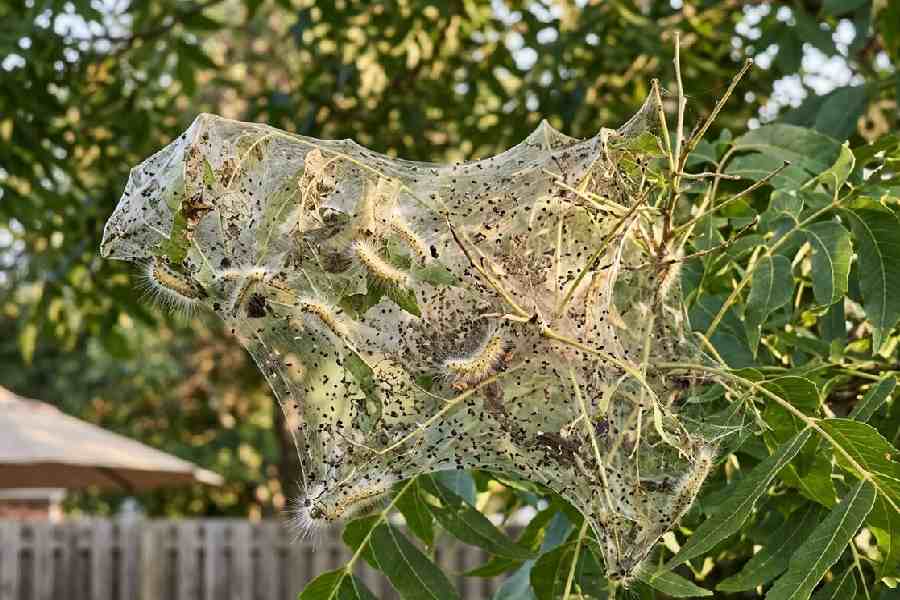
You’ll know.
A few feet across, sloppy nests filled with half-chewed leaves, silk, and pale, fuzzy caterpillars.
Timing is what saves your tree.
Webworms peak in August and September, and by then a mature pecan has banked most of what it needs for the year.
It can drop a lot of foliage that late and leaf out fine in spring.
I’d focus more on your young trees, recent transplants, and anything already struggling through drought.
Those young trees are usually the ones you planted for a reason, to shade a patio or soften a blank wall, so they’re worth protecting even when the big pecan can shrug it off.
Bagworms vs. Webworms: Which One Is Causing the Damage?
Go by what’s built on the branch, not the chewed leaves.
Trouble starts when you’ve got damage and no insect anywhere.
Spider mites, scale, herbicide drift from a neighbor’s yard, root problems, a brutal summer, and plenty of that looks like caterpillar feeding at a glance.
Spray insecticide at mites and you’ll come out worse, since you’ve killed the predators too.
Tree pest control that starts with a guess gets expensive fast.
It’s the same logic as figuring out why a wall keeps getting stains before you repaint it, because treating the wrong cause just costs you the work twice.
How Do You Get Rid of Bagworms and Webworms?
Hand-picking.
The most effective and longest-lasting way to control bagworms on shrubs and small trees is to pull the silk band off the twig rather than just the bag.
Winter’s easiest.
You’re pulling eggs off before anything hatches.
Sprays like Bt and spinosad only work when the larvae are small and eating, which happens in late spring.
Once they seal the bag to pupate, they stop feeding, and you waste product.
For webworms, prune the nest out if you can reach it safely.
If you can’t, and your tree’s healthy, leaving it alone is defensible.
Don’t take a torch to the webbing.
We see that bark damage every year, and it beats anything the caterpillars did.
A scar on a trunk is permanent in a way a chewed branch isn’t, and that trunk is the thing your eye lands on all winter once the leaves are down.
Whatever you spray, your tree has to be listed on the label.
Big infestation, forty feet up, or you’ve looked three times and still can’t tell?
Call somebody.
CitiTurf sees plenty of these around Allen and Collin County, and our crews can tell you whether it needs treating at all.
Sorting Out Which Pest You Have before You Buy Anything
Cases on the twigs of an evergreen means bagworms, and that one’s worth dealing with.
Webbing at the tips of a healthy hardwood in September is fall webworm, mostly cosmetic.
I’d work out which one you’ve got before you buy anything, because bagworm control and webworm control aren’t the same job.
Your trees are the biggest thing in your landscape and the first thing anyone sees, so getting this right protects the whole look of your home, not just one branch.
Leave a comment