
Not all designer dupes are worth buying.
Some reproductions are so faithful you’d struggle to tell them from the original, while others are cheap copies that miss the point entirely.

The difference isn’t really about price.
It’s about which pieces reproduce well, which don’t, and whether the maker is honest about what they’re selling.
I’ll walk you through how to tell them apart, because getting this right is what stands between a room that feels considered and one that feels like a compromise.
Dupe versus Counterfeit: Know the Difference
Start with the line that matters.
A faithful reproduction, sold openly as a reproduction, is a legitimate thing to buy.
A counterfeit, made to be passed off as the genuine article, is not.
The first is honest and legal, and the second deceives someone, usually a future buyer, so I’d avoid it however good it looks.
So the first question I’d ask of any dupe is simple.
Is the seller clear that this is a reproduction?
An honest one always is.
If a listing is coy about whether a piece is original, that’s a reason to walk away, not a sign of a bargain.
This matters beyond ethics.
A piece sold honestly as a reproduction comes with realistic expectations and, usually, a realistic price.
A piece dressed up as something it isn’t comes with neither, and the gap between the promise and the product is where buyers get burned.
I’ve found that honesty from the seller is the single best predictor that the item itself is any good.
There’s a quieter reason to care, too.
You live with your furniture every day, and a piece you feel slightly uneasy about never quite settles into a room the way an honest one does.
The Pieces That Dupe Well
Some designs reproduce beautifully, because their quality lives in proportion and geometry rather than in a secret process.
These are the ones I’d say are worth buying as a dupe.
The clean, spec-driven classics are your best candidates.
The Barcelona chair, the Eames shell chairs, the Wishbone and the Noguchi table all come down to getting the shape and the materials right.
The Noguchi knock-off coffee table is a perfect example.
A freeform glass top resting on two interlocking wooden legs is all about proportion, so a faithful version can get remarkably close to the original for a fraction of the cost.
If a design could be described accurately in a few measurements, a good reproduction can usually nail it.
The reason is worth understanding.
These pieces were designed for mass production in the first place, to be built to a specification rather than carved once by a single craftsman.
Reproducing them faithfully isn’t faking a one-off, it’s following the same instructions the design was always meant to be made from.
That’s why the gap between a licensed version and a genuinely good dupe of a spec-driven classic can be surprisingly narrow.
It’s also why these pieces work so hard in a room, since a sculptural silhouette reads across the whole space and sets the tone long before anyone notices what it cost.
The Pieces That Dupe Badly
Other designs resist duping, and these are the ones I’d be careful with.
Anything whose quality depends on complex upholstery, specific foam densities, precise stitching or fine hand-finishing is much harder to copy well.
A cheap version of a heavily upholstered classic often looks right in a photo and feels wrong in person, because the part that was hard to make is exactly the part that got skipped.
As a rule, the more of a piece’s quality is hidden inside it, the more a cheap dupe will disappoint you.
Sculptural, structural designs travel well. Soft, complex, craft-heavy ones don’t.
I think that’s the real cost of a bad upholstered dupe.
Seating is where your guests actually land, and a chair that looks the part but sits badly quietly undoes the welcome you were trying to create.
How to Spot a Good Dupe
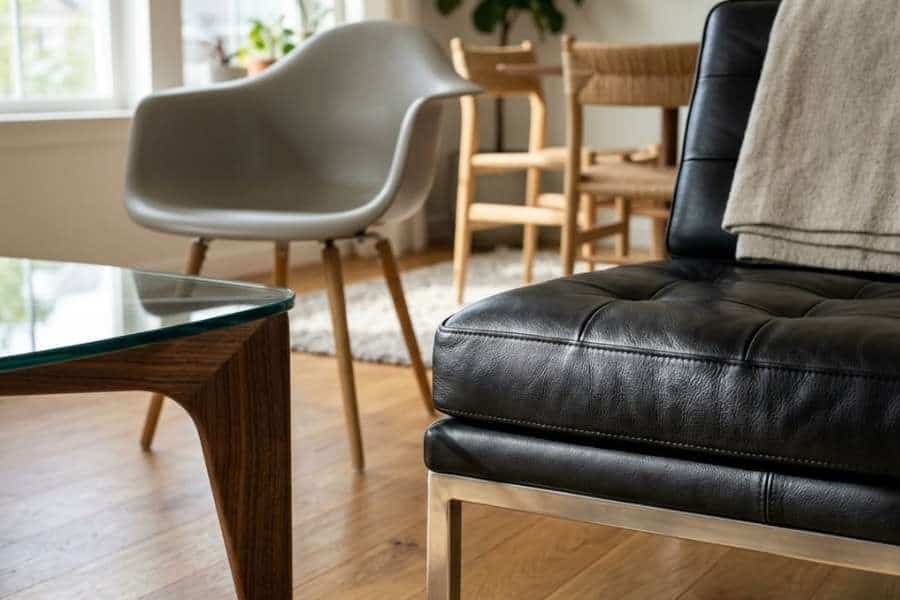
Once you’ve decided a piece is worth duping, a few checks separate the good from the bad.
- Proportions. Compare the dimensions with the original, since cheap copies often shrink or distort them.
- Materials. Real leather, solid wood and proper foam age well, and bonded leather and thin padding don’t.
- Construction. Look at the joins, the base and the stitching, the parts a corner-cutter tends to skimp on.
- Honesty. The seller describes it plainly as a reproduction and doesn’t hide behind vague wording.
I’d pay closest attention to the materials, because those are the ones you touch.
Wood and leather that age well pick up a patina over the years, and that softening is what makes a room feel lived in rather than staged.
Where to Spend and Where to Save
The smart approach is to dupe the icons and buy the simple things outright.
An expensive design classic is exactly where a faithful reproduction earns its keep, because the saving is large and, on the right piece, the difference is small.
Put that saving into the quality of the dupe rather than into more furniture, and you end up with fewer, better pieces that happen to have cost a fraction of the originals.
That restraint is worth as much as the money you save.
A room with fewer, better things in it breathes, and the space around each piece is what lets your eye rest when you walk in at the end of the day.
Buying Dupes without Compromising Your Room
Buy the dupes that reproduce well, avoid the ones that don’t, and insist on honesty about what you’re getting.
Do that and a room full of design classics is well within reach, with no deception required and nothing to apologize for.
The best result is a room that looks expensive and mostly isn’t, put together by someone who knew which corners were safe to cut and which were not.
That isn’t settling for less.
On the right pieces, it’s simply the smarter way to buy.
And the home you end up with feels like yours, assembled with judgment rather than a budget, which is the thing people actually respond to when they walk through your door.

Leave a comment