
The right toolbox can make or break your garage experience.
Some garages are fast and flexible.
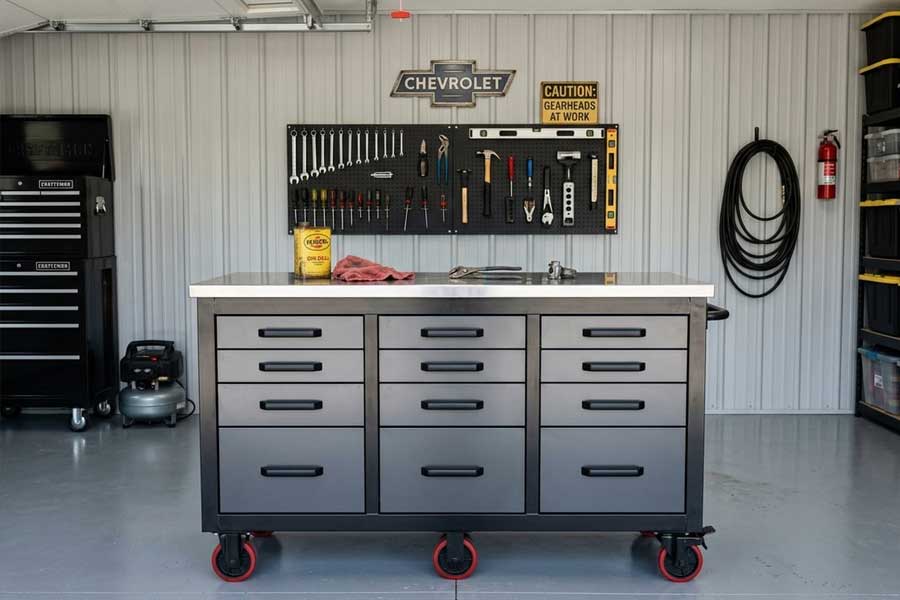
Others rely on the sheer amount of storage space and a single home base for each wrench and socket.
The choice between mobile and stationary toolboxes depends on your work habits, the types of tools you carry, and the amount of floor space you’re willing to sacrifice.
This article explains both options so you can compare them to your actual workflow, and not what works in a showroom.
What Sets Mobile and Stationary Toolboxes Apart
A mobile toolbox rolls. That’s the entire premise.
It’s mounted on locking casters, typically four to six, and moves from the workbench to the car lift to the driveway.
Most mobile units are mid-sized, between 26 and 41 inches wide, and have a handle or side grips designed for one-person handling.
They can be found in shops as wheeled tool chests or service carts and are a common feature in shops where technicians move between various work areas throughout the day.
A stationary toolbox, on the other hand, is designed to stay put.
These tend to be bigger, and sometimes they’re a combination of a bottom roller cabinet and a top chest that’s bolted or permanently attached to a wall.
Since weight isn’t a design concern here, manufacturers can fit more drawers, heavier gauge steel, and higher weight capacities per drawer, often 100 to 150 pounds compared to 50 to 90 pounds for mobile carts.
At the end of the day, a garage is where all tools come home to, and stationary boxes are the anchor of that space.
Much like a well-planned mudroom or built-in shelving system in a living space, a stationary toolbox brings that same sense of order and permanence to your garage.
Storage Capacity and Organization
Stationary units are typically the clear winners when it comes to storage capacity, and it isn’t close.
A large stationary combo can offer 15 to 20 drawers and 40 to 60 cubic feet of storage to keep hand tools, power tool accessories, fasteners, and specialty equipment organized in dedicated compartments.
If you’ve got a large tool collection in your home shop or small commercial garage, that kind of capacity matters.
Mobile units trade some capacity for access.
A rolling cart with 5 to 8 drawers is still a solid solution for daily-use tools, but it shouldn’t be your only storage method.
Most technicians who use mobile boxes pair them with a stationary cabinet elsewhere in the shop, using the mobile box as a satellite station stocked with just what’s needed for the job at hand.
The organizational mindset shifts from “store everything” to “store what you need right now.”
I think that shift is actually one of the more useful ways to think about garage organization in general, whether you’re a working technician or a home hobbyist trying to keep your space tidy and functional.
| Feature | Mobile Toolbox | Stationary Toolbox |
| Typical drawer count | 5-8 | 15-20+ |
| Storage volume | 10-25 cu ft | 40-60+ cu ft |
| Weight capacity per drawer | 50-90 lbs | 100-150 lbs |
| Footprint flexibility | High | Low |
| Setup permanence | Temporary, movable | Fixed, semi-permanent |
Workflow and Accessibility
Mobile toolboxes are where workflow really comes into play.
Whether you’re working in a two-car garage or servicing a vehicle on a lift and constantly reaching for the next tool, a rolling cart saves steps.
You load it with tools for the job, bring it to the vehicle, and everything is within easy reach.
This matters more than it sounds.
The time a technician spends walking back and forth to a wall-mounted cabinet 15 times during a brake job is real time, and it adds up fast over a full day of work.
Stationary toolboxes are built for a different kind of workflow, one that happens at a single workstation.
Whether you’re working at a single bench on small-engine repairs, custom fabrication, or detailed electronics work, a stationary unit keeps everything in one place.
It also removes the chance of losing your cart somewhere in a busy garage.
Stationary units also hold up longer when used repeatedly in the same spot, since the drawers aren’t absorbing the vibration and shifting weight that comes with rolling across uneven concrete.
Think of it the way you’d think about any dedicated storage space in your home: when everything has a fixed place, the whole room feels more intentional and easier to work in.
Durability and Build Considerations
Durability depends on how you use the box, and manufacturers design with that in mind.
Mobile toolboxes need a low center of gravity and strong caster mounting points to stay stable while loaded and moving.
Some cheaper models cut corners here, with wheels rated for less weight than the drawers can actually hold, causing the casters to wear out ahead of schedule.
When you’re shopping for a mobile unit, check that the caster load rating lines up with the overall capacity of the box, not just one or the other.
Stationary units face different stresses.
Since they’re not rolling anywhere, there’s no need to compromise on steel gauge or drawer slide strength.
That’s why stationary combos tend to feel more solid and why their drawer slides can handle years of heavy daily use.
The tradeoff is that once your stationary box is set up and filled, you really won’t want to move it.
I’d encourage you to think carefully about your garage layout before you commit to a permanent spot, the same way you’d plan out any major furniture placement in a room you want to get right.
Cost and Space Planning
For a lot of people, this decision comes down to budget and available space as much as anything else.
Mobile toolboxes are generally the more affordable option, with quality mid-size units running between $200 and $600, making them a practical choice for a home garage or a first commercial setup.
Stationary combination units, especially larger cabinet and chest combos, can run anywhere from $800 to $2,500 or more depending on drawer count and build quality.
Space planning deserves just as much attention as cost.
In a one-car garage with limited floor space, a mobile cart can be rolled against a wall when it’s not in use, freeing up room for parking or other projects.
A stationary unit fits better in a larger garage with a dedicated shop area, where it won’t eat into the space you need for everything else.
Your garage is part of your home, and how you organize it affects how the whole property feels to live and work in.
A well-planned storage setup, whether mobile, stationary, or both, can make that space feel just as purposeful and put-together as any other room in the house.
Building a Garage Setup That Actually Works for You
Most well-equipped garages end up using both.
A stationary cabinet handles full-capacity storage, while a mobile cart covers the daily tasks that need flexibility.
When you’re weighing either purchase, think about your average workday: how often you move from one task to another, how much you need to store, and how much floor space you can realistically give up.
It’s not really about mobile versus stationary.
It’s about building a system that works for the way you actually use your space, and that’s a goal worth getting right.

Leave a comment