
Layout will ultimately determine how your bathroom functions.
Your tile, tap, or vanity choices will never have as much of an impact on how your small bathroom works as choosing the right layout from the start.
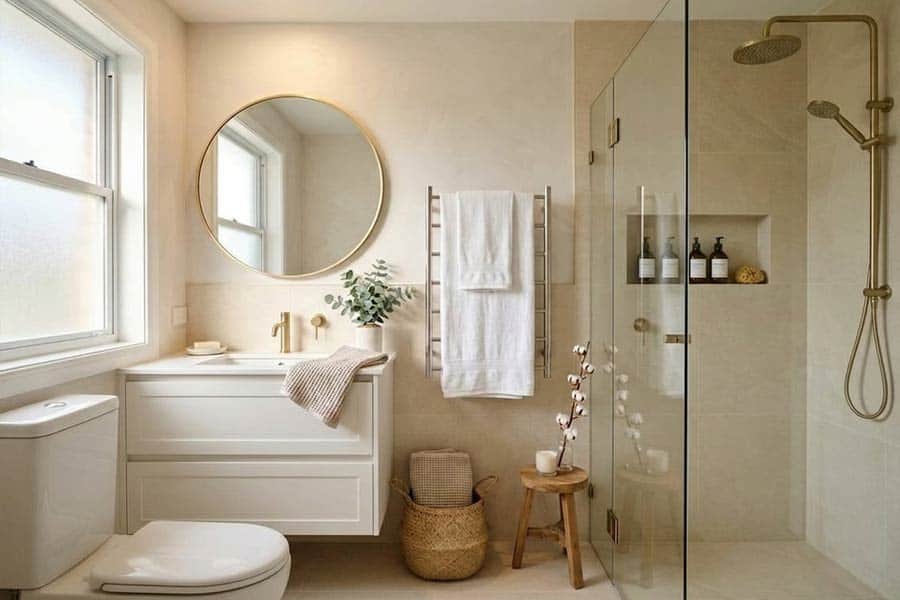
The three most common small bathroom layout options are linear, L-shaped, and corner.
A linear configuration places all fixtures along a single wall, which is an ideal choice for a narrow room.
One thing I’d pay close attention to is the location of the toilet.
The standard calls for a clear minimum circulation space of 48 inches by 35 inches measured from the front edge of the toilet, as well as a clear width of no less than 35 inches between opposing finished wall surfaces on either side.
Placing the toilet directly opposite the entry door draws the eye straight to it and makes a small bathroom feel even smaller.
Choose Fixtures and Fittings Sized for the Space
Compact fixtures have come a long way, and I’ve been genuinely impressed by how well-designed some of the smaller options are across every fixture category.
A correctly proportioned fitting makes all the difference to a tight floor plan.
Wall-hung toilet pans paired with a concealed in-wall cistern recover around 6 to 8 inches of floor depth compared to a standard back-to-wall suite.
Shower bases in the 28 x 28 inch to 36 x 36 inch range suit compact configurations well.
A good-quality frameless walk-in shower screen creates an open, airy feeling rather than the visual weight of a framed screen or the floor intrusion of a hinged door.
From a home decor standpoint, a frameless screen is one of the easiest ways to make your bathroom feel more polished and intentional without a major renovation.
A single-lever mixer for a compact basin keeps your benchtop clear and suits a smaller basin well.
Once you’ve decided which fixtures fit your bathroom, the next step is choosing storage that holds everything without eating up your floor space.
Storage Solutions for a Small Bathroom
Storage can make or break a small bathroom, and I think it’s one of the most overlooked parts of the planning process.
Floor-standing cabinets reduce usable floor area, so getting storage off the floor is always the better move where you can manage it.
A recessed tiled niche set between wall studs keeps shower gels and soaps within reach without consuming any wet area space.
It also doubles as a subtle design detail that adds visual interest to your shower wall.
A small bath vanity is another strong option, available in widths of roughly 16 to 24 inches for compact configurations.
A typical wall-hung vanity sits at a benchtop height of around 34 inches with a cabinet depth of 14 to 18 inches.
Material choice matters here.
PVC board is the most practical option for damp environments since it’s fully waterproof.
Moisture-resistant MDF performs well provided it’s adequately sealed, but it isn’t waterproof and shouldn’t come into direct contact with water.
An LED shaving cabinet delivers mirror, light, and storage in one unit, which I’d call one of the smartest space-saving picks you can make in a small bathroom.
Hard-wiring requires a licensed electrician.
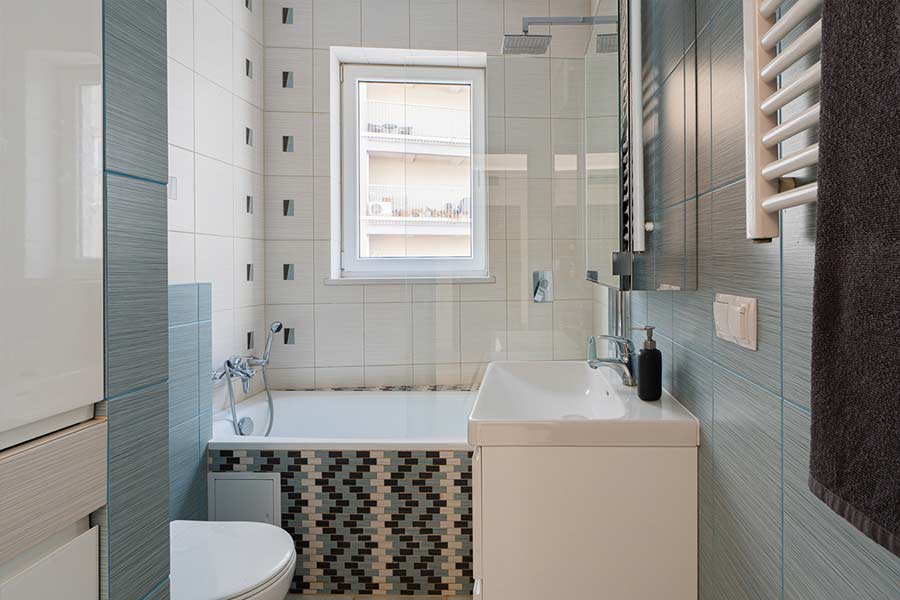
Finishing Touches that Work Hard, Not Just Look Good
Tiles matter for style, but in a small bathroom their performance is just as important.
Larger format tiles such as 24 x 24 inches or 12 x 24 inches reduce grout lines, visually open up the space, and are easier to keep clean.
I’ve always found that fewer grout lines give a bathroom that seamless, spa-like quality that makes a small space feel much more luxurious than it actually is.
Whatever size you choose, slip resistance is a non-negotiable consideration for floor tiles in wet areas.
Lighting is often overlooked in small bathrooms, and it really shouldn’t be.
An LED shaving cabinet contributes well, but combining it with a ceiling downlight gives better overall coverage than a single central fitting alone.
At a minimum, your bathroom exhaust fan needs to move around 53 cubic feet per minute.
An undersized fan is the most common problem I see during bathroom renovations, and it leads to condensation and mold damage to paint and finishes over time.
If you need a bath but your floor space is limited, corner baths are a practical solution.
A standard corner bath footprint ranges from roughly 48 x 48 inches to 55 x 55 inches, which is considerably smaller than a full-length freestanding bath that needs at least 71 inches of clear floor space.
Corner baths tuck neatly into the room, keeping the remainder of your floor area open and easy to move around in.
A licensed plumber is required to connect the waste and overflow.
A heated towel rail adds warmth and a dedicated place to dry your towels, and from a styling perspective it’s one of those finishing touches that makes a bathroom feel complete rather than just functional.
Installation requires a licensed electrician.
Every decision in a well-resolved small bathroom, from your tapware type to your grout color, should be made with both performance and proportion in mind.

Leave a comment