
Two hundred dollars.
That’s roughly what a single framed partition wall costs in lumber and drywall before anyone swings a hammer, and it never includes the part where you patch and repaint it when your lease ends.
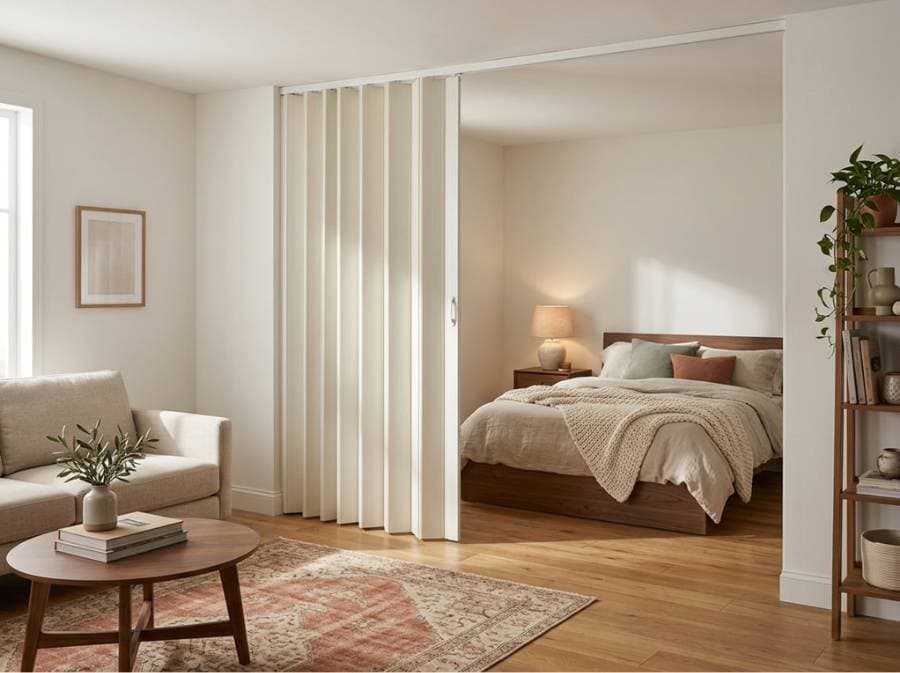
So when my studio apartment kept turning into one long hallway with a bed in it, I didn’t call a contractor.
I called a door guy.
Here’s the promise: by the end of this piece you’ll know which divider actually fits your space, which one I’d buy with my own money, and the four measurements you need before you order anything.
The trick most renters miss is that you don’t need a wall at all.
You need a track, a header, and a panel that folds back out of the way when the room needs to breathe.
I’ve found that a room that can open and close like this feels calmer, because your bed finally gets its own quiet corner instead of sharing the spotlight with your kitchen.
I’ve set up three of these now, in a rental, a basement, and a closet that was pretending to be a laundry room.
The version that held up best was folding accordion vinyl doors, because vinyl shrugs off humidity in a way that wood and fabric never do.
That’s the short answer. The longer one is worth your coffee break.
What Actually Separates a Room without a Wall?
Five options lead the market, and they break into two families: things that hang and things that roll.
Curtains, tension rods, and freestanding screens hang or lean.
Sliding barn doors and bifold or accordion panels ride a track.
The track family costs more and works better.
That’s my stance and I’m not wobbling on it.
Curtains are where most of us start, and I get why.
They cost less than dinner, they install in ten minutes, and they photograph beautifully.
But walk past a curtain at 7 a.m. and you can hear your roommate’s podcast through it.
Fabric absorbs some sound and blocks none of it, and if the fabric is cotton, a steamy bathroom will teach you about mildew the hard way.
I still love a curtain for softness, so if you go that route, choose a heavy linen or velvet panel that adds warmth to your room instead of just hiding part of it.
Accordion panels solve the sound problem and the sightline problem at once.
They fold into a stack about as wide as a shoebox, which matters in a hallway where a hinged door would whack your light fixture.
Sliding barn doors look great in photos and take up a full wall width of travel room.
In a 9 by 11 bedroom, that’s a quarter of your wall gone to a door that’s open half the time.
That’s wall space you could give to art, a mirror, or a bookshelf that makes the room feel like yours.
Vinyl Versus the Alternatives, Side by Side
This is the table I wish someone had handed me before my first trip to the hardware store.
Costs vary by region and size, so treat the price column as a rough guide rather than a quote.
| Option | Best for | Install effort | Sound and privacy | Relative cost |
| Curtain on a rod | Soft room split, quick fix | Minutes | Low | Lowest |
| Freestanding screen | Corners, staging, photos | None | Low | Low |
| Sliding barn door | Wide openings, farmhouse look | Day project | High | Mid to high |
| Hinged door | Standard doorway only | Half day | High | Mid |
| Folding accordion vinyl | Odd widths, closets, humid rooms | Afternoon | Mid to high | Low to mid |
Notice what vinyl wins on. It isn’t glamorous.
It’s the weird opening, the closet that’s 58 inches wide instead of the standard 60, and the basement that stays damp from October to April.
You can cut a vinyl accordion panel down to fit a nonstandard opening, which you can’t do with a hollow core slab without buying a new slab.
I like that it lets your space decide the door instead of the other way around, so the quirky openings that give older homes their charm can stay just as they are.
The Renter’s Three-Line Rule for Picking a Divider
I made this up after my second install went sideways, and it’s saved me twice since.
Sketch your room on paper and draw three lines: the line the room must not cross (your bed, your desk), the line that has to stay clear (a closet door, a heat register, a path to the bathroom at night), and the line you’d like to move (a hallway, a play zone, a fold-out couch).
Whichever divider crosses the fewest of those lines wins. That’s the whole framework.
It rules out a lot of pretty ideas fast.
A barn door that slides across your closet opening breaks line two every single morning.
A curtain that sits two feet into the walk path to the bathroom breaks line two at 3 a.m., which is the worst possible time.
I’ve noticed the rooms that feel most restful are the ones you can move through in the dark without thinking, so that clear line matters as much as any pillow or lamp.
Then measure four numbers before you order: the clear opening width, the height from floor to ceiling, the depth of the wall or header you can fasten into, and the swing or fold clearance.
Write them on the inside of your phone case. I’m serious.
Store staff will ask, and guessing wastes a return trip.
Does a Folding Door Actually Hold Up Over Time?
Longer than you’d expect, as long as you get the hardware right.
The panels aren’t the weak spot. The track is.
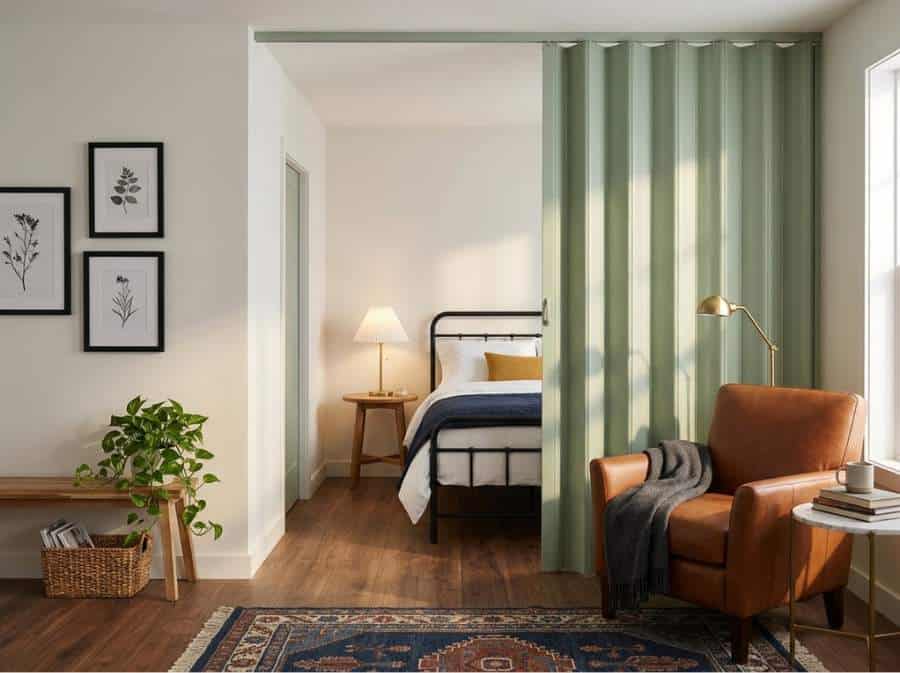
Cheap top tracks bend at the pivot points and the panels start to sag within a season, so buy the track as if it’s the whole product, because it pretty much is.
Vinyl itself is a workhorse material.
It doesn’t absorb water, it wipes clean, and it won’t warp in a humid room the way a wood panel will.
That matters if you’re sectioning off a laundry nook or a basement guest corner.
Where vinyl loses is style points.
Up close it reads as vinyl, and no amount of matte finish hides that from a guest standing two feet away.
If your goal is a magazine spread, go wood.
If your goal is a door that works in a damp room for a decade, go vinyl and spend the savings on a better track.
I’d put anything left over toward soft bedding, a warm lamp, and a basket of fresh towels so your basement guest corner feels like a real welcome.
Energy behavior matters too. A closed door, even a light one, cuts drafts between zones.
The Department of Energy has long highlighted air sealing and zoning as low-cost steps that reduce heating and cooling demand, and blocking an unused wing of a house with a door is exactly that kind of small move.
You’ll feel it in your rooms too, since a cozy space is as much about steady warmth as it is about throws and pillows.
Four Things to Check Before You Buy
- Header strength. The track has to screw into something solid. Drywall anchors alone will pull out under a folding panel’s weight.
- Floor clearance. Panels need to glide, not scrape. Check for rugs, thresholds, and tile lips.
- Rental terms. Most leases allow small holes for hardware. Ask in writing anyway, and keep the reply.
- Trim depth. Older homes often have casing that pushes the track out past the opening. Measure the trim, not just the doorway.
Screw placement is where most of us get humbled.
You want to hit studs or a header, and you want the track level to within a hair.
Use a laser level if you have one.
If you don’t, a chalk line and patience work fine.
I’ve done both, and the chalk line install is still hanging straight six years later.
A level track is one of those quiet details your eye picks up right away, so it’s worth the extra few minutes.
One more check that nobody mentions: your renter’s or homeowner’s policy.
The Department of Housing and Urban Development maintains broad guidance on housing and home improvement matters, and it’s worth knowing what your lease or policy says about alterations you install yourself.
A five-minute read beats a deposit dispute.
Which Divider I’d Pick for Your Space
I’d buy a vinyl accordion door for any humid, odd-sized, or narrow opening, and I’d buy a wood slab only for a doorway that’s already standard and dry.
Curtains stay in the running for a month-long trial run before you commit to hardware.
That’s my honest ranking.
So here’s your question to sit with over the weekend: which single line in your apartment is the one you keep tripping over at night?
Draw it, measure those four numbers, and let it tell you what to order.
If it turns out to be a closet or a laundry nook, I already told you my answer.
Once your space finally works the way you live, it’s so much easier to make it feel beautiful.

Leave a comment