
When you’re getting ready to sell, every appliance in the house becomes a line item a buyer’s inspector will poke at.
Most of them, like the dishwasher, the microwave, and the HVAC, are visible and easy to assess.
The water heater is the quiet exception.
It lives in a closet or basement, often overlooked until something goes wrong, and yet its age and condition can shift how smoothly an offer closes.
Alt text: Residential water heater installed in a basement utility closet
That’s why smart FSBO sellers check their water heater early in the prep process.
For readers in Ontario, a certified regional HVAC team like Handy Bros handles tankless installation, repair, and maintenance for the London area, and the same kind of licensed inspection is worth lining up wherever you live.
Here’s what to check, what buyers will ask about, and what’s worth upgrading before you list.
Why Does the Water Heater Come Up During a Home Sale?
Water heaters have an expected lifespan of 10 to 15 years for traditional tank units and 20 or more for tankless models.
Buyers’ inspectors open the utility closet, read the manufacturer’s label, and do the math.
If the unit is at or past its expected life, it gets flagged in the report.
A flagged water heater doesn’t kill a deal, but it almost always shows up as a negotiation point.
Buyers ask for a price reduction equivalent to replacement cost, or a credit at closing.
For a standard 50-gallon tank unit, that’s $1,200 to $2,500.
For a tankless system, $3,000 to $6,000.
Those numbers come off your walk-away price if you haven’t addressed the issue first.
Knowing the age and condition before you list keeps you in control of the conversation rather than scrambling to respond to an inspection surprise.

What Should Sellers Check Before Listing?
Run through this short list while the house is still yours:
- Age of the unit. Look at the serial number on the label. Most manufacturers encode the year in the first 2-4 characters. A quick search of the model number usually decodes it.
- Visible rust or corrosion. Rust on the tank body or around fittings is a red flag. Small surface rust is cosmetic. Rust in the drip pan beneath the tank often signals a slow leak inside.
- Standing water around the base. Any pooling water means the tank is leaking, and that’s a full replacement job, not a repair.
- Anode rod condition. If the unit is more than five years old, a licensed plumber can check the sacrificial anode rod. A worn-out rod means the tank’s interior has been corroding silently.
- Pressure relief valve. Test it by lifting the lever briefly. Water should flow, then stop cleanly when you release.
- Recent maintenance records. If you have receipts from flushes or service calls, pull them together. Buyers love a paper trail.
Most of these checks cost nothing.
The anode rod inspection runs about $75 to $125, and I’d say it’s worth every dollar when you’re pricing a home.
The US Department of Energy’s water heater guidance has a solid background on sizing and efficiency ratings if you’re weighing a replacement.
Should You Replace Before Listing, or Disclose and Move On?
Here’s where sellers split.
If your water heater is under 10 years old and in good shape, disclose the age, include receipts, and let buyers accept it.
You won’t recoup a replacement’s full cost in your sale price.
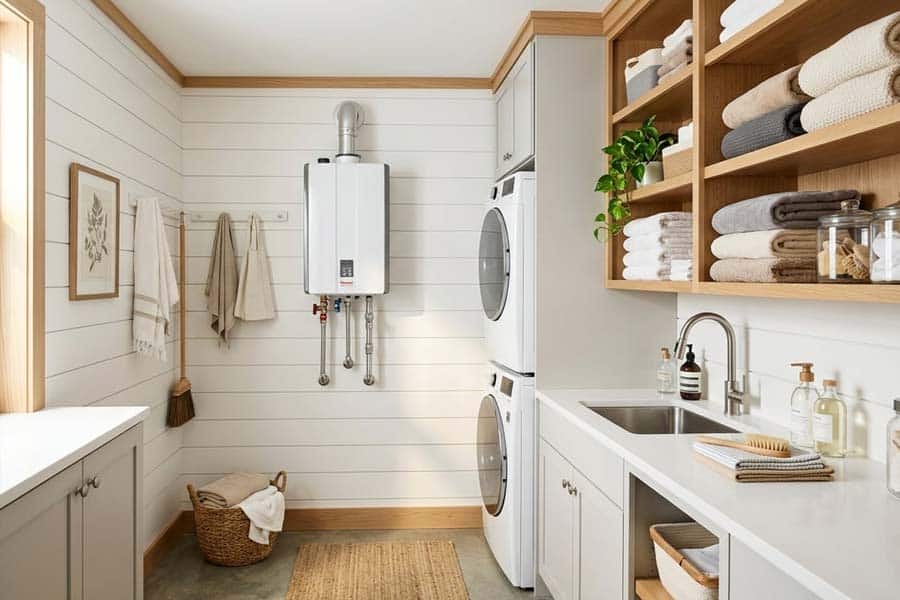
Alt text: Wall-mounted tankless water heater in a modern utility room
If the unit is over 12 years old or has visible issues, replacement often pays off in three ways.
You remove the inspection flag.
You can upgrade to tankless, which appeals to energy-conscious buyers.
And you list with a clean, positive feature instead of a question mark hanging over the utility closet.
I’ve seen sellers overlook this step and end up losing far more in negotiation than a replacement would have cost them.
It’s also worth thinking about how the utility spaces in your home present overall. Buyers notice clean, well-kept mechanical areas just as much as they notice fresh paint or updated fixtures, and a tidy utility room signals that the whole home has been looked after.
For homes in areas with hard water, common across much of the Midwest and Southwest, the decision leans harder toward replacement.
Hard water shortens tank life by 30 to 40 percent, so a 10-year-old heater in hard-water territory is often functionally older than its label suggests.
What Buyers Actually Look For
A buyer’s inspector will note the following on the water heater:
- Manufacturer, model, and year pulled from the label
- Type: tank vs tankless, electric vs gas
- Capacity (50-gallon, 75-gallon, and so on)
- Signs of leaks, corrosion, or improper venting
- Condition of the temperature-pressure relief valve and discharge pipe
- Proximity to combustibles if it’s a gas unit
- Condition of water lines entering and exiting the unit
Buyers tend to assess a home holistically, and the utility room is part of that picture.
A clean, well-maintained mechanical space quietly reinforces the same confidence that a thoughtfully decorated living room or a tidy kitchen does.
It all adds up to the same impression: this home has been cared for.
If you’re preparing to list, I’d recommend walking through this checklist yourself with a flashlight before the inspector ever shows up.
Anything you can fix ahead of time saves you a negotiation later.
For bigger-picture prep, see this guide, which covers timing considerations that pair well with appliance prep.
HUD’s home inspection overview also covers what inspectors look for in plumbing and utility systems.

Quick Reminders for Sellers
- Water heater age is one of the top five items buyers’ inspectors call out
- Tank units last 10-15 years; tankless systems 20+
- Address units older than 12 years before listing whenever possible
- A paper trail beats verbal assurances every time
- Regional factors like hard water change the lifespan math significantly
What This Means for Your Listing
Your water heater isn’t glamorous, but it’s one of the few appliances that can move your sale price by thousands of dollars.
Spend thirty minutes checking it this weekend, gather any service records, and decide now whether it’s staying, getting serviced, or getting replaced.
You’ll close faster and cleaner, and buyers will appreciate the transparency in what’s usually a forgotten corner of the listing.
And honestly, taking care of the practical stuff first frees you up to focus on the parts of your home that buyers fall in love with, like how your living spaces are staged, how your kitchen reads, and whether your home’s overall style tells a cohesive story.
Frequently Asked Questions
How long does a water heater replacement take?
A standard tank-to-tank swap takes 2-4 hours for a licensed plumber.
A switch from tank to tankless can take 4-8 hours because it often requires upgraded gas lines or electrical service.
Most work wraps up in a single day.
Do I have to disclose a water heater over 10 years old?
Disclosure rules vary by state, but most require known defects to be disclosed.
Age itself isn’t a defect.
Include the installation date in your seller’s disclosure alongside other appliance ages to stay ahead of buyer questions.
Will a new water heater actually increase my home’s sale price?
Not dollar-for-dollar, but it removes a negotiation item.
Sellers typically recoup 60-80 percent of a water heater replacement cost through a faster sale and fewer inspection negotiations.
The cleaner the comp sheet, the quicker the offer.
Is it worth switching from tank to tankless before selling?
Only if you plan to stay long enough to enjoy the energy savings yourself.
Buyers do notice tankless, but they rarely pay the full upgrade premium up front.
If your tank is failing and you need a replacement anyway, tankless is usually worth the incremental cost.

Leave a comment