
Nine out of ten readers I hear from about bad lighting are renting.
They can’t touch the wiring, the landlord won’t approve a fixture swap, and yet the flattest, most builder-grade glow in your house is the thing guests notice first.
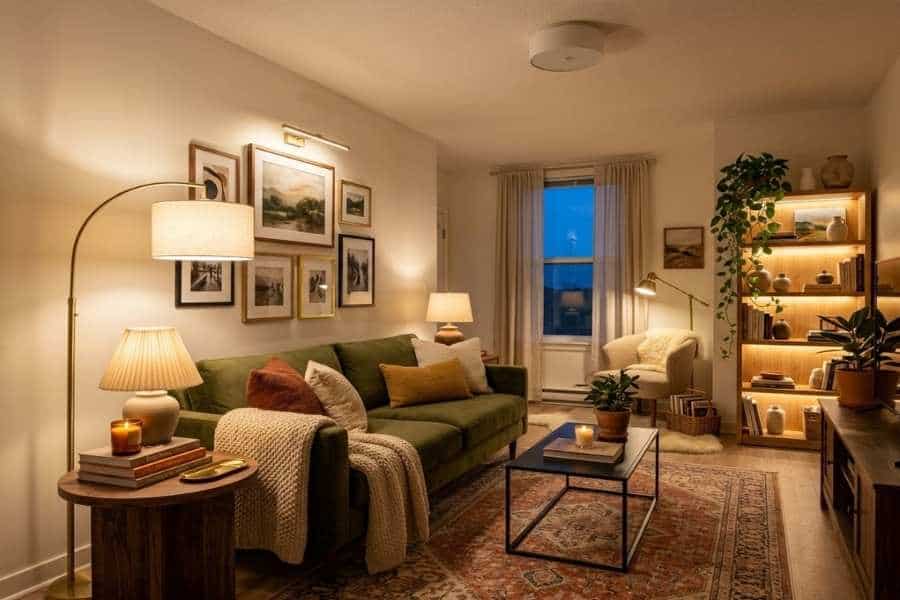
I’ve lived in four rentals with the same sad “boob light” in every hallway, so I’ve tested nearly every workaround that doesn’t end with a lost deposit.
Here’s the good news: you don’t need new wiring to make a room look expensive.
You need the right layers of light in the right places, and a few cheap tricks that do the job invisibly.
After all, a rental only starts to feel like yours when the light feels like it was chosen, not assigned.
I’ve found the starting point is control, not fixtures.
Photographers will tell you the same thing: light that never changes is light that never feels intentional.
Once you can dim, warm, or narrow a beam, even a cheap ceiling fixture starts behaving like something you’d see in a designer’s portfolio.
An led light controller does this work on a bigger scale, adjusting output and warmth room by room, and the principle holds whether you’re running a commercial floor or a two-bedroom rental.
Your goal is the same either way: stop treating every bulb as an on/off switch.
Why Bad Lighting Looks Cheap (and It’s Not the Fixture)
Your eye forgives worn floors and dated tile.
It won’t forgive a single bare bulb glaring from the middle of the ceiling at four thousand kelvin.
That harsh, blue-white tone is what builder-grade installs default to, and it makes every wall look gray and every face look tired.
I’ve watched it wash out a velvet sofa, a warm rug, and a gallery wall someone spent weeks arranging.
The other half of the problem is that one light is doing five jobs at once: overhead, task, accent, mood, and hallway navigation.
No single fixture is good at all of those.
A cheap lamp used as a bedside reading light can look luxe.
The same lamp blasting your whole room from the ceiling looks like a dorm.
A 3-Layer Plan You Can Set Up in One Weekend
Every room worth photographing has three distinct jobs of light, and you can build all three without touching a wire.
- Ambient: the low, even glow you want at 8 pm.
- Task: the bright, direct beam over a counter, desk, or book.
- Accent: the small pools of light aimed at art, plants, or a shelf.
Here’s my honest call on which to fix first.
Even if your rental has zero outlets in the right spots, buy a floor lamp and a smart plug before you buy anything else.
That one pairing ends the ceiling’s hold on your evenings, and it costs less than a single nice pendant.
I think of it as the moment a room stops feeling like a waiting area and starts feeling like a place you’d invite friends to linger.
Dimmers, Plugs, and Bulbs: The Swap That Does the Heavy Lifting
If your fixtures take standard bulbs, you’re in luck.
Warm, dimmable LED bulbs in the 2700K range cost very little, and a smart plug with dimming support gives you a remote control you never had.
No wiring, no landlord conversation, no permanent change.
Pick your smart plug carefully.
The cheap ones buzz at low brightness, and that buzz is real, not imagined.
I’ve returned more than one because the hum was louder than the fridge.
Nothing undoes a cozy, candlelit dinner faster than a lamp that whines.
Test at 20 percent brightness the moment you unbox, while returns are still easy.
Warmth matters more than most people admit, and I’d say it’s the single easiest dial you can turn.
According to the U.S. Department of Energy, LED bulbs use a fraction of the electricity of the old incandescent style, so you can swap every bulb in the apartment guilt free and lose nothing in brightness.
What the Energy Department won’t tell you is which color temperature makes a navy wall look alive instead of dead.
That’s a taste call, and I’d bet on 2700K in living rooms, 3000K in kitchens, and something warmer still in bedrooms.
The difference is closer to candlelight than office light.
Small Changes That Make a Renter’s Lighting Look Custom
You don’t need a designer.
You need a few inexpensive moves that most people never think to try.
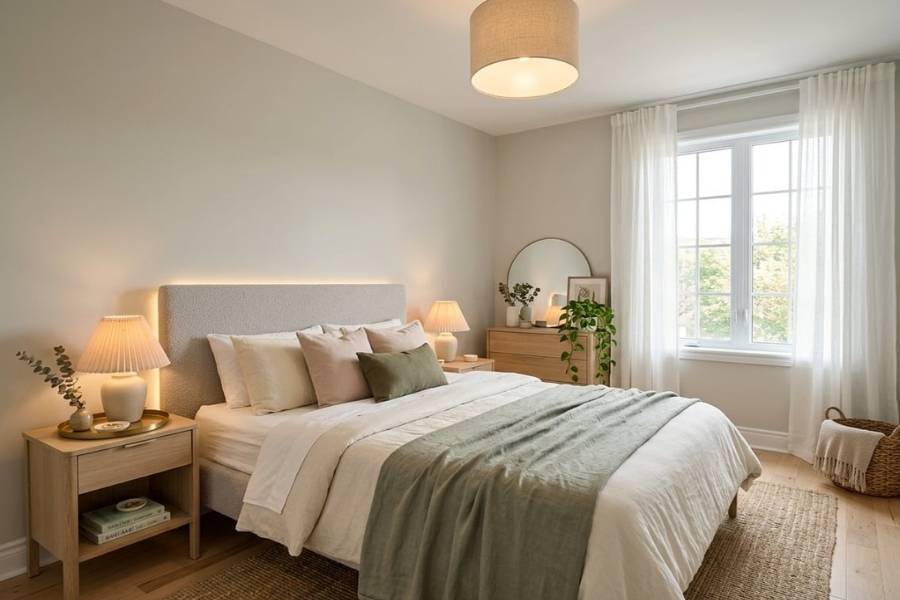
- Swap the dome glass on a builder fixture for an open shade, or drape a linen fabric shade over it.
- Point your lamps inward so two light sources cross the room instead of one blasting from above.
- Tuck warm LED strip tape behind a headboard or bookcase for a soft glow with nothing visible.
- Add a low-cost plug-in dimmer to any lamp that has a switch you hate.
- Lay a mirror or a brass tray under a lamp so light bounces back up the wall.
These aren’t permanent fixes.
They’re cosmetic nudges, and I’d argue that’s the point.
Nothing here requires a single hole in your wall.
When you move, every one of these pieces comes with you, so the warmth you build travels to your next home too.
How Lighting Controls Actually Save Money
Lighting is a bigger line on the utility bill than most renters assume, and turning things off when you leave the room is the simplest, cheapest energy upgrade there is.
The U.S. Energy Information Administration tracks how homes and businesses spend electricity, and lighting consistently lands among the biggest slices in a typical building.
The pros already know this.
If you look at how commercial spaces handle large lighting systems, the trick isn’t fancier bulbs.
It’s making sure lights are off or dimmed when nobody’s in the room.
Occupancy sensors and daylight sensors do exactly that, and they cut usage steadily without anyone feeling the change.
A home version is basically the same idea at a smaller scale: a smart plug, a motion sensor, and a spare afternoon.
I love setting a hallway lamp to glow softly when I walk in after dark, so the house feels like it’s welcoming me back.
The Illuminating Engineering Society is the technical body that sets baseline lighting recommendations, and its guidance on light levels exists for a reason.
Most homes run brighter overhead than they need and dimmer at eye level than they want.
Flipping that ratio fixes your room almost instantly.
The Renter’s Lighting Checklist
Before you buy anything else, walk through this in one lap of the room:
- Count your light sources. Fewer than three is the real problem.
- Check the color temperature of every bulb and match them.
- Find which lights have no dimming option.
- Move one lamp to a corner that currently sits dark, like the one behind your reading chair.
- Kill any light that hits you directly at eye level, like a bare bulb or a bad downlight.
| Room | Main issue | Cheapest fix |
|---|---|---|
| Living room | Ceiling does all the work | Floor lamp plus smart plug |
| Kitchen | Harsh overhead only | Warm under-cabinet strip |
| Bedroom | One glaring bulb | Warm dimmable bulbs, dimmed low |
| Bathroom | Mirror shadow | Plug-in sconce or strip at eye height |
The One Lighting Move I’d Make First in Any Rental
If you only make one move this month, replace every bulb with a warm, dimmable LED.
Then put the ugliest fixture in your house behind a smart plug on a schedule.
Total spend, in most apartments, sits under thirty dollars.
Your room at 8 pm won’t look like the room at noon, and I’ve found that shift is where the “expensive” feeling comes from.
It’s also where the cozy, come-sit-down feeling your guests remember comes from.
Skip the rewiring fantasy.
Skip the pendant you saw online that requires a ceiling box you don’t have.
The rental wins go to whoever layers light instead of replacing fixtures, and you can start tonight with a lamp you already own.
Try it in your worst-lit room and see if anyone asks whether you hired someone.
Then tell me which swap made the difference.

Leave a comment