
The tile is new. The lighting is better.
The shower feels larger, the fixtures finally match, and the old vanity that never quite worked is gone.
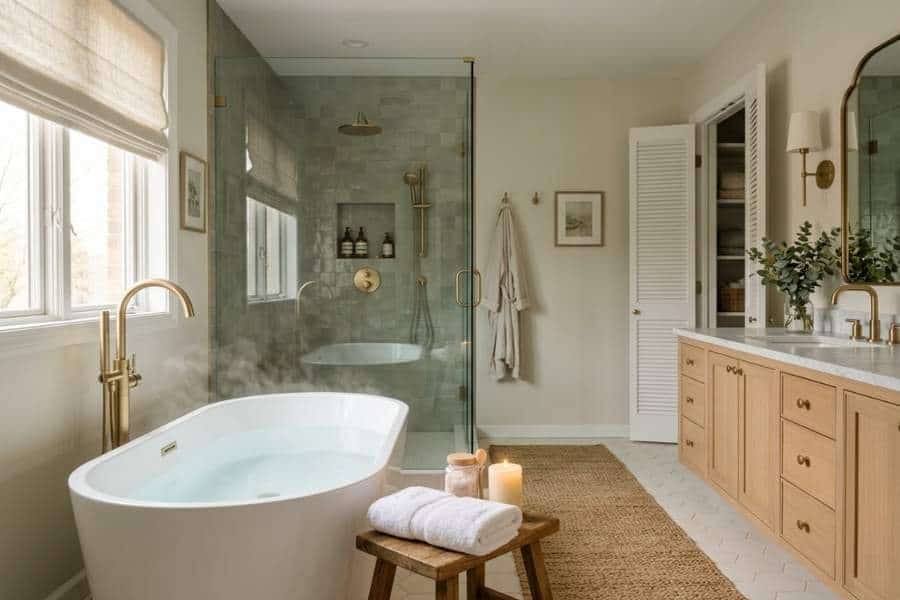
Then someone takes a shower and notices something unexpected: the hot water doesn’t last as long as it used to.
Maybe the temperature changes halfway through.
Perhaps your new soaking tub takes so long to fill that the water is lukewarm by the time it’s ready.
Or the bathroom looks completely different while that old rumbling sound from the water heater stays exactly the same.
It’s easy to assume the remodel caused the problem.
I’ll admit a renovation sometimes does change the way a household uses hot water.
But it can also expose a limitation or developing problem that was already there.
That distinction matters.
Your beautiful bathroom still depends on equipment hidden in a garage, basement, utility closet, or exterior enclosure.
After all, the spa-like comfort you designed for only works when the water stays warm.
Understanding how that equipment interacts with your newly renovated space can help you figure out what deserves attention without jumping straight to either a minor DIY fix or a complete water-heater replacement.
A Bathroom Remodel Can Change More than the Room’s Appearance
Bathroom remodeling tends to focus on what people can see and touch: tile, faucets, storage, lighting, mirrors, counters, tubs, and shower enclosures.
Hot-water demand is much less visible, but I’ve found a renovation can change that demand even when nobody intentionally changes the plumbing system itself.
New Fixtures May Change the Way the Household Uses Hot Water
Think about the difference between a quick shower in an older tub-shower combo and a new bathroom with a spacious walk-in shower.
Your newer room may be more comfortable, which can simply mean people spend longer using it.
When you’ve added warm lighting, a teak bench, and plush towels, lingering is kind of the point.
A remodel might also add a larger bathtub, a second shower outlet, a handheld sprayer, or fixtures that get used differently from the ones they replaced.
None of those changes automatically mean your water heater is inadequate.
They do mean that comparing today’s hot-water experience with the old bathroom isn’t always an apples-to-apples comparison.
The important question isn’t merely, “Did this happen after the remodel?”
It’s, “What changed about how much hot water your home needs at one time?”
The Water Heater May Have Been Adequate for the Old Routine
Storage water heaters have a limited amount of heated water available and have to recover as hot water is used.
The U.S. Department of Energy’s consumer water-heater test procedure defines first-hour rating, or FHR, as an estimate of the maximum volume of hot water a storage heater can supply during an hour beginning with a fully heated tank.
That number can become especially relevant after your household changes its routines.
A larger tub filled while the dishwasher is running and another family member is showering creates a different demand pattern than one short shower at a time.
I think of it like hosting, since a home that comfortably serves two guests may need more planning when the whole family visits.
Tankless systems have their own limitation: instead of stored volume, their performance is closely tied to how much hot water they can deliver per minute while reaching the needed temperature rise.
U.S. Department of Energy Building Science Education guidance similarly bases tankless sizing on the practical maximum flow rate needed at one time and the required temperature rise.
ENERGY STAR’s Water Heater Key Product Criteria distinguishes between first-hour rating for storage systems and gallons per minute for instantaneous water heaters.
In other words, “big enough” isn’t simply a question of the tank’s gallon number.
Your household’s use matters too.
Pay Attention to the Pattern, Not Just One Cold Shower
A single disappointing shower doesn’t diagnose a water-heater problem.
Repeated patterns are more useful, so before assuming the heater failed, you can watch what happens, when it happens, and whether the problem affects the whole home.
Hot Water Runs Out Earlier than It Used To
Suppose your water always lasted through two back-to-back morning showers before the renovation.
Now it turns lukewarm during the second.
Several possibilities could explain the change.
Your household may simply be drawing more hot water.
A storage heater may no longer be producing its expected usable capacity.
Sediment may have built up. An electric unit could have a heating-element problem.
A thermostat or other component may not be working correctly.
Those possibilities can’t be told apart reliably by the symptom alone.
That’s why I’d recommend jotting down when the problem happens.
Does the water run cold only after several fixtures have been used?
Does it happen during the first shower of the morning?
Does waiting for the heater to recover solve the problem?
Those answers give a plumber, or you if you’re reviewing the appliance manual, far more useful info than saying only that “the hot water isn’t working right.”
The Temperature Changes during the Shower
Temperature swings can be especially noticeable after you’ve installed a shower that’s meant to feel more comfortable or luxurious, but the heater isn’t always responsible.
When you’ve designed a shower as your daily retreat, an unexpected cold blast can undo that calm in seconds.
A shower valve, pressure change, fixture issue, or another plumbing condition can affect what reaches you.
If temperature problems show up at several fixtures, a system-level issue becomes more likely than when the problem exists at only one newly installed shower.
That’s one reason I always start troubleshooting with a pattern rather than a conclusion.
Try the hot water at another sink or shower.
Note whether the change happens there as well.
Don’t take apart gas, electrical, or safety components just to test a theory.
That Noise from the Water Heater Deserves Context
People often notice unfamiliar sounds only after a remodeling project because they’re paying closer attention to the house.
I get it. When you’ve poured love into a space, you start listening to it differently.
Other times, a sound really does get louder over time.
Popping or Rumbling Can Be Associated with Sediment
Storage water heaters can collect material at the bottom of the tank.
CDC’s Preventing Waterborne Germs at Home guidance notes that many manufacturers recommend periodic flushing and advises following the manufacturer’s instructions or having a professional do the work.
Sediment-related sounds are commonly described as popping, crackling, or rumbling, although a sound by itself can’t confirm the cause.
This is another place where your appliance manual matters.
Maintenance steps differ among systems, and you shouldn’t assume that a flushing method found for one heater applies safely to another.
I like tucking manuals into a labeled basket or binder near the utility area so they’re easy to grab.
Mineral Buildup Doesn’t Affect Every Home in Exactly the Same Way
Water chemistry varies among communities and water sources.
Household treatment equipment, plumbing materials, system age, and maintenance history can also influence scale and sediment.
You may already see this on your faucets and glass shower doors as chalky spots that dull those pretty finishes.
That’s why broad advice like “flush every heater exactly once a year” shouldn’t replace the manufacturer’s instructions for your specific appliance.
The more useful approach is to know your model, know its maintenance requirements, and keep a record of what’s been done.
Look around the Water Heater, Not Only at the Shower
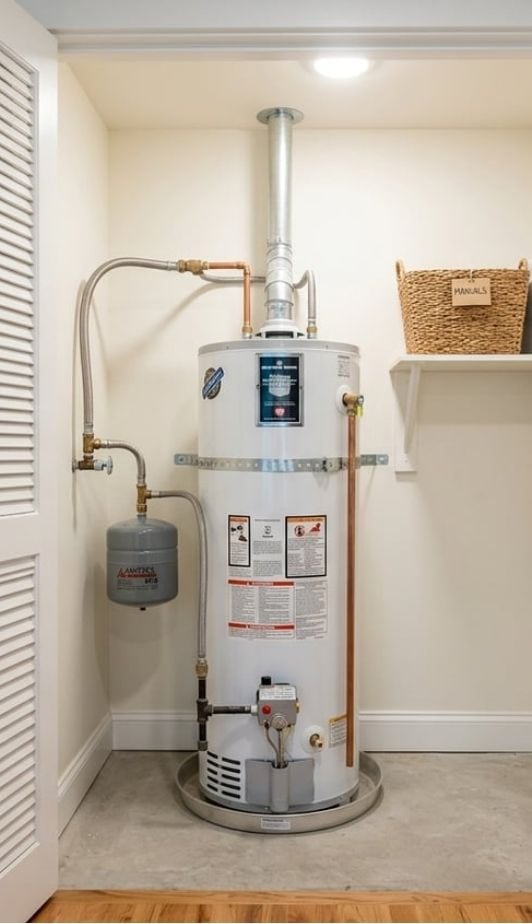
A renovation can make you focus so closely on the finished bathroom that you overlook the equipment supplying it.
Take a look at the accessible area around your water heater periodically.
You don’t need to take anything apart to notice whether the environment has changed.
Water Where It Shouldn’t Be Is Worth Investigating
Moisture around a water heater can come from several places. A connection may be leaking.
A valve may be involved. Condensation can sometimes be mistaken for a leak.
In other situations, the tank itself may be compromised. Those are very different problems.
A recurring puddle shouldn’t be treated as normal just because the heater still produces hot water.
Slow leaks are the kind of quiet damage that can creep into nearby flooring, baseboards, and the freshly painted walls you worked so hard on.
Where the moisture is, when it appears, and whether it returns after being dried can all be useful clues for diagnosis.
Rust and Discoloration Need More than a Quick Assumption
Visible corrosion around fittings or equipment deserves attention, but it doesn’t automatically tell you what’s happening inside the tank.
Likewise, discolored hot water can have more than one possible source.
Tinted water can also stain white grout, a new tub, or the crisp white towels you picked out, so it’s worth checking soon.
If discoloration suddenly shows up throughout your home, you may also need to consider what’s happening with the water supply rather than assuming the heater is responsible.
The safest approach, in my experience, is to identify the pattern before choosing the remedy.
Not Every Hot-Water Problem Means the Water Heater Is Finished
One of the most expensive troubleshooting mistakes I see is treating every symptom as proof that the entire appliance must be replaced.
Water heaters contain individual parts, and some failures can be repairable.
Depending on your type of system, problems may involve thermostats, heating elements, valves, thermocouples, ignition components, controls, connections, or other serviceable parts.
For additional examples of faults that may be evaluated during a water-heater service call, find out more here.
The key point isn’t that a particular symptom guarantees a repair.
It’s that diagnosis comes before the repair-versus-replace decision.
A Component Failure Is Different from a Failing Tank
Replacing a thermostat on an otherwise sound system is a different situation from dealing with a leaking or seriously worn-out tank.
Age matters, but I’d weigh it alongside condition, maintenance history, repair history, efficiency, household demand, and the nature of the current failure.
An old heater that’s already needed repeated repairs presents a different decision from a fairly recent system having its first isolated part failure.
Repeated Repairs Can Change the Calculation
There’s also a point where individually repairable problems become part of a bigger pattern.
If you’ve repeatedly paid to fix separate problems, the real question is no longer simply, “Can this part be replaced?”
It becomes, “What’s the likely condition and usefulness of the system as a whole?”
That takes more judgment than a generic age cutoff can provide.
It’s a lot like deciding whether to reupholster a beloved chair one more time or finally replace it.
The Bathroom May Be Exposing a Capacity Problem
Imagine your renovation replaces a standard tub with a large soaking tub.
Before the project, nobody complained about hot water because nobody regularly needed that much at one time.
After the project, filling the tub uses up a big share of the available hot-water supply.
If you pictured slow evening soaks with candles and a good book, that vision depends on enough hot water to fill the tub.
The remodel didn’t necessarily damage the water heater. It changed the job being asked of it.
Household Size Is Only One Part of Sizing
A lot of homeowners think a water heater should be chosen by the number of people in the house.
That matters, but so does timing.
A household where four people shower at different times creates a different peak demand from one where everyone showers within the same hour.
Laundry, dishwashing, tubs, showers, and other hot-water uses can also overlap.
Holiday weekends with houseguests are a perfect example, since the hospitality you love to offer often means extra showers stacked into the same morning.
For storage heaters, first-hour rating can be more helpful than tank volume alone when comparing the appliance with periods of heavy use.
For tankless equipment, flow rate and required temperature rise become important considerations.
Before Upsizing, Find Out Whether the Existing Heater Is Working Properly
If you run out of hot water, you may immediately assume the tank is too small, but increasing capacity before diagnosing the existing system can solve the wrong problem.
If the heater is underperforming because of a failed part or maintenance issue, replacing it with a larger appliance may be unnecessary.
On the flip side, repairing a heater that’s working exactly as designed won’t solve a true capacity mismatch.
Diagnosis separates those situations.
One comparison I find useful is to watch the same shower when no other hot-water fixtures or appliances are running.
If performance improves only when competing loads are removed, peak demand or capacity becomes more likely.
If the system still underperforms from the first use, a malfunction or maintenance issue deserves a closer look.
Water Temperature Is a Safety Question, Not Just a Comfort Setting
When your showers suddenly seem too cool, turning the water-heater thermostat higher can feel like the easiest fix.
That deserves caution.
Hotter Is Not Automatically Better
The U.S. Consumer Product Safety Commission’s Avoiding Tap Water Scalds guidance recommends lowering residential water-heater temperatures to 120°F to reduce the risk of tap-water scalds.
A home that feels welcoming should also feel safe, especially if little ones or older relatives visit.
That said, water temperature also affects water quality.
CDC’s Preventing Waterborne Germs at Home guidance explains that keeping a home water heater in the 130°F to 140°F range can help kill germs such as Legionella, but doing so increases burn risk.
It advises thermostatic mixing valves when heaters run above 120°F and recommends discussing individual health risks when appropriate.
CDC guidance also notes that applicable state and local scalding requirements should be followed.
That tension is why I think a one-size-fits-all temperature setting can be misleading.
Your household’s vulnerability, system design, manufacturer instructions, anti-scald protection, and any applicable state or local requirements all matter.
If you’re having temperature problems, resist repeatedly cranking up the thermostat as a substitute for figuring out why the water isn’t behaving normally.
Some Checks Are Reasonable for Homeowners. Others Are Not.
There’s a helpful line between observing a plumbing problem and trying to repair equipment that involves fuel, electricity, pressure, or high-temperature water.
You can gather valuable information without crossing that line.
Write Down What the System Is Actually Doing
Before you arrange service, note:
- Whether the problem occurs at one fixture or throughout the house
- Whether there is no hot water or simply less than before
- How long the hot water lasts
- Whether the temperature fluctuates
- Whether unusual sounds have appeared
- Whether moisture or visible leaking is present
- Whether the water itself looks or smells different
- Whether the problem began suddenly or developed gradually
- Whether household hot-water use changed after the remodel
Also locate the model information and, if known, the installation date if you can reach both safely.
Knowing your equipment type, model, and approximate age can make manufacturer guidance and service history much easier to understand.
I keep these notes with the paint colors, tile names, and fixture finishes from my remodel, so everything about the space lives in one spot.
Know When Observation Should Stop
Don’t open electrical panels, bypass safety controls, modify gas equipment, block or disable a temperature-and-pressure relief valve, or take apart a pressurized water heater just to keep troubleshooting.
The 2024 International Residential Code, Sections P2804.1 and P2804.6, requires pressure-and-temperature relief protection for water-heating equipment and prohibits check or shutoff valves where they could isolate a relief valve from the tank or heater or block its discharge path.
Because a model code becomes enforceable only when adopted by the relevant jurisdiction, you should follow the appliance instructions and applicable local requirements rather than altering safety devices yourself.
Gas concerns require an even clearer boundary.
PG&E’s Gas Safety guidance instructs people in PG&E territory who suspect a natural-gas leak to leave the area immediately, avoid possible ignition sources while nearby, call 911 from a safe location, and then report the leak to PG&E.
A suspected gas leak isn’t a water-heater troubleshooting project.
Do Not Design the Utility Space out of the House
Remodeling tempts you to hide things.
Pipes disappear behind walls, storage fills awkward corners, and utility equipment may suddenly look out of place beside your carefully chosen finishes.
But “out of sight” shouldn’t become “impossible to access.”
I’m all for a pretty louvered door or curtain panel to soften a utility nook, as long as it opens easily.
Future Maintenance Needs Physical Access
Water heaters have components, valves, connections, controls, and service areas that may need inspection or maintenance.
The 2024 International Residential Code, Section P2801.3, calls for water heaters to be located and connected so they can be observed, maintained, serviced, and replaced.
Whether that model rule is legally enforceable depends on adoption and amendment by the applicable state or local jurisdiction.
Placing permanent cabinetry, stored belongings, or decorative construction in the way can turn an ordinary service task into a much more disruptive project.
Before you enclose or redesign a utility area, think about how a technician would safely reach the equipment and how the appliance could eventually be removed.
A beautiful remodel shouldn’t require finished work to be torn out just to service an appliance that was always expected to need maintenance someday.
Planning for access is really a kindness to your future self, so the home you love stays easy to care for.
Document What Changed during the Remodel
Keep records of significant plumbing changes.
Photos taken before walls close can be especially valuable because they preserve pipe locations and routing that may otherwise disappear behind drywall or tile.
Save fixture specs as well.
When a problem starts after renovation, knowing exactly what changed makes it easier to tell apart coincidence, changed demand, an installation issue, and an unrelated equipment failure.
The Best Troubleshooting Question Is “What Changed?”
Home problems are often easier to understand when you view them as timelines.
If your water heater performed normally before a remodel and poorly right afterward, compare the new plumbing and usage pattern with what existed before.
If the heater had already been rumbling, running out early, or leaking now and then, the remodel may have simply made an existing issue harder to ignore.
If hot-water demand didn’t change and performance dropped months later, the renovation may have little to do with it.
The timing matters, but I’d remind you that timing alone doesn’t prove the remodel caused the problem.
Why Hidden Systems Matter as Much as Your Bathroom’s Finishes
Home design is often discussed through surfaces.
Tile changes the visual scale of a room, lighting changes how it feels, and thoughtful storage makes the space easier to live with.
But I’ve come to see a bathroom as an operating system too.
It depends on supply lines, drains, valves, ventilation, waterproofing, electrical work, and reliable hot water.
Most of those systems disappear from view when the project is finished, yet they decide whether the room works as well as it looks.
The cozy, restful feeling you wanted when you chose every towel hook and light fixture really comes from both.
That’s why a water-heater problem after a remodel shouldn’t automatically trigger panic or an assumption that your renovation was a mistake.
Compare what changed in hot-water demand and where the symptoms show up.
Leaks, unusual noises, temperature changes, repeated failures, and appliance documentation can help you tell apart a fixture problem, a repairable heater fault, a maintenance concern, or a true capacity mismatch.
The tile may be what everyone notices first, but when your first shower starts, the parts of the remodel no one can see matter just as much.
Leave a comment