
I painted a wall completely white, baseboards and all, then stepped back and stared right at the ugliest thing in the room.
It was a 1970s air return the size of a pizza box, bolted to the drywall about a foot off the floor.
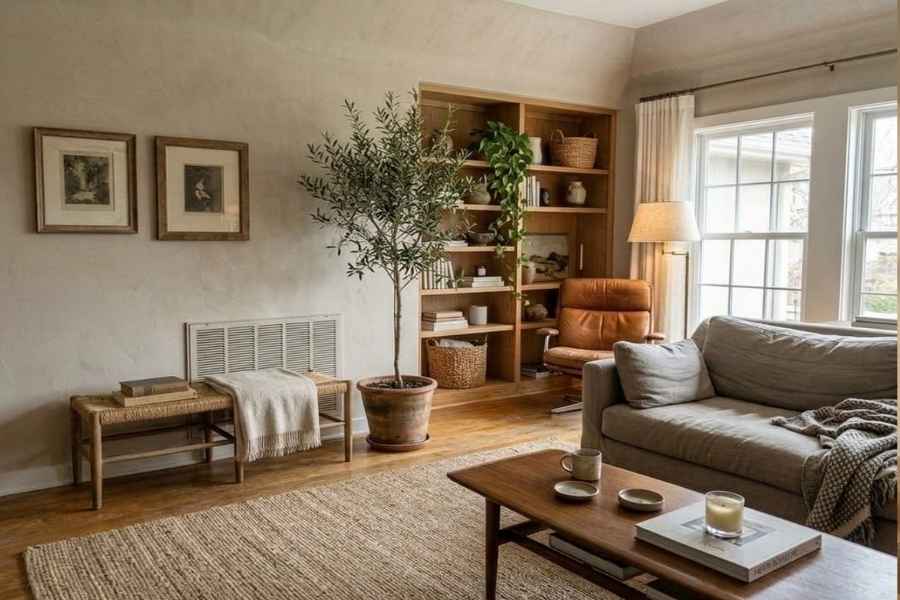
Paint doesn’t fix that, and you know the drill.
You’re standing in the doorway, mentally congratulating yourself, and then your eye lands on the vent instead of the lamp you spent a month hunting down.
Here’s the good news.
Every vent, radiator cover, and mini-split head in your house can shrink visually, which is really the whole game.
Decorators don’t erase mechanical equipment, they lower its contrast against the wall behind it until your brain stops flagging it.
According to the Department of Energy, every room in a home needs a supply and a return path for heated and cooled air, so removal is off the table.
Disguise is the only move, and I promise you can do almost all of it yourself.
Why Vents Pull Your Eye First
The vent wins because of contrast.
Metal is slick, bright, and a different temperature from the wall, so it reads as a foreign object in an otherwise soft surface.
Drop the contrast and the vent effectively vanishes, even though nothing about its size changed.
Your eye stops because it has nothing left to catch on.
I think this is why a room can feel restful without being expensive, since calm usually comes from fewer interruptions rather than better furniture.
That’s also why the best solutions are boring.
Paint the grille the same color as your wall.
Move the curtain panel a few inches wider so it overlaps the edge of the return, and let the fabric do the softening that hardware never will.
Slide a bench, a console, or a slim bookcase in front of it if the return has at least a couple of inches of clearance for airflow.
None of these tricks cost more than a gallon of paint, and together they handle most of the vents in a typical house.
Start by taking a walk with your phone and photographing every grille, radiator, and return from the doorway.
You’ll spot the offenders fast, and the photos stop you from buying decorative covers that clash with the wall color you already own.
When a Decorative Cover Makes Sense, and When It Backfires
I’ve found decorative covers earn their price in exactly two places.
The first is floor registers in high traffic rooms where you want the grille to look like furniture.
The second is old fashioned baseboard radiators that could use a slim wooden surround with a metal face.
The rest of the time they create new problems for you.
They come in their own finishes, they sit proud of the wall, and they collect dust in ways nobody warns you about.
A cover that fights your trim color also adds one more thing to notice, and a room feels generous when your eye can rest.
Skip the mesh, louvered, or fabric wrapped covers on any return.
Returns pull large volumes of air at low pressure, and restricting them is the fastest way to choke the whole system.
A supply register can handle a little more restriction than a return, but honestly, I’d rather paint the grille and keep the airflow.
Painting costs a third as much and never shows up on a repair invoice.
The other habit that backfires is sealing.
Gaps around a register aren’t decor problems, they’re heat loss problems, and the fix is a tube of caulk, not a cover.
The Environmental Protection Agency notes that the typical American household spends a large share of its energy budget on heating and cooling, and air leaks around the openings are part of that bill.
Seal first and decorate second, because a room that holds its warmth feels more welcoming than one you keep adding throws to.
What Belongs in a Room Where You Cannot Hide the Equipment
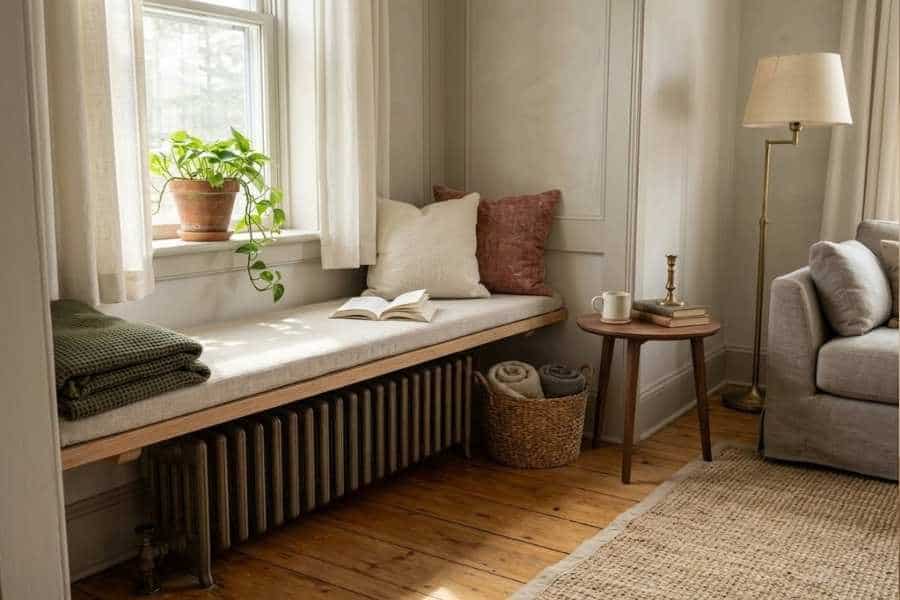
Some equipment refuses to disappear, so I’d put it to work instead.
Radiator benches are the classic example.
The radiator already sits in the cold spot under a window, so lay a slab of stained wood across a pair of low supports and you get a reading nook in a footprint you were already paying for.
Keep the wood clear of the radiator fins by an inch or two so heat can rise freely.
I love that move because the warmest seat in the house ends up being the one nobody planned for.
Mini-split heads respond beautifully to the same logic.
Give the wall behind the head a painted arch or a panel of patterned wallpaper and the unit starts reading as an intentional element of your composition.
A floating shelf just below it hides the line of sight from the sofa without blocking the louvers.
Wallpaper costs you a weekend and zero chunks of your HVAC runtime.
Baseboard heaters are the hardest to love.
Curtains that hang past the floor block them, and rugs that creep up to the baseboard smother them.
If your baseboard heater sits behind a sofa, slide the sofa a few inches out from the wall and let the heat have somewhere to go.
That small gap usually makes the room look better too, since furniture pushed flat against every wall reads like a waiting area.
In rooms where your furniture layout really doesn’t allow it, my honest stance is that a properly sized radiator cover with an open top and a metal face beats a bare unit that forces you to abandon the whole arrangement.
The Stuff You Should Never Hide
Vents stay visible in two rooms.
The first is the laundry, where a dryer vent runs somewhere you should be able to inspect.
The second is anywhere the equipment needs clearance.
If a panel has to be removable for service, don’t bury it behind built-ins.
This is the kind of thing that gets forgotten until a service visit, and then the crew has to pull your furniture out of the way while you watch.
The other thing you should never hide is the return air path.
A return is a vacuum, not a source of airflow.
Covering one with a decorative panel that looks pretty but blocks the volume of air the room needs will make every room nearby feel stuffy at night.
Stuffy is the one thing no amount of styling can cover, because comfort is something your body notices before your eye does.
For grilles and registers, the label on the packaging lists the free area.
If you can’t find a number, hold the panel up to a light.
If you can barely see through it, the airflow has nowhere to go.
| Equipment | Best disguise | What to avoid |
|---|---|---|
| Wall supply grille | Paint to match the wall | Heavy full-face covers |
| Floor supply register | Decorative flush grille | Rugs that cover the slats |
| Return air grille | Paint or light frame trim | Solid wood panels, fabric covers |
| Mini-split head | Arch or wallpaper panel behind | Shelf directly above the louvers |
| Baseboard radiator | Slim surround with an open top | Curtains hanging past the floor |
A Weekend Checklist You Can Actually Finish
You can wrap this up in two days with one trip to the paint store and one to the hardware store.
Walk your house and photograph every vent and radiator.
Wipe each grille with a degreaser so paint will hold.
Paint the wall colored grilles first, because those give you the biggest payoff for the least effort.
Caulk visible gaps around the frames.
Shop for a decorative cover only for the floor registers that still bother you.
Test the finished room from the doorway and then from the sofa where you actually sit.
I always check from the sofa last, since that’s the view you live with every evening and the one that decides whether a room feels finished.
Outdoor units deserve a version of the same treatment.
A slim screen of tall grass or a low lattice panel around a condenser pulls attention away without blocking airflow, and you get to skip the argument about whether the unit is “part of the landscape.”
While you’re crawling around vents, it’s worth noticing what shape yours are in.
Denver homeowners juggling a furnace, an AC, and a water heater in the same mechanical closet often end up calling Cooper Heating and Cooling to sort out which grilles are feeding which rooms before anyone paints a single panel, because guessing wrong wastes paint and a Saturday.
That’s the whole secret.
Lower the contrast, protect the airflow, and let your eye land on the lamp instead.
What’s the one vent you’ve been quietly avoiding for years?
Photograph it today, buy a sample pot of wall paint, and settle the question before the weekend runs out.

Leave a comment