
A leather sofa can take up more visual space than you expect once it’s in your living room.
Deep brown and black leather can look especially substantial, and even a cognac sofa can dominate a smaller room when it sits beside dark flooring or bulky furniture.

That doesn’t mean you need to keep the rest of the room pale or decorate everything around the sofa.
Instead, look at what makes the seating feel heavy.
Sometimes it’s the wall color.
In other rooms, I find the problem is a dark rug, matching leather chairs, oversized tables, or flat overhead lighting.
Once you know what’s adding to the sofa’s weight, you can make smaller changes around it and keep the leather as your room’s anchor.
Start with the Color of the Leather
Brown leather covers a wide range of tones.
A reddish chestnut sofa behaves differently in a room than cool espresso leather.
Cognac and caramel bring more orange into your palette, while taupe and gray leather can lean cooler.
Color names are not standardized across good leather sofa brands, either.
One company’s cognac may be much more orange than another’s, while a leather described as brown may lean toward chocolate, tobacco, or even burgundy.
If you’re still choosing a sofa, I’d look at an actual leather swatch whenever possible rather than relying on the color name alone.
Once the sofa is in your room, look at it in daylight before you choose the surrounding colors.
Warm whites, muted greens, dusty blues, and soft earth tones often sit comfortably beside warmer brown leather.
Very cool gray walls can make orange undertones appear stronger than they did in the showroom.
Black leather needs a little more care because it creates such a hard edge against light walls.
You can soften that edge with mid-tone paint, wood furniture, curtains, or a rug that carries some of the black into another part of the room.
That softening is worth the effort, because the sofa is usually where people land at the end of the day, and it should feel like an invitation rather than a wall.
Bring Fabric Close to the Sofa
A room can start to feel hard when your sofa is leather and the surrounding surfaces are also smooth.
Glass tables, polished floors, bare windows, and leather accent chairs leave very little softness around the seating area.
Fabric breaks up that surface without hiding the sofa.
A throw draped over one arm is enough in some rooms.
Pillows can work too, though you don’t need to cover the entire back with them.
Choose materials that look different from the leather up close.
Linen, wool, cotton, boucle, and woven fabrics give the eye a change in surface.
They also change how the room sounds and feels to sit in, which is a big part of why some living rooms feel welcoming and others feel like a showroom.
Curtains can have an even bigger effect because they add softness across a large vertical area.
If your room already has blinds or shutters, simple fabric panels can make a dark leather sofa feel less severe without changing the sofa itself.
Pay attention to color, too.
A brown sofa with rust pillows and brown curtains can become one large block of similar tones.
Moving one or two textiles into cream, green, blue, or another color already present in your room gives the leather more separation.
Use the Rug to Separate the Sofa from the Floor
The rug sits directly against your sofa, so its color strongly affects how heavy the furniture appears.
Dark leather on dark hardwood can visually merge into the floor.
A lighter rug creates a clear boundary under the seating area.
It doesn’t need to be white.
Oatmeal, faded blue, muted patterns, soft green, and many traditional rugs can provide enough contrast.
With a lighter tan or cognac sofa, you have more room to use a medium or darker rug.
Pattern can be helpful when the sofa is a large solid block of color, especially if the rug repeats the leather tone in small amounts instead of making brown the dominant color.
Size matters here.
A tiny rug floating in front of a large leather sofa can make the seating look even bulkier.
In most living rooms, I’d let the rug reach under at least the front legs of the sofa and nearby chairs so the furniture reads as one seating area.
That grouping is what makes a room feel gathered rather than scattered, and it’s usually what people are reacting to when they say a space feels cozy.
If your room already feels crowded, try removing a small rug before buying another.
Seeing more continuous floor can show whether the rug itself is the problem or your room simply has too many separate objects competing for space.
Mix the Furniture Finishes
Buying a leather sofa doesn’t require a matching leather loveseat and chair.
Matching sets can bring too much of the same dark material into one area.
A fabric chair beside a leather sofa gives you more freedom with the rest of your room.
Wood-framed chairs with upholstered seats can do the same while taking up less visual space than another fully upholstered piece.
The coffee table matters too.
A chunky dark wood table beside a dark brown sofa can make your room’s center feel dense.
A slimmer wood table or an open-base design leaves more floor visible.
A glass top can open up the center of the room even further.
You can still repeat materials.
If your sofa has dark wood legs, a small amount of similar wood elsewhere can make sense.
You don’t need to find the exact same finish for every table or shelf.
Older rooms often improve when you let one piece look different.
An older side table beside a newer sofa can be enough to break up the matching-set look.
A painted cabinet can do the same.
I’ve found those mismatched pieces are what make a room feel like it belongs to someone, since a space that looks collected over time reads as warmer than one bought in a single afternoon.
Give a Dark Sofa Some Breathing Room
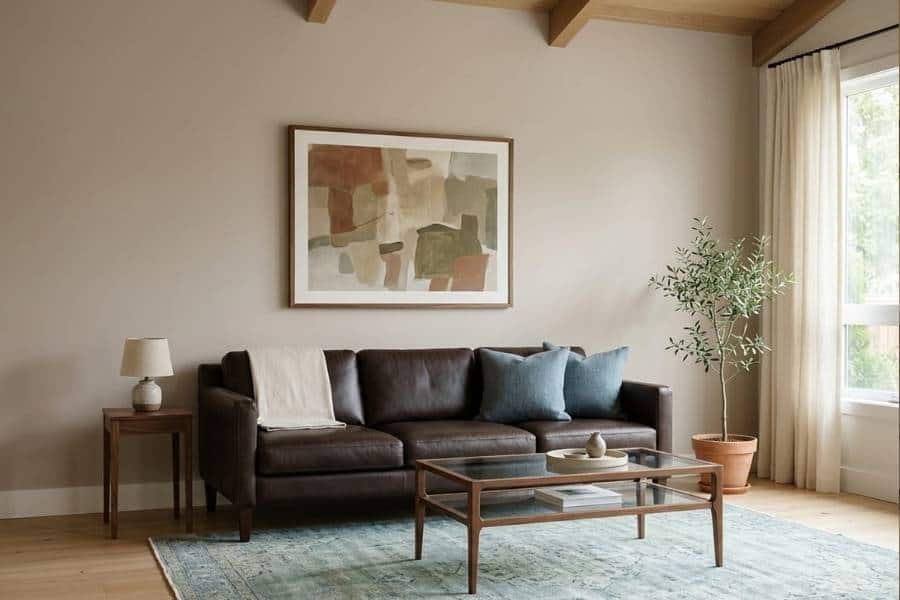
Leather sofas often get pushed against a wall because they’re large, but the rest of your furniture doesn’t have to crowd around them.
Leave enough space beside the arms so the sofa’s outline stays visible.
If a side table is almost as tall and wide as the arm, try a narrower one.
If a floor lamp, basket, table, and plant are all squeezed into the same corner, remove one and see whether the sofa feels less boxed in.
Open space around the seating also makes a room easier to move through when you have guests, and that ease is part of what makes a home feel hospitable.
The wall behind your sofa can add weight too.
A gallery wall that stretches far beyond both arms may make a large sofa look even wider.
One substantial piece of art, or a smaller arrangement with clear space around it, may suit the proportions better.
The same idea applies to shelving.
Open shelves filled edge to edge with books and objects create a busy background.
Leaving some open wall or shelf space gives the sofa a cleaner outline.
Use Lighting to Soften Dark Leather at Night
A brown or black sofa can look much darker after sunset than it does during the day.
If your room relies on one ceiling light, the leather may absorb much of that light while the floor and corners fall into shadow.
Put light near your seating area.
A floor lamp beside the sofa can light the leather from the side and make its texture easier to see.
A table lamp across the room can keep the opposite side from disappearing into darkness.
Several small pools of light almost always feel more restful than one bright ceiling fixture, which is why lamps do so much for the mood of an evening at home.
Bulb temperature changes the leather too.
Warm light can bring out red and orange in cognac or brown leather.
Cooler bulbs may make the same sofa look flatter or slightly gray.
Check your room at the time of day when you use it most before changing paint or upholstery.
If the sofa only feels too dark in the evening, the lighting may be the first thing worth changing.
Choose Wall Art after You See the Whole Seating Area
Wall art above a leather sofa needs to fit the wall while still having enough presence to hold its own above a large piece of furniture.
Small frames spread across a wide wall can look scattered above a substantial sofa.
A larger piece can be easier to place because the sofa gives it a natural center point.
A pair of pieces can work well too if their combined width suits the furniture below.
The subject and colors are personal, so use your room as your guide.
If the sofa and rug already contain several strong colors, quieter art may be easier to live with.
If most of your room is neutral, the wall is a good place to bring in a color you’ve wanted to use elsewhere.
I’d avoid choosing art only because it contains the exact brown found in the leather.
A small repeat of that color is enough.
The art should still look like something you would have bought if the sofa were not sitting underneath it, because the pieces you actually love are what make a room feel like yours.
Check the Wall Color before Changing the Furniture
Sometimes the sofa is blamed for a room that actually has a paint problem.
A deep brown sofa against a beige wall with similar undertones can lose its outline.
Black leather against bright white can create so much contrast that the sofa becomes the first thing you notice from every doorway.
Tan leather may turn noticeably orange beside a cool gray wall.
Warm neutrals can work particularly well with tan and brown leather, but the undertones still matter.
Natural light, bulbs, window direction, and the other colors in your room can all change how paint looks once it’s on the wall.
If you are thinking about repainting, it helps to see the new wall color with the sofa still in the room using a tool like Paint Visualizer AI.
Seeing it before you commit saves you from the long stretch of living with a color that quietly works against everything else you own.
Let the Sofa Be Part of the Room, Not the Whole Room
A leather sofa doesn’t need a room full of brown furniture, matching leather chairs, or accessories chosen specifically to coordinate with it.
Add contrast through fabric, paint, rugs, artwork, lighting, and different furniture finishes.
If your sofa is dark, create some lighter areas around it.
If it has a strong warm tone, bring in a few cooler or quieter colors.
If it’s visually bulky, leave more open space nearby.
The sofa can still be the largest piece in your room without being the first thing you notice every time you walk through the door.
The rest of the room simply needs enough variety to keep that large expanse of leather in proportion.
Get that balance right and the sofa stops being the thing you manage around, and becomes the place everyone naturally ends up.

Leave a comment