
Most people order a custom pool float thinking only about the design.
They skip the material question entirely, and that’s exactly the mistake that leads to fading, cracks, or deflation before summer ends.
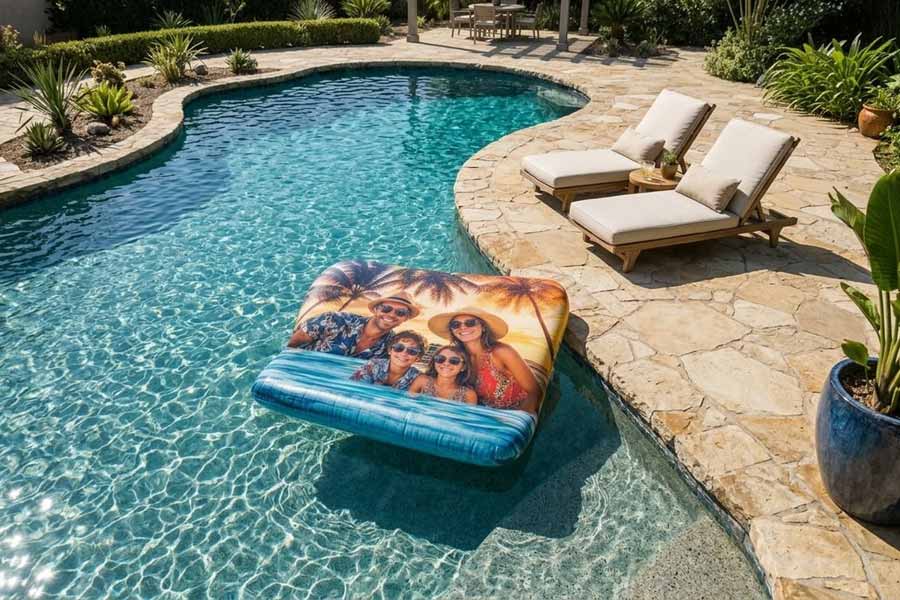
If you’re putting real thought into making your backyard pool area look and feel beautiful, the float you choose is part of that picture.
Choosing the right vinyl and material for custom pool floats isn’t just a technical detail.
It affects print quality, durability, safety, and how long your float actually looks good in the water.
Vinyl Types and What Each One Does for Your Float
Knowing what each type offers before you order saves both time and money.
PVC Gauge: Why Thickness Is the Starting Point
PVC (polyvinyl chloride) is the standard material for pool floats, and gauge thickness determines almost everything.
Light, foldable floats made from 0.25mm to 0.35mm PVC feel nice in your hands but puncture easily and won’t hold their shape under weight.
The 0.45mm to 0.6mm range hits a sweet spot.
It keeps air longer, resists scrapes from pool edges, and handles repeated inflation cycles without stress cracks at the seams.
For heavier use, commercial-grade PVC starting around 0.7mm is built to withstand daily wear and tear or support multiple adults.
Yes, it’s stiffer and harder to roll up.
But the tradeoff, resistance to UV damage and abrasion, makes sense if your float will get serious mileage.
Glossy vs. Matte Finish and Print Clarity
Your vinyl’s finish determines how your custom graphics actually read in sunlight.
Glossy PVC saturates colors and makes designs jump off the float, which is why branded and event floats tend to use it.
The catch is glare and surface scuffs that show more readily on shiny vinyl.
Matte vinyl softens the overall look and better hides minor scratches.
It’s a smart choice for floats with detailed text or photography-style prints where glare ruins the image.
Is your design all about color pop? Glossy works well.
Does your design rely on fine detail or a premium feel? Matte is worth requesting.
Drop-Stitch vs. Standard Inflatable Construction
Standard inflatable PVC traps a single air chamber inside two sealed layers.
Drop-stitch construction connects top and bottom panels with thousands of tightly woven internal fibers.
It holds the float completely flat and rigid under pressure.
Inflatable paddle boards and tanning platforms use this approach all the time.
Drop-stitch floats handle 10 to 15 PSI without deforming, compared to 1 to 3 PSI for standard inflatables.
For a lounging float, standard construction is lighter and more affordable.
For a large branded platform at an event or a float people stand on, drop-stitch costs more but absolutely earns its place.
Once you decide to build a custom inflatable, you can create one here with options spanning multiple vinyl weights and finishes.
How to Choose the Right Vinyl and Material for Custom Pool Floats Based on Use Case
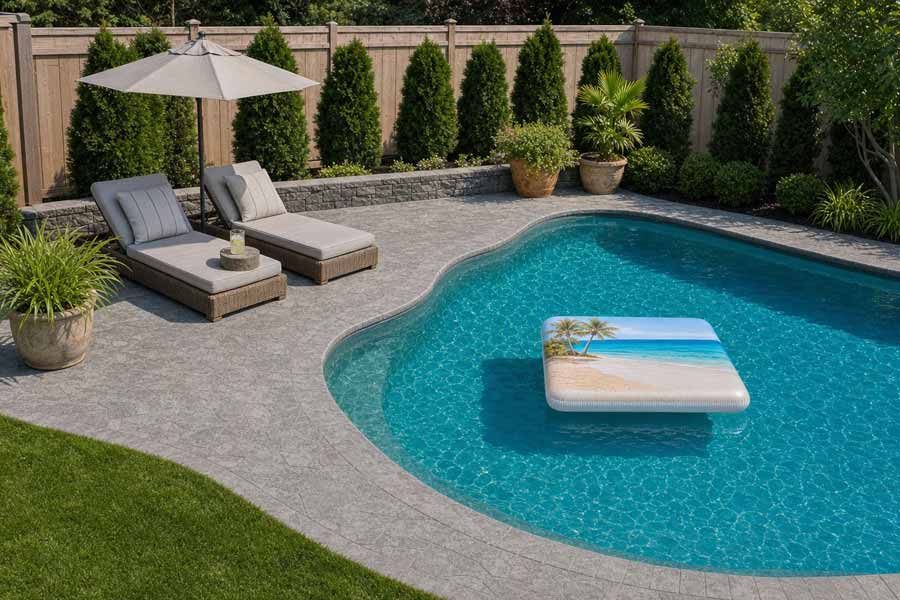
The right vinyl isn’t abstract.
It depends on what your float will actually do, who’ll use it, and where it lives between pool sessions.
I always think it helps to picture your specific setup before deciding, whether that’s a laid-back backyard pool with weekend guests or a high-traffic resort situation.
Residential Backyard Use vs. Commercial or Event Floats
A backyard pool float needs good UV resistance and durability to last two or three summers with normal care.
Standard 0.45mm PVC with a UV-resistant coating does that job well.
It’s affordable, prints cleanly, and repairs easily with a patch kit, which makes it a great option if you’re going the DIY route with a custom design for your own pool space.
A well-chosen float can genuinely add to the whole look of your backyard, tying into your color scheme, your outdoor furniture, or even the vibe you’ve built around your pool area.
But commercial floats at hotels, resorts, or outdoor events face a different world.
Sunscreen, chlorine, and direct sun exposure for hours every day isn’t the same as weekend use.
Thicker PVC (0.6mm and above) with reinforced seams and antimicrobial additives noticeably extends service life in those conditions.
Kids’ Floats and Safety-Rated Materials
Children’s floats need specific safety standards.
In the US, that’s ASTM F963 (consumer product safety for toys) and California’s Proposition 65 if the floats are sold or used there.
These standards restrict certain phthalates and heavy metals that older PVC formulations used as plasticizers.
Look for vinyl labeled phthalate-free or REACH-compliant.
Reputable manufacturers test to these standards during production.
Don’t skip this step if children are the intended users.
Eco-Friendly Material Options
Standard PVC isn’t biodegradable, but better alternatives exist if your brand or event cares about environmental impact.
TPU (thermoplastic polyurethane) is worth considering.
It’s chlorine-free, phthalate-free, lighter than PVC, and more resistant to oils and abrasion.
It costs more per unit, but the environmental trade-off is real.
Recycled PVC and water-based ink printing are two other ways to reduce your float’s footprint without sacrificing print quality.
Floatie Kings offers eco-friendly production options, so building a float that looks great and aligns with an environmental message is genuinely within reach.
The Right Material Makes All the Difference All Summer Long
The material behind your custom pool float shapes every outcome: how long it lasts, how sharp the print looks, and whether it’s safe for everyone using it.
Start with the right PVC gauge for your use case, pick your finish based on your design needs, and match construction type to real-world use.
I’ve found that taking a few extra minutes to think through these details before ordering makes a noticeable difference in what you end up with.
Knowing how to choose the right vinyl and material for custom pool floats before you order means fewer surprises and a float that holds up beautifully all season long.

Leave a comment