
What Are the Best Blinds for Sliding Glass Doors?
Quick Answer:
Side-stacking systems suit your sliding patio entrance best, since they clear the opening horizontally instead of lifting overhead.
Louver assemblies remain the practical baseline across wide spans.
Fabric sheet systems on a top rail handle openings past 2.4 m more cleanly, and cellular versions add insulation.
Match the control side to the moving leaf, and confirm 90 to 100 mm of rotation depth before you order.
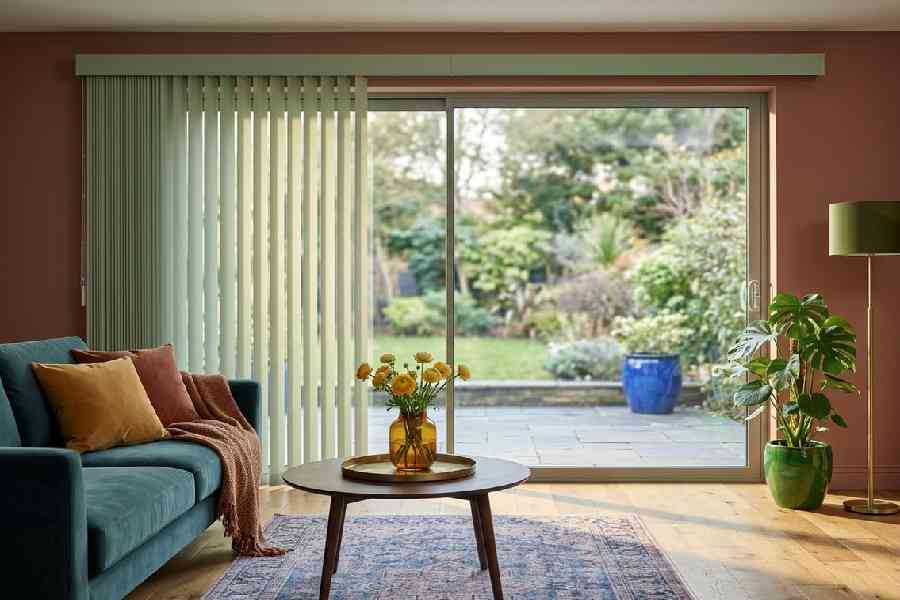
Most complaints about a patio covering trace back to one measurement nobody took.
The louvers rotate into a lever handle, or the parked assembly sits across 300 mm of glass, and the entrance no longer opens cleanly.
Vertical blinds for sliding doors still dominate wide spans, and fitters in Calgary size the headrail to extend beyond the frame rather than fit inside it.
Homeowners researching blinds for sliding glass doors compare fabrics and colors first, when the deciding factors are stack width, rotation depth, and which panel actually moves.
I’d flip that order, and here’s why it matters beyond the hardware.
A patio door is usually the brightest wall in the room and the one your guests walk toward, so the covering you choose sets the light, the sightline, and the whole mood of the space behind it.
How Patio Door Blinds Stack, Rotate, and Clear the Opening
Every covering on a sliding entrance surrenders part of the glass to its own hardware.
The good news is that the loss is calculable before purchase, though most buyers find the figure only after installation.
Losing 300 mm of glass also costs you view and daylight, which is the one design element you can’t buy back with furniture.
Stack Width and the Clear Opening Formula
Bali’s vertical measuring guide sets the working relationship, so stack equals finished width minus clear opening.
Order a 2,440 mm headrail across a 2,440 mm passage and the parked louvers cut into it.
Blinds Chalet publishes stack figures by width and adds a caution worth repeating, since on a split draw, the charted figure covers one side only, so the total loss doubles.
Four numbers settle your specification:
- The passage width your vanes must never obstruct
- Finished width of the headrail, extended past the frame on an outside mount
- Stack allowance, read from the manufacturer’s chart at that width
- Draw configuration, since a split draw spreads the parked vanes across both jambs
Those same numbers tell you where a console or a plant stand can live without fighting the stack, which saves you rearranging the room twice.
Rotation Depth behind a Protruding Handle
Louvers turn through an arc, not a plane.
Roughly 90 to 100 mm of flat depth allows a full rotation without contact against frame or glass, and brackets want about 50 mm of solid landing.
A lever handle standing proud of the slab consumes that arc.
So measure your handle first, and let the mount type follow from the result.
That arc is also what gives you soft raking light across a wall in the late afternoon, and a covering that can’t rotate fully never delivers it.
One-Way Draw or Split Draw
The control side belongs on the fixed panel, never the leaf that travels.
Park the vanes over your operable leaf, and every trip outside starts with pushing fabric aside.
Matched to your traffic flow, the covering stops competing with the entrance.
A door you open without a second thought is what makes a patio feel like part of your living space instead of a room you look at.
Comparing Vertical Blinds and Panel Track Blinds for Wide Spans
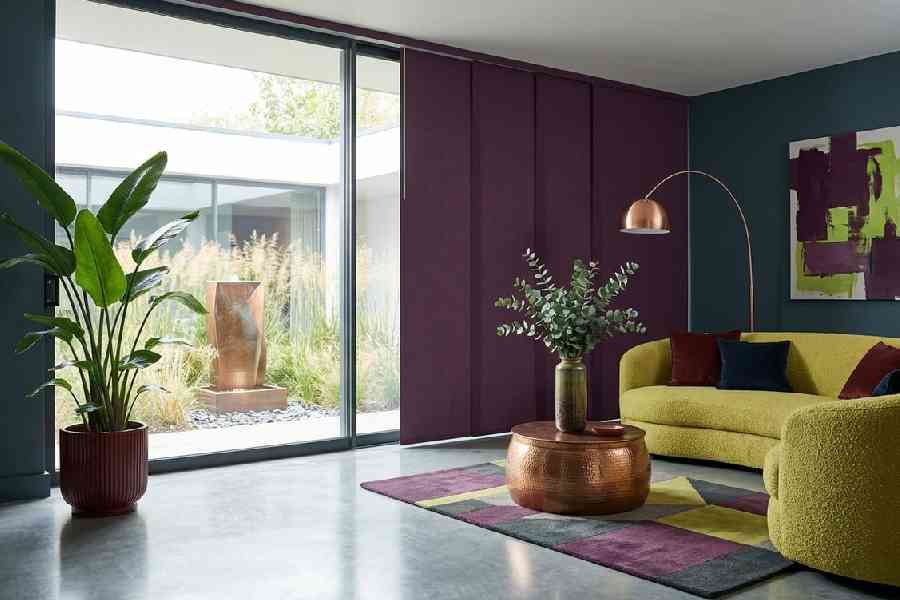
Two families dominate spans wider than a standard casement, and they fail differently.
Louver assemblies flex around irregular frames, while fabric sheets glide quietly but park wider at the jamb.
They read differently too, since vanes give you a crisp vertical rhythm and fabric sheets sit flatter and quieter against a room.
Vane Systems against Wide Fabric Panels
A vane system carries individual louvers on carriers inside the headrail, each rotating on its own stem.
Standard vane width runs 89 mm, with 100 mm and 127 mm profiles for broader spans, which cuts the carrier count across a long run.
Sheet systems replace vanes with fabric panels gliding on a multi-channel rail.
- Vanes tilt through a full arc, giving you graduated light control without moving the assembly sideways
- Fabric sheets offer no tilt, so adjusting the light means sliding a whole panel across
- Spans past 2.4 m suit sheets, where fewer moving parts mean fewer failure points
- Out-of-square reveals favor vanes, which tolerate a wandering frame line
- Chainless bottom weights remove the connecting chain that snags on your furniture and pets
Wider profiles also read calmer across a long wall, since fewer vertical lines means less visual noise behind your seating.
Material and Light Control Trade-offs
Vinyl, fabric, and aluminum behave differently under exposure.
Suppliers serving Calgary carry all three in a single product family, alongside soft-vane lines that mimic drapery folds without the bulk.
Aluminum holds its shape under a heavy heat load.
Fabric absorbs sound and softens glare, while vinyl resists moisture near a kitchen exit and wipes clean.
Cellular versions trade tilt control for insulation, with published R-values reaching R-4.
I’d weigh that sound absorption more heavily than most buyers do, because a hard-surfaced room with a big glass wall echoes, and fabric is what settles it.
Softened glare also protects the things you’ve chosen, since direct sun fades rugs, art, and wood finishes faster than anything else in your home.
Side by Side Comparison
The table below sets the three side-stacking families against the specification inputs above.
| Criterion | Vane Systems | Fabric Sheet Systems | Cellular Versions |
| Parked width, 2.4 m span | Moderate, chart-dependent | Widest, sheets overlap | Narrowest |
| Depth for full rotation | 90 to 100 mm | Rail depth only | Rail depth only |
| Light adjustment | Full tilt arc | Slide only | Slide only |
| Insulation | Minimal | Fabric dependent | Up to R-4 |
| Tolerance for out-of-square reveals | High | Low | Moderate |
Read the parked width row first, since it decides whether your passage stays usable after installation.
Measuring and Maintaining Sliding Door Blinds
Specification errors surface at the tape measure, not on delivery day.
Suppliers across Calgary publish a measuring sequence because the same faults keep repeating.
Inside Mount and Outside Mount Measurements
- Take three width readings inside the reveal, at head, center, and sill, then carry the shortest forward
- Take three height readings on a vane assembly and carry the shortest, so the louvers clear your floor along the full run
- Add roughly 75 to 100 mm of width beyond the frame and 50 to 75 mm above it for an outside mount
- Measure the frame itself, never the covering already hanging there, since old hardware carries accumulated error
That extra height above the frame does something for you visually too, since mounting higher stretches the wall and makes your ceiling read taller.
Pro Tip: Check your floor gap before ordering the height.
A 12 to 19 mm clearance suits hard flooring, and thick carpet or a robot vacuum warrants 25 mm, since friction at the bottom edge wears vanes faster than sunlight does.
An even gap along the whole run is also the detail your eye catches first, the same way a hem line does on curtains.
Keeping Carriers, Vanes, and Tracks Running True
Carrier failure, rather than fabric wear, ends most assemblies.
Vacuum the headrail channel twice a year with a brush attachment, and confirm the spacer links still hold even gaps.
Uneven spacing signals a stem starting to slip.
Wipe vinyl with a damp cloth, and treat fabric with a low-suction pass instead of water.
Hunter Douglas designs address cord access at assembly, so a replacement part matching your original specification protects that safety work.
Two vacuum passes a year is a small price for vanes that hang in a straight, quiet line, which is what keeps the wall looking deliberate rather than tired.
Sizing Sliding Glass Door Coverings on the Numbers
Stack width, rotation depth, and draw direction settle your specification before fabric enters the conversation.
A 2,440 mm span with a lever handle and 60 mm of reveal rules out most inside mounts on its own, and the manufacturer’s chart delivers that verdict long before a showroom visit does.
Measured against those figures, the best blinds for sliding glass doors are the ones that park clear of the glass and leave your passage at its full width.
Get those numbers right and the covering disappears into the room, which is exactly what you want from the largest piece of glass in your home.

Leave a comment