
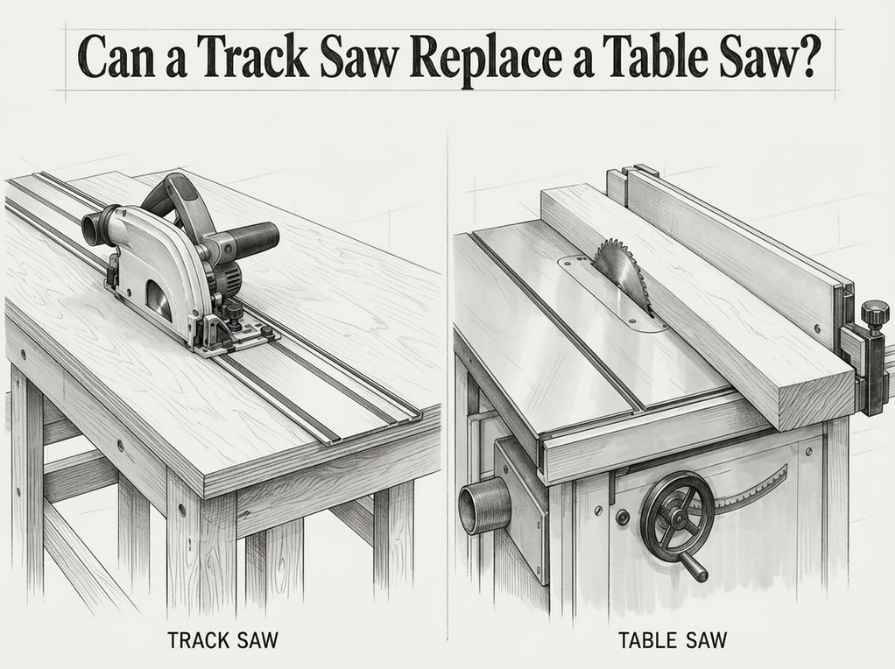
Yes, for a lot of woodworking a track saw can stand in for a table saw, especially when you’re cutting plywood, MDF, and other large sheet goods.
I’ve found it makes long, straight cuts without a big stationary machine in the middle of your shop.
It won’t replace a table saw for everything, though.
A table saw is still the better tool when you need many identical rip cuts, work with narrow boards, cut small parts, or rely on certain jigs and joinery methods.
So, the way I see it, the choice comes down less to which saw is “better” and more to what you build for your home, how much space you have, and how often you need the same cut repeated.
In this guide, I’ll compare the two on accuracy, plywood, rip cuts, furniture making, cabinetry, space, dust collection, and everyday work.
The Short Answer: It Depends on What You Build
For most DIYers and woodworkers, a track saw can handle a large share of the work a table saw traditionally does, particularly if your projects are built from sheet goods: kitchen cabinets, wardrobes, shelving, built-ins, plywood furniture, cabinet doors, workbenches, storage units.
Nearly all of these start by cutting large panels into accurate rectangles, and a track saw is very good at that.
Those are the pieces that quietly give your rooms their sense of order and calm, so getting those first cuts right matters.
You place the guide rail on your cut marks, set the depth, and run the saw along the rail.
You bring the saw to the material instead of wrestling a large sheet through a stationary blade.
Things change when you regularly cut dimensional lumber or need dozens of parts at exactly the same width.
A table saw’s rip fence makes that repetitive work far easier.
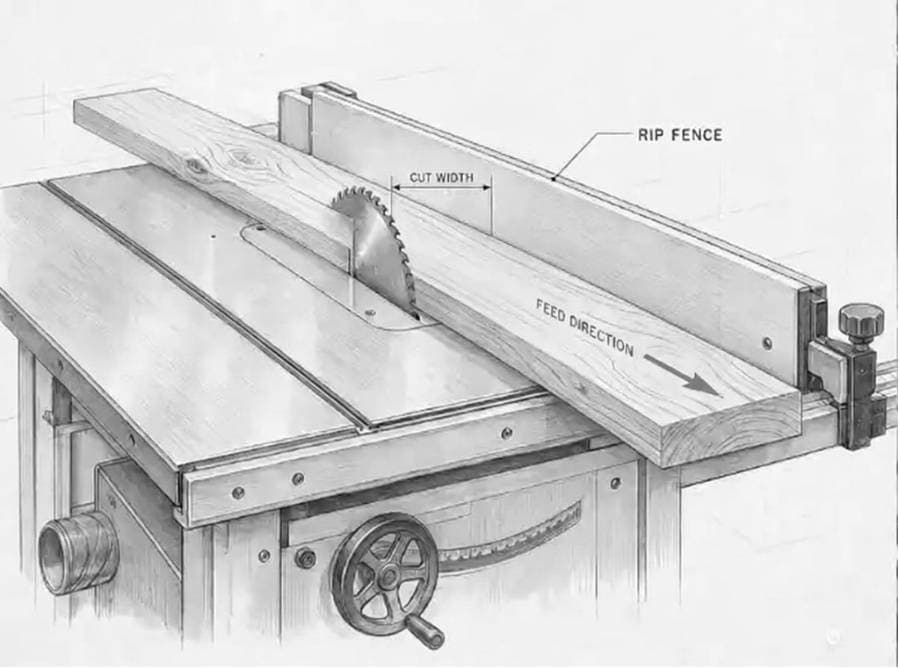
So, can a track saw replace a table saw?
For sheet-based work in a small shop, I’d say often yes.
For high-volume repetitive cutting, narrow stock, specialized jigs, and some joinery, the table saw still wins.
Track Saw vs Table Saw: How Each Tool Works
Both tools produce straight cuts, but they get there in opposite ways, and I think that difference explains which jobs suit each one.
The Track Saw Brings the Blade to the Workpiece
A track saw is a portable plunge saw that runs along a guide rail.
The workpiece stays put, so you position the rail where you want the cut and push the saw along it.
The rail controls the blade’s path, and most systems have a splinter strip along the edge that helps you line up the cut and supports the material right next to the blade.
Because the tool moves and the workpiece doesn’t, a track saw shines on large material.
To cut a full sheet of plywood, you lay it on a support surface and cut it where it sits.
No lifting the whole sheet onto a machine, which is also why track saws work well on job sites or right outside the room you’re updating.
There’s a cheaper way into the same workflow.
A universal kit turns a track saw for a circular saw you already own, clamping onto the saw so it runs along a guide rail like a dedicated plunge saw.
If you mainly need clean panel cuts, that gets you most of the benefit without a second saw sitting on your shelf.
The Table Saw Brings the Workpiece to the Blade
A table saw reverses that.
The saw stays fixed and you feed the workpiece across the table and through the blade.
For rip cuts, a fence runs parallel to the blade, so you set it to the width you want, lock it, and feed the material through.
That fence gives the table saw its biggest advantage, repeatability.
Need eight strips the same width?
Set the fence once, then cut one piece after another with no measuring or realigning between cuts.
On production work, that saves real time.
The trade-off is material handling.
A full plywood sheet is heavy and awkward, and controlling one safely through a table saw needs solid infeed and outfeed support plus enough open floor space to move the sheet around.
This DIY mirror makeover uses a table saw to cut an MDF backing panel to size.
Where a Track Saw Can Replace a Table Saw
A track saw is most likely to replace a table saw when your work centers on large panels rather than small components.
It handles straight cuts, crosscuts, long rip cuts, and bevel cuts.
Breaking Down Plywood and Large Sheet Goods
In my opinion, this is the track saw’s strongest case.
Full sheets of plywood, MDF, and melamine are hard to manage on a table saw, especially working alone.
With a track saw the sheet stays supported, so you just set it on a cutting surface, mark your dimensions, align the track, and cut.
That brings three practical wins.
You don’t need a large clear area in front of and behind a stationary saw just to move a sheet through it.
The material stays supported through the whole cut.
And with the right blade and a properly set rail, the edge comes out clean enough to need little cleanup, which matters when that edge ends up on an open shelf in your living room.
That makes track saws especially handy for cabinets.
A cabinet project often starts with several full plywood sheets that have to become sides, shelves, bottoms, tops, and other panels, and a track saw makes those first cuts without a big stationary setup.
Cabinetry, Built-Ins, and Large Furniture Panels
Cabinetry is one of my favorite uses for a track saw.
Modern cabinets are mostly sheet goods, so if your work is mainly turning large sheets into rectangular parts, a track saw can do most of the cutting.
Built-ins are the same.
If you’re building a floor-to-ceiling bookcase, you might need two tall side panels, several shelves, a top and bottom, dividers, back panels, and doors.
Nearly all of those can come off a track saw.
That’s great news, since I think built-ins are often what make a room feel finished and give your favorite books and keepsakes a proper home.
Large furniture benefits from the same workflow.
Tabletops, cabinet sides, desk panels, wardrobe parts, and shelving are all easier to cut lying flat.
If you’re building one cabinet or piece at a time, that can remove the need for a permanent table saw.
Projects like a DIY L-shaped desk are useful examples of working with large desktops and shelving panels.
Where a Table Saw Still Has the Advantage
The table saw pulls ahead as the work gets smaller, narrower, or more repetitive.
A track saw needs enough surface for the rail to sit securely, and as parts get narrow, supporting and positioning that rail gets tricky.
A table saw doesn’t have that problem.
Repeated Rip Cuts and Narrow Stock
Say you need 12 strips of lumber at exactly the same width for something like a slatted accent wall.
On a table saw you set the fence once and run the boards through one after another at the same setting.
A track saw asks you to measure, mark, position the track, check it, and cut for each piece.
Parallel guides help, but the workflow is still slower than a fixed fence.
That points to a distinction I always keep in mind: accuracy and repeatability aren’t the same thing.
A track saw can make a highly accurate cut.
A table saw can make an accurate cut and then repeat that same width with almost no extra setup.
If you routinely make multiple identical parts, that repeatability is what you’re paying for.
Narrow boards are the other catch.
A rail needs a stable surface under it, and if the workpiece is narrower than the rail you’ll need an extra jig or support.
A table saw fence is built specifically to rip boards to width.
Small Parts, Jigs, and Joinery
A table saw is also a flexible base for jigs.
Depending on the saw, setup, blade, and your local safety rules, woodworkers use table saw jigs for crosscutting, repeatable parts, grooves, rabbets, some dado work, angled parts, and tenons cut with a suitable jig.
A crosscut sled is a good example.
Once built and dialed in, it makes accurate crosscuts on smaller pieces and gives you a repeatable reference.
A track saw isn’t built to cover all of these.
You can usually find another route with a router, miter saw, circular saw, hand tools, or a dedicated jig.
If your furniture projects call for more detailed joinery and structure, the table saw’s versatility becomes more valuable.
Those finer details are often what make a handmade piece feel like a future heirloom instead of something off a big-box shelf.
Track Saw vs Table Saw Accuracy and Cut Quality
Both tools cut accurately.
In my experience, the difference is how you set and repeat the cut.
| Task | Track Saw | Table Saw |
| Long straight panel cuts | Excellent | Excellent |
| Breaking down full sheets | Excellent | Good with adequate space/support |
| Repeated identical widths | Good with setup/accessories | Excellent |
| Narrow rip cuts | Less convenient | Excellent |
| Large crosscuts | Excellent | Depends on setup |
| Small parts | Limited | Better with appropriate setup |
| Clean plywood edges | Excellent with correct blade/setup | Excellent with correct blade/setup |
| Bevel cuts | Very capable | Very capable |
| Portable cutting | Excellent | Limited for larger saws |
A quality guide rail gives the track saw a straight reference edge, so once it’s positioned the saw follows the rail instead of you steering along a pencil line.
The blade matters too.
A fine plywood blade leaves a very different finish from a coarse construction blade, and blade condition, tooth geometry, feed speed, and material all show up in the edge.
You’ll see that finish every day on painted cabinet doors and open shelving, so I never skimp on the blade.
Table saw accuracy leans just as hard on setup.
The fence has to run true and the saw has to be adjusted and used according to the manufacturer’s instructions.
Neither tool guarantees good work on its own.
Where the table saw clearly pulls ahead is after that first setup, since once the fence is set for a rip, cutting more pieces at that width is a breeze.
With a track saw, every new track position is another chance for a measuring or alignment slip.
For one large panel that hardly matters. For 50 identical parts it matters a lot.
Safety, Dust Collection, Space, and Portability
Cutting ability isn’t the whole decision.
Your shop space and how you handle material often decide which saw is actually practical for you.
Workshop Space
A table saw needs more than its footprint.
Long boards need room before and after the blade, and sheet goods need space to position and support.
A track saw stores on a shelf or in a case, and while the rails need storage too, the whole system takes far less permanent floor space.
In a garage or shared shop that’s a big deal, because you can set up a temporary cutting surface, make your cuts, and clear it away.
I love that your garage doesn’t have to give up its other jobs, whether that’s storing holiday decor or hosting a summer get-together.
Learn more about planning your workshop layout.
Portability
Track saws are built to travel.
The saw, rails, clamps, blades, and dust extractor go to the work instead of the work coming to a fixed machine, which suits installers, remodelers, cabinetmakers, carpenters, and you, if you’re tackling projects in different rooms.
Portable table saws exist, but the full working setup still needs stands, material support, and room to operate.
Dust Collection
A track saw collects dust well when paired with a compatible extractor, since the housing surrounds most of the blade and helps steer material toward the port.
A table saw can also extract well, but results vary a lot by machine design and setup.
Don’t judge a saw by whether it has a dust port.
Look at the whole system: saw design, extractor, hose, blade, material, and shop ventilation.
I’ve learned this matters even more when your shop is attached to the house, since fine dust has a way of drifting onto your furniture and soft furnishings.
Safety
Both saws expose a fast-moving blade and can cause serious injury if misused, but their risks differ.
A track saw keeps the workpiece still for many common cuts, which means less steering a large sheet past a blade.
A table saw needs you to feed material through the cutting area, so fence setup, guards, riving knives, push devices, workpiece support, and technique all matter.
Always follow safe table saw practices.
A track saw still needs correct rail positioning, stable support, the right cutting depth, control of the saw throughout the cut, and the manufacturer’s instructions.
Neither design is a substitute for safe practice, and I’d never skip those steps.
Track Saw vs Table Saw by Project Type
I think the simplest way to choose is to look at what you actually build.
| Project | Track Saw | Table Saw |
| Breaking down plywood | Strong choice | Useful but needs more handling |
| Kitchen cabinets | Strong choice | Strong choice |
| Built-in wardrobes | Strong choice | Strong choice |
| Large shelving | Strong choice | Strong choice |
| Job-site panel cutting | Strong choice | Less convenient |
| Small furniture parts | Can be limiting | Strong choice |
| Repeated narrow strips | Possible but slower | Strong choice |
| Production woodworking | Useful companion | Often highly useful |
| Small garage workshop | Strong choice | Requires more dedicated space |
| Large equipped workshop | Useful | Strong choice |
For cabinet-focused work, the track saw can become your main panel-cutting tool.
Furniture making is more mixed.
If you mostly build plywood cabinets, desks, shelves, and large modern pieces, you can do most cutting with a track saw plus a few other tools.
If you work with solid lumber, small components, jigs, and repeated dimensions, you’ll get more from a table saw.
Should You Buy a Track Saw or Table Saw First?
My advice? Buy for your projects, not a generic tool list.
Choose a track saw first if you mostly work with large sheets, have limited space, often work at different locations, or want to avoid handling full plywood sheets on a stationary saw.
It also fits a shop that has to be packed away after use, like a corner of the garage or a spare room that doubles as your craft space.
Choose a table saw first if you frequently rip dimensional lumber, make many parts at identical widths, work with smaller components, or want to run sleds and jigs as part of your workflow.
There’s a third option, which is to own both.
They overlap, but they also pair well.
Use the track saw to break a full sheet into manageable pieces, then move those to the table saw when you need repeated dimensions or extra operations.
That takes away the most awkward table saw task, steering a full sheet, and for a professional or serious shop the combination is very efficient.
For a small DIY setup, I’d say buying both at once is probably overkill.
Start with the tool that solves most of your current cutting problems, and you’ll be on your way to building the pieces that make your home feel like yours.

Leave a comment