
If you’ve followed my DIY painting posts, you’ll know I’m happy to pick up a roller myself.
Some jobs are better handed over, though.

A high-set Queenslander with flaking weatherboards is one.
A whole house you want finished before moving day is another.
If you’re in Brisbane and getting quotes for an interior or exterior repaint, these are the things I’d check before booking anyone.
I think paint deserves that care, because it’s the one finish your eye touches in every room before a single cushion or lamp gets noticed.
Interior or Exterior: What a Full Repaint Involves
Most of the hours in an interior job go into prep.
Cracks get filled, walls are sanded and sugar soaped, everything is masked, patched areas are sealed, and then two top coats go on.
Ceilings, walls, doors and skirtings are often priced separately, so check which ones are in your quote.
If your home has VJ timber walls (the vertically jointed boards you see in a lot of older Queenslanders), the grooves need brushing in rather than a quick roll, and that adds time.
I’ve always loved those walls for the shadow lines they throw across a hallway, and a sloppy roll flattens that character out.
Exteriors are a different job.
Brisbane’s UV fades and chalks paint, especially darker colors, and the humid summers leave mould on shaded walls.
A proper exterior repaint starts with a wash to kill mould and lift dirt.
Loose paint is scraped back and rotten timber is replaced or filled.
Bare wood is primed before any top coat goes on.
On a house with verandas and fretwork, the detail work can take longer than the walls.
I’d pay for that detail work happily, since a crisp veranda is the first thing your guests see before they ever reach your front door.
If your house was built before 1970, some of the older layers may contain lead.
Ask any painter how they test for it and how they’ll contain the dust if sanding is needed.
A good one will have a clear answer without you having to push.
Timing matters too.
Exterior work is easiest to schedule in Brisbane’s drier months, roughly May to September.
Summer storms can push a job back by days, so if you’re booking outside work for January, ask how weather delays are handled.
I’d rather wait a fortnight than rush a finish you’ll be looking at every day for the next ten years.
Check the License and Warranty before You Sign
In Queensland, any painter you hire for a decent-sized job should hold a QBCC license, and the number should be easy to find before you sign.
For example, DC Decorators, a Woolloongabba firm that does interior and exterior house painting across Brisbane, shows its QBCC licence number (15331027) on its site, so you can look it up on the QBCC register in a minute.
It also gives a five-year warranty on its house painting, and I’d ask any painter about that, because peeling or flaking from rushed prep tends to show up a year or two after the job, long after you’ve paid the final invoice.
The QBCC’s online license search shows whether a license is current and what class of work it covers.
If a painter can’t give you a number, or the name on the license doesn’t match the business quoting you, I’d keep looking.
While you’re checking, look at the deposit.
Queensland caps deposits on domestic building contracts at 10% for jobs under $20,000 and 5% for jobs of $20,000 or more.
A painter asking for half the price upfront is one I’d walk away from.
Ask for a copy of their public liability insurance as well, especially for exterior work on ladders or scaffolding.
Get the warranty in writing and read what it covers.
Some only cover workmanship or exclude surfaces the painter flagged as poor before starting.
Most won’t cover damage from leaks or termites.
I find that paperwork buys something quieter than protection, which is the freedom to stop worrying about your walls and start enjoying the home inside them.
Getting Your Colors Right
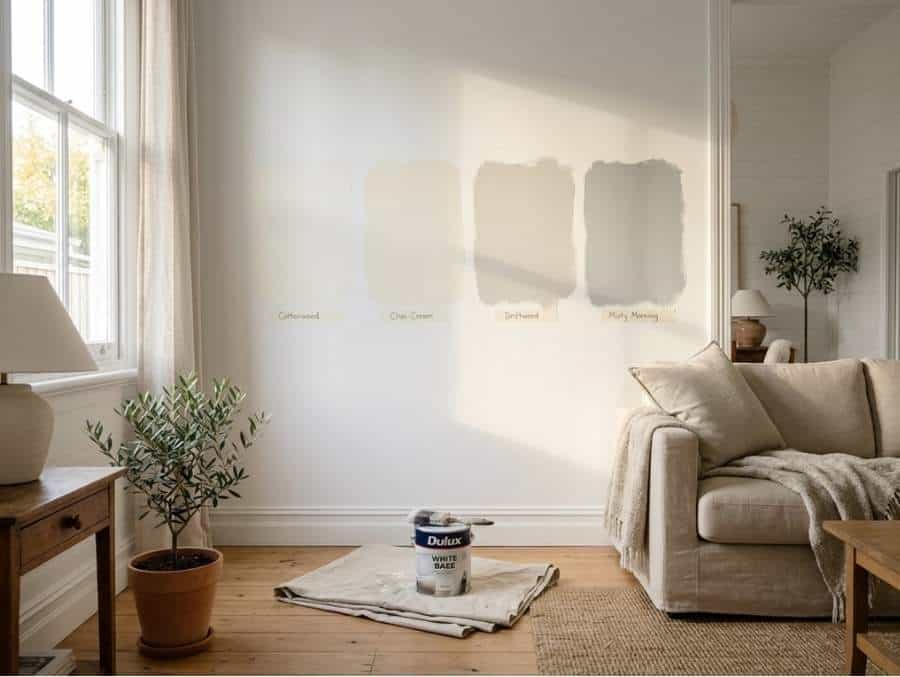
Brisbane light is bright and strong, and it changes how your colors read.
A grey that looks soft on a swatch can turn cold and blue on a sunny wall, and a cream can look almost white.
Paint large samples (at least A3) on two different walls and look at them in the morning and late afternoon before you commit.
I’d hold your rug, your curtain fabric and a favorite cushion up against each patch too, because a wall color only works in the company it keeps.
For exteriors, lighter colors stay cooler and hold up better against fading.
Some exterior paints are made to reflect more heat, and they’re worth asking about for west-facing walls or a dark color you’ve set your heart on.
Most painters will use a low sheen on weatherboards and a gloss or semi-gloss on your trims and doors, which makes them easier to wipe down.
Inside, a lot of Queensland homes have white VJ walls, and your choice of white makes a big difference.
A white with a touch of warmth stops a room looking clinical in that strong light, while a cooler white suits rooms that face south and get less sun.
That warmth is what makes a lounge room feel welcoming at dusk, when the lamps come on and you want people to settle in rather than perch.
In bathrooms and laundries, ask for a paint with a mould inhibitor.
In Brisbane’s humidity, a standard interior paint in a poorly ventilated bathroom will grow mould on the ceiling within a summer or two.
If you’re torn, ask your painter to do a sample patch on site.
Most are happy to, and it’s far cheaper than repainting a room you don’t like.
Comparing Quotes
Get at least two written quotes so you can see where the prices differ.
I’d want a quote that lists:
- the surfaces included, room by room or wall by wall outside
- the paint brand and product, plus the number of coats
- the prep work, including any timber or plaster repairs
- who moves your furniture and covers floors, and how the site is cleaned each day
That last point matters more than you’d think, since a painter who treats your sideboard and floorboards carefully is usually the same one who cuts a clean line at the cornice.
When one quote is much lower than the rest, the gap is usually in the prep.
Fewer coats or no primer on bare timber will bring the price down.
So will a quick wash instead of a mould treatment.
These are also the reasons paint fails early.
Ask the cheaper painter to walk you through what they’ll do on a problem area, like a mouldy southern wall or a cracked ceiling, and compare the answer with the others.
Ask how long the job will take and whether the same team will be on site throughout.
A crew that changes halfway through can leave you with uneven finishes between your rooms, and your eye will catch it every time you walk the hallway.
When the work is done, walk around with the painter in daylight and point out any patchy spots or drips before you pay the final invoice.
Keep the leftover paint, labelled with the room and color name, for touch-ups later.
I’ve found it saves a lot of guessing when a scuffed hallway needs fixing in a couple of years, right before you hang new art or have people over.

Leave a comment