
A door specification sheet can look daunting at first glance!
But strip it back and you are really looking at six things:
What size the door is, what performance it claims, how secure it is, what hardware is included, what finish it comes in, and whether the sheet is describing a leaf or a full doorset.
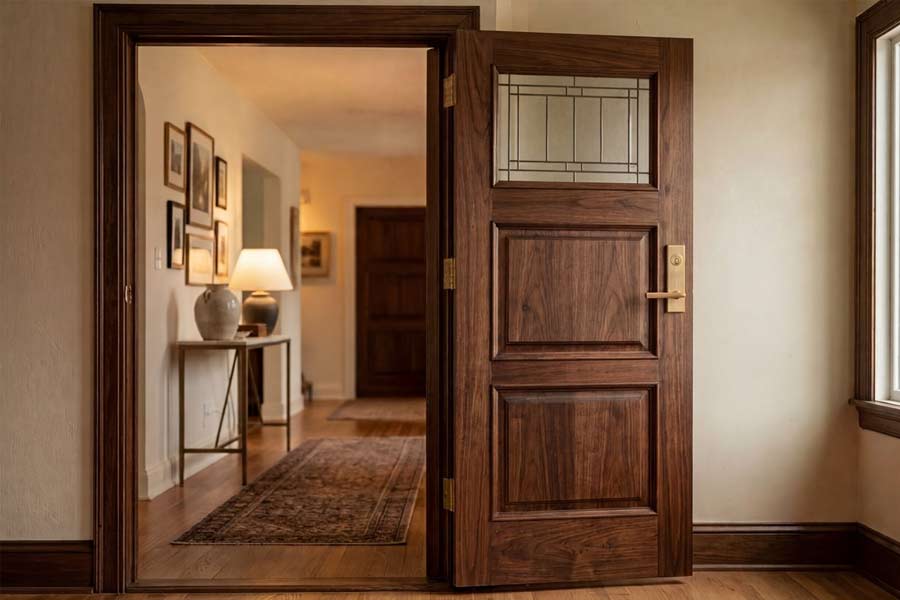
Once you know where those details live, comparing two products becomes far less painful.
The problem is that spec sheets are written for people who already know the terminology.
A buyer who doesn’t work in the trade is effectively handed a document in a foreign language and asked to make a major purchasing decision from it.
This guide is a plain-English interpreter for that document.
It won’t turn you into a door consultant, but it will tell you which lines matter most, which terms are just shorthand, and where buyers most often go wrong.
What a Door Specification Sheet Is Actually Telling You
A spec sheet is a technical summary of what the product is, how it performs, and what is included in the supply.
It is not a sales brochure, even if it lives on the same page as marketing copy.
That distinction matters because spec sheets contain declared values and test references that carry real meaning, while surrounding product descriptions might use adjectives like “heavy duty” or “premium” without backing them up with any evidence.
The first source of confusion for buyers is that spec sheets don’t always describe the same thing.
Some describe a complete doorset, meaning the leaf, frame, threshold, hardware, and seals as a tested assembly.
Others describe only the leaf, or only a hardware pack.
If you’re comparing two products and one sheet covers a full doorset while the other covers just the slab, you’re not comparing the same scope of supply.
I’d recommend checking that before anything else.
Start by Checking Whether It Describes a Door Leaf or a Full Doorset
This is probably the single most useful check you can make before reading anything else on the sheet.
A door leaf is the moving panel.
A frame is the fixed surrounding structure attached to the wall opening.
A doorset is the tested assembly, usually combining the leaf, frame, and often the hardware, seals, and threshold.
Why does it matter?
Because security ratings, fire ratings, thermal values, and acoustic ratings are usually declared for the complete doorset, not the leaf alone.
If a product sheet declares PAS 24 compliance but describes only a leaf, that claim needs scrutiny.
The test was conducted on an assembly.
Without the tested frame, hinges, locking hardware, and seals installed together, the performance may not carry over.
Look for the words “doorset,” “complete assembly,” or “tested assembly” in the description.
If the sheet only ever says “door leaf” or “door slab,” treat all performance claims with that scope in mind.
The First Fields Most Buyers Should Read
Buyers often start at the top of a spec sheet and read every line in order.
A better approach is to identify the fields that determine whether the product is suitable before spending time on secondary details.
The fields that matter most, roughly in order:
- Overall size and how it is measured. Is the quoted size the leaf, the frame, or the structural opening? These are different numbers, and confusing them is the most common dimension mistake.
- Application (internal or external). External doors carry different performance requirements. A sheet that doesn’t specify clearly is worth querying.
- Performance claims and their scope. Is the door fire-rated? Security-rated? Thermally rated? If so, which standard is referenced, and does it apply to the full doorset?
- Hardware inclusion. Is hardware included, or does it need to be ordered separately? Many spec sheets list hardware as “optional” or “available” rather than “supplied.”
- Threshold type. The threshold affects weather resistance, accessibility, and whether the door can be retrofitted into an existing frame.
Once those fields are clear, the rest of the sheet fills in the detail.
How to Understand Dimensions and Size Notation
Door dimensions look straightforward until the moment you try to order.
The core issue is that width x height notation doesn’t always describe the same thing.
A leaf size is the physical dimension of the moving panel.
A frame size is larger, because it includes the frame sections around the leaf.
The structural opening in your wall needs to be larger still, because the frame sits inside it with room for adjustment and fixings.
Spec sheets may quote any one of those three dimensions.
The one that catches buyers out most often is assuming the listed size is the opening they need to cut into the wall.
Check whether the sheet says “leaf size,” “frame size,” or “opening size.”
Clear opening width is a separate concept.
It describes the usable width of the gap once the door is open and the frame rebate is accounted for.
Accessibility guidance, including Approved Document M, uses clear opening widths when setting minimum requirements for wheelchair access and general accessibility.
So spec sheets and regulations may quote different numbers even when they refer to the same door.
Metric and imperial equivalents still appear on some sheets, particularly for older product lines.
Where both are shown, the metric figure is the one that matters for UK regulatory purposes.
What Security Terms on a Spec Sheet Usually Mean
Security terminology on a spec sheet tends to cluster around three things: the test or standard the doorset has been assessed against, the locking system, and the frame and hinge reinforcement.
PAS 24
PAS 24 is a Publicly Available Specification developed by the British Standards Institution.
It tests the enhanced security performance of doorsets and windows by simulating the types of forced entry an opportunist burglar is likely to attempt, including manual attacks with tools, mechanical loading on the frame, and impacts on locking points and hinges.
It is a pass-or-fail standard. There is no grade or scale.
A doorset either passes all elements of the test or it does not.
PAS 24 matters in a regulatory context because Approved Document Q, which covers security in dwellings in England, requires that easily accessible doors and windows in new builds provide reasonable resistance to physical attack.
Meeting PAS 24 is the standard way to demonstrate compliance with Part Q.
One important nuance: PAS 24 is tested on the complete doorset.
When a spec sheet references PAS 24, check that it refers to the doorset you are buying, including the frame and hardware, not just the leaf.
Secured by Design
Secured by Design (SBD) is a police-backed initiative that certifies products meeting a defined security standard.
To carry SBD accreditation, a door product must first pass PAS 24 testing.
SBD adds a layer of ongoing certification and auditing on top of the initial test, so it is a stronger indicator of consistent compliance than a one-off test reference alone.
Multipoint locking and cylinder type
A multipoint locking system engages at multiple points along the door edge when the handle or key is operated, rather than at a single central bolt.
This distributes the locking load across the doorset and makes it harder to force the door by attacking one point.
Euro cylinders are the most common lock cylinder type in the UK.
Look for references to anti-snap, anti-drill, or anti-pick cylinders on external security doors.
A cylinder described only as “euro profile” without those attributes may be a vulnerability, since standard euro cylinders can be snapped with a common tool in under 30 seconds.
That last point is worth paying close attention to if you are specifying an external door.
Hinge-side protection refers to reinforcement designed to prevent the door being levered off its hinges from the outside.
Security spec sheets for external doors should describe the hinge type and whether anti-jemmy features are present.
What Thermal and Weather-Performance Lines Are Really Telling You
External doors on a spec sheet should carry thermal and weather performance data.
The key fields to look for are U-value, weather classification, and where relevant, air permeability and water tightness.
U-value
A U-value measures how much heat passes through a building element.
It is expressed in W/m2K (watts per square metre per degree kelvin).
The lower the number, the better the thermal performance.
For external doors in the UK, Building Regulations Part L sets a maximum U-value of 1.4 W/m2K for replacement doors in existing dwellings, and 1.6 W/m2K for doors in new builds.
A high-performing external doorset will commonly sit between 1.0 and 1.4 W/m2K.
Anything above 1.8 W/m2K is poor by modern standards.
Watch out for one common spec sheet ambiguity: the declared U-value should relate to the complete doorset, including glazing if present.
A value quoted only for the panel without including the glazed area will look better than the whole-door figure.
Weather resistance
External pedestrian doorsets are typically tested to EN 14351-1, the European product standard for pedestrian doors and windows.
This standard covers performance characteristics including air permeability, water tightness, and wind resistance, each rated on a classification scale.
On a spec sheet you may see these expressed as class numbers, for example “air permeability Class 3” or “water tightness Class 6A.”
Higher class numbers generally indicate better resistance to air and water infiltration, though the scale differs between each characteristic.
Where a spec sheet lists EN 14351-1 declarations, those figures are measured results from tested assemblies, not estimates.
How to Read Fire-Performance References without Panicking
If a door spec sheet references fire performance, you will likely see one or more of the following: an FD rating, a test standard, references to intumescent or smoke seals, and sometimes a third-party certification body.
FD ratings are the most visible shorthand.
FD30 means the doorset has been tested to resist fire for a minimum of 30 minutes.
FD60 provides 60 minutes of protection.
FD30S and FD60S indicate the doorset also controls cold smoke, which matters because smoke inhalation causes more fire-related deaths than flames in most building fires.
Testing in the UK has historically been carried out to BS 476 Part 22 or the European equivalent EN 1634-1.
Some specs still reference legacy BS 476 classifications while newer ones use EN 1634-1 designations such as E30 or E60.
Both can demonstrate compliance with Approved Document B, which covers fire safety in buildings, though the specific requirement depends on building type and application.
The important practical point here is that fire performance, like security performance, applies to the complete assembly.
The door leaf, frame, ironmongery, glazing, seals, and closer are all part of the tested doorset.
Replacing a component with one that was not part of the original test assembly can compromise the rating.
A spec sheet should list the hardware and seals the door was tested with, and any installation instructions should specify what can and cannot be substituted.
Third-party certification bodies such as Certifire, BM TRADA Q-Mark, and Warringtonfire conduct ongoing audits of fire door manufacturers.
A spec sheet that references third-party certification provides stronger assurance of consistent manufacturing standards than a test result alone.
Hardware Language That Looks More Complicated Than It Is
The hardware section of a spec sheet is usually where buyers start to feel out of their depth.
Most of it is straightforward once you have a reference for the terminology.
Here are some of the terms you are most likely to encounter:
- Ironmongery. The collective term for all the hardware on a door: hinges, handles, locks, closers, letter plates, and related fittings. An ironmongery schedule is the full list of hardware items for a door or project.
- Lever/lever or lever/pad furniture. The handle arrangement. Lever/lever means a lever handle on both sides. Lever/pad means a lever on one side and a flat pad on the other, typically used where one side should not allow free egress.
- Escutcheon and backplate. An escutcheon is the decorative or protective plate around a keyhole or cylinder. A backplate is the larger plate behind the handle furniture. Spec sheets mention these when describing the grade or finish of the visible hardware.
- Mortice lock. A lock that fits into a mortice, a slot cut into the door edge. The most common type in UK security doors. A five-lever mortice deadlock is a standard insurance requirement for external doors.
- Euro cylinder. The barrel component of many mortice and sash locks, recognisable by its oval shape. Look for anti-snap, anti-drill, or anti-pick variants on external security doors.
- Threshold. The strip at the bottom of the door opening where the door meets the floor. Options include rebated thresholds, accessible low-threshold designs, and weather-bar thresholds. The type affects weather sealing, drainage, and accessibility.
- Door closer. A hydraulic or spring mechanism that controls the closing speed and force of the door. Required on fire doors to ensure they close fully after use. Spec sheets should list the closer grade and EN class.
- Dog bolt or security bolt. A hinge-side bolt that shoots into the frame when the door is locked, preventing the door being lifted off its hinges even if the hinge pins are attacked. Common on high-security external doorsets.
- Kick plate. A protective panel fitted to the lower portion of the door face to resist scuffs, kicks, and wear.
- Vision panel. A glazed opening in the door leaf, allowing light transmission or visibility without opening the door. The spec sheet should list the glass specification and any fire or security rating the panel has been tested to.
If the hardware section of a spec sheet is still losing you, it helps to keep a reference resource open alongside it.
Latham’s door part terminology guide is a practical companion that translates the basic part names and hardware terms buyers typically encounter, from frames and leaves to kick plates, hinges, and handle furniture.
Finish Terms, Color References, and Appearance Notes
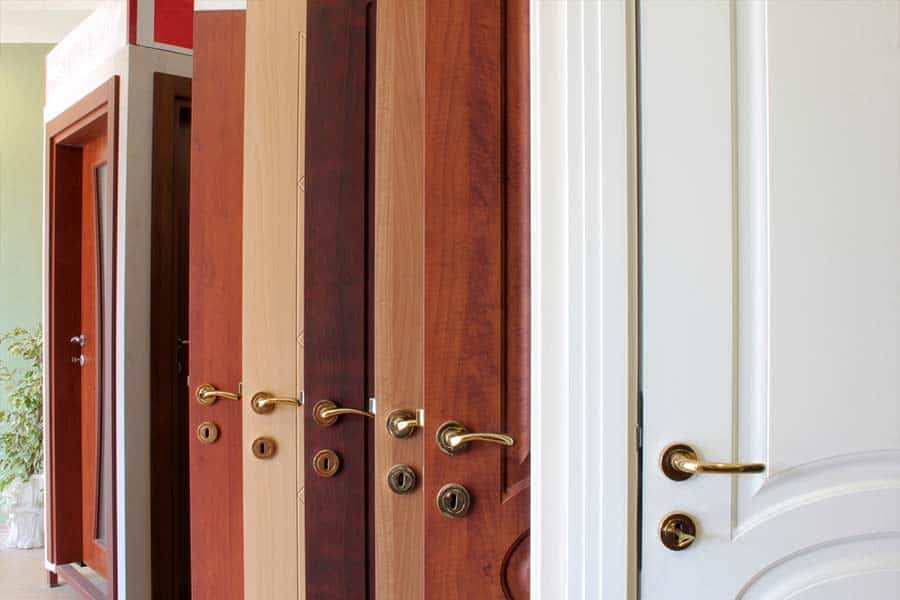
Finish terminology on a spec sheet describes how the door surface has been treated and what it will look like.
These are not purely cosmetic notes.
The finish affects maintenance, longevity, suitability for internal or external use, and sometimes the substrate material beneath.
Common Finish Types
Powder coated: A dry finishing process where electrostatically charged powder is applied to the door and then cured under heat. Produces a durable, hard-wearing surface. Standard for most steel doors. Spec sheets should state the powder coat grade and specify whether it is inside-only, outside-only, or through.
Primed: The door has been prepared with a primer coat but not finished, with the expectation that the buyer or installer will apply a topcoat. Primed doors are often cheaper but require additional work before installation.
Galvanized: A zinc coating applied to steel to prevent corrosion. Relevant for external steel doors in exposed environments. Sometimes listed as “hot-dip galvanized” for higher-grade protection.
Veneer: A thin layer of real wood or wood-effect material applied to the door face. Used on timber or composite doors to achieve a specific appearance while managing cost and stability.
Paint grade vs stain grade: Terminology used for timber doors. Paint grade timber has knots and imperfections acceptable under a painted finish. Stain grade has a cleaner face suitable for transparent or semi-transparent finishes where the grain will be visible.
Color references
RAL colors are the standard reference system for powder-coated finishes on steel doors.
RAL 9016 is traffic white, RAL 9005 is jet black, RAL 7016 is anthracite gray.
If a spec sheet references RAL colors, you can look up the exact shade using any RAL color chart.
Note that screen representations are approximate.
Always request a physical sample if color match is critical.
Glazing and panel styles
Spec sheets for glazed doors should specify the glass type and any performance ratings it has been tested to.
Terms like “toughened safety glass,” “laminated glass,” or “Georgian wired glass” describe different constructions with different impact, security, and fire performance characteristics.
The Difference Between Compliance Language and Selling Language
This is where spec sheets can trip up even careful buyers, because the two types of language often appear in the same document.
Compliance language looks like this: “Tested to PAS 24:2022,” “Declared air permeability Class 3 to EN 14351-1,” or “FD30 certified to BS 476 Part 22.”
These are references to actual tests or standards with defined criteria.
They mean something specific and verifiable.
Selling language looks like this: “Heavy duty,” “Premium quality,” “High security,” or “Robust construction.”
These are adjectives.
They are not backed by any test.
A door described as “high security” with no standard cited is not the same as a door certified to PAS 24.
When a spec sheet is short on tested values and long on adjectives, that is useful information in itself.
It may mean the product has not been through formal testing, or that the sheet is a marketing document rather than a technical one.
Either way, it is a prompt to ask the supplier for the test evidence directly.
Don’t be shy about asking for it.
Any reputable supplier should be able to produce it without hesitation.
How to Compare Two Door Spec Sheets Side by Side
Comparing spec sheets is easier when you work through the same categories for each product in sequence, rather than reading both sheets end to end and trying to hold everything in your head.
A sensible order of comparison:
- Door type and application. Are both sheets describing equivalent products? A doorset spec and a leaf-only spec are not directly comparable.
- Dimensions. Is the quoted size the same type of measurement (leaf, frame, or opening)? Do both products fit your structural opening?
- Security claims. What standard is cited, and does it apply to the complete doorset? Is hardware included or separate?
- Thermal performance. What U-value is declared, and does it reflect the full doorset including any glazing?
- Fire or smoke claims. If relevant to your application, are fire ratings comparable and based on the same test standard?
- Included hardware. What is actually in the box? Is the hardware schedule the same across both products, or does one include components the other treats as optional?
- Finish and maintenance. What does the surface treatment require in terms of ongoing care, especially for external applications?
Where one sheet has a declared value and the other only has a marketing claim in the same category, that gap is worth weighing.
Declared values have been tested.
Claims have not.
Common Places Buyers Misread a Spec Sheet
A few mistakes come up repeatedly when non-trade buyers interpret spec sheets.
Assuming leaf size equals opening size. The leaf is smaller than the frame, which is smaller than the structural opening required. If you measure your opening and order a door listed at that size as a leaf dimension, it will not fit.
Assuming hardware is included when it is optional. Many spec sheets describe hardware packs that are available but not supplied as standard. A lower list price sometimes reflects that the door is undrilled or supplied without locks. Read the supply scope carefully.
Confusing a product family description with a specific product. Where a range of doors shares a single spec sheet, the performance claims may apply to the top specification in the range. A budget variant within the same family may have different hardware, glass, or frame construction.
Mistaking a doorset performance claim for a leaf-only claim. If you plan to supply your own frame, the tested performance of the complete doorset may not transfer. Ask the manufacturer whether leaf-only supply affects any declared ratings.
Treating broad marketing terms as formal test evidence. “High security” is not a standard. “PAS 24 certified” is. If a spec sheet uses only the former, that is a question to ask before buying.
The Spec Sheet Is There to Help You, Not to Confuse You
A door specification sheet exists to show exactly what is being supplied and how it performs.
Once you know where to find the six key pieces of information, which are size, doorset scope, performance, hardware, finish, and compliance, comparing products stops being guesswork and starts being a straightforward exercise in matching what the sheet declares against what your project needs.
The terminology takes a bit of getting used to.
But most of it follows a consistent logic: ratings describe tested behavior, dimensions describe physical size, and hardware terminology describes specific components.
The more familiar you get with those three categories, the faster spec sheets become readable documents rather than obstacles.
If you want a quick reference for part names and hardware terminology while reading a spec sheet, Latham’s guide to door part terminology covers the most common terms a buyer is likely to encounter across frames, leaves, and fittings.
Frequently Asked Questions
What is the difference between a door leaf and a doorset?
A door leaf is the moving panel, the piece that swings open and closed.
A doorset is the complete tested assembly, which includes the leaf, frame, threshold, seals, and often the hardware.
Performance ratings for security, fire, and thermal performance apply to the doorset as a whole.
If a spec sheet claims a performance rating but only describes a leaf, check what hardware and frame the test was carried out with.
What does PAS 24 mean on a door specification sheet?
PAS 24 is the UK’s enhanced security test standard for doorsets and windows.
It is a pass-or-fail test that simulates common forced entry methods.
On a spec sheet, a PAS 24 reference means the doorset has been independently tested and certified to that standard.
It is also the test referenced under Approved Document Q (Part Q of the Building Regulations in England), which covers security in new residential dwellings.
What does U-value mean on a door spec sheet?
U-value measures how well a door resists heat loss.
It is expressed in W/m2K. Lower is better.
For external doors in the UK, 1.4 W/m2K or below meets current minimum requirements for replacement doors in existing homes, while 1.6 is the limit for new builds.
A well-insulated external doorset will typically sit below 1.4.
Check that the declared value reflects the complete doorset, including any glazing, rather than just the panel.
What does ironmongery mean on a spec sheet?
Ironmongery is the collective term for all the hardware components on a door: hinges, handles, locking mechanisms, closers, letter plates, kick plates, and similar fittings.
When a spec sheet refers to an ironmongery schedule or ironmongery pack, it is listing the hardware items included in or available for the door.
Always check whether the hardware is supplied as standard or needs to be ordered separately.
It is one of the most common areas where buyers are caught off guard by an unexpected additional cost.
Why do two doors that look similar have different spec sheets?
Because visual similarity does not indicate performance equivalence.
Two doors with the same panel profile might have entirely different frame construction, locking systems, test evidence, glass specifications, and thermal performance.
Surface finish and door style are the most visible attributes and the least diagnostic ones.
Spec sheet differences in performance ratings, hardware, and compliance references are what tell you whether two products are genuinely equivalent or just superficially similar.