
Few decisions carry more weight than choosing the right home style, especially when you’re building from the ground up on rural land.
Two styles dominate the conversation for country living right now: the barndominium and the modern farmhouse.
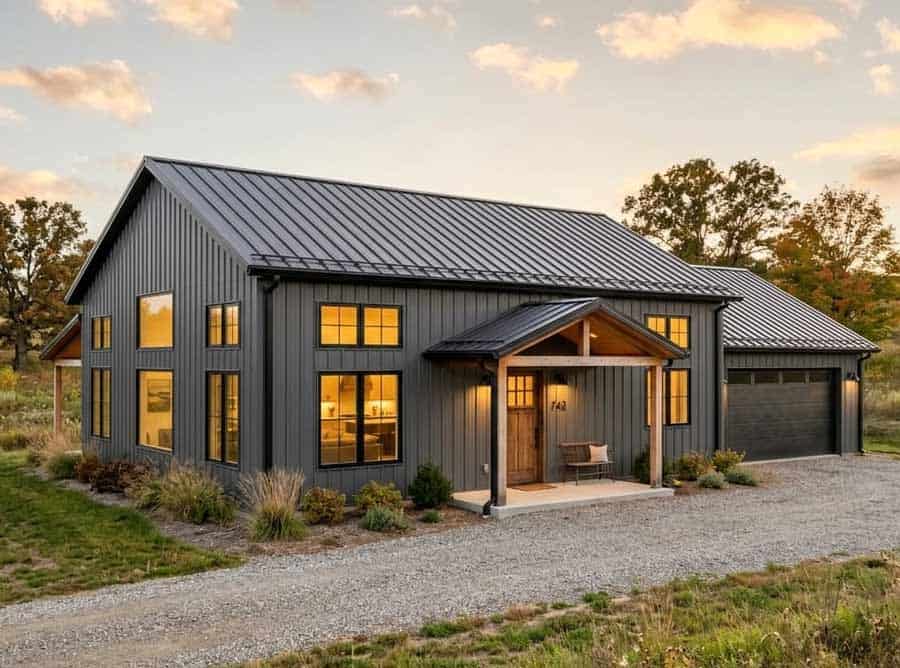
Both offer distinct aesthetics, construction approaches, and long-term value, but they serve very different buyers.
This guide breaks down the key differences between barndominiums and modern farmhouses, covering construction costs, design flexibility, energy efficiency, resale value, and lifestyle fit.
By the end, you’ll have a clear picture of which option makes the most sense for your land, your budget, and your vision.
What Is a Barndominium?
A barndominium, commonly called a “barndo,” is a metal building converted or purpose-built to function as a residential space.
It often combines living quarters with a workshop, garage, or storage area under one roof.
The exterior typically features steel panels, a metal roof, and a utilitarian profile.
Inside, though, barndominiums can range from simple open-plan layouts to high-end, custom-finished spaces with exposed steel beams and polished concrete floors.
I’ve seen interiors that would genuinely stop you in your tracks, where the industrial bones of the building get dressed up with warm wood tones, cozy textiles, and thoughtful lighting that make the whole space feel incredibly livable.
The appeal is straightforward: barndominiums are fast to build, cost-effective per square foot, and exceptionally durable.
The metal shell resists fire, pests, and harsh weather far better than traditional wood-frame construction.
What Is a Modern Farmhouse?
The modern farmhouse blends traditional rural architecture with contemporary design sensibilities.
Think white shiplap siding, black-framed windows, wide front porches, board-and-batten accents, and pitched gable roofs, all softened by clean lines and open-concept interiors.
Unlike barndominiums, modern farmhouses are built using conventional wood-frame construction methods.
This makes them more familiar to contractors, lenders, and appraisers, which has both practical and financial advantages.
The style prioritizes warmth, livability, and curb appeal, drawing from the agrarian architecture of the American South and Midwest while updating it for contemporary tastes.
If you’re someone who loves layering in home decor details, a modern farmhouse gives you a canvas that’s incredibly easy to work with.
The neutral palette and classic lines pair beautifully with everything from vintage finds to clean, minimal furniture.
How Do Construction Costs Compare?
Cost is one of the most significant factors separating these two building types, and it’s worth understanding before you fall in love with either style.
Barndominiums typically run between $30 and $125 per square foot to build, depending on the level of interior finish.
A basic shell with a no-frills interior sits at the lower end of that range.
A fully custom barndominium with high-end finishes, custom cabinetry, and a large workshop addition can push toward the upper end, but still tends to come in below comparable conventional construction.
Modern farmhouses generally cost between $150 and $300 per square foot to build, depending on materials, labor markets, and the complexity of the design.
Certain features common to the style, like vaulted ceilings, large windows, and custom millwork, add meaningfully to the total.
The cost gap narrows when you factor in finishing.
A bare-bones barndominium with exposed walls and minimal fixtures is affordable.
But a barndominium finished to the same standard as a well-appointed modern farmhouse can reach similar price points.
Budget accordingly, and I’d recommend getting detailed quotes from local contractors before committing to either direction.
Which Style Offers More Design Flexibility?
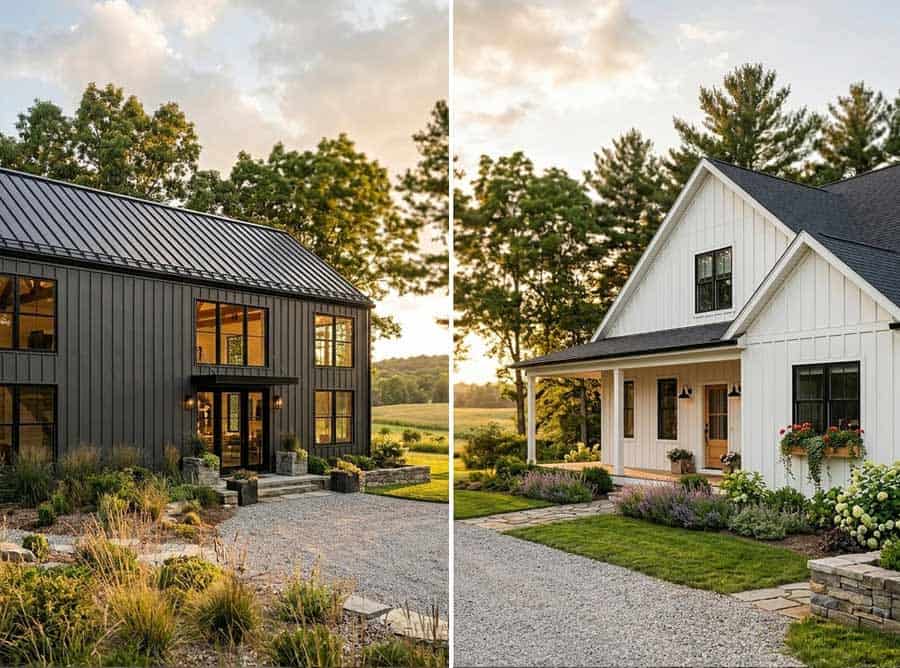
Both styles accommodate significant customization, but in very different ways.
Barndominiums shine when floor plan flexibility matters most.
Because the structural load is carried by the steel frame, interior walls are largely non-load-bearing.
This means you can design wide-open spaces, double-height ceilings, and large workshop areas without the constraints that wood-frame construction imposes.
If you need a home that doubles as a workspace for farming equipment, vehicles, or a small business, the barndominium’s layout options are hard to match.
From a home decor standpoint, those soaring ceilings and open floor plans are genuinely exciting to work with.
You have room to go big with statement light fixtures, oversized art, and furniture arrangements that would feel cramped in a more traditional layout.
Modern farmhouses, by contrast, offer more architectural variety on the exterior.
The style’s vocabulary is broad: you can go full classic farmhouse with wraparound porches and dormer windows, or pull it toward minimalism with flat planes and muted palettes.
Interior layouts follow conventional residential norms, which limits some structural creativity but makes room arrangement more intuitive for most buyers.
Your furniture, your textiles, and your decor choices will feel right at home in either direction you take it.
Energy Efficiency: Metal vs. Wood Frame
This is an area where barndominiums often get an unfair reputation.
Metal buildings, if not properly insulated, can be energy nightmares, freezing in winter and sweltering in summer.
However, with the right insulation strategy, spray foam being the most effective option for metal buildings, barndominiums can achieve excellent thermal performance.
Modern farmhouses rely on traditional batt or blown insulation within wood-stud walls, which is a well-understood and highly effective system.
Because contractors and building departments are deeply familiar with conventional construction, achieving strong energy performance in a modern farmhouse is comparatively straightforward.
The edge here goes to modern farmhouses for predictability.
Barndominiums can absolutely match their efficiency, but only when the insulation is installed correctly, which means working with a contractor who has specific experience in metal building construction.
A well-insulated home also means your interior comfort is easier to maintain, and that makes a real difference in how cozy and inviting your living spaces actually feel day to day.
Resale Value and Financing Considerations
This is where the two styles diverge most sharply, and it matters more than many buyers initially realize.
Modern farmhouses appraise and sell through conventional real estate channels without friction.
Lenders are comfortable with wood-frame construction, appraisers have ample comparable sales data, and buyers know what they’re getting.
Resale in most rural and semi-rural markets is reliable.
Barndominiums, on the other hand, can complicate the financing process.
Some lenders are reluctant to issue traditional mortgages for metal buildings, particularly in markets where comparable barndominium sales are scarce.
You may need to pursue a construction loan, a portfolio loan, or a lender with specific experience in non-traditional rural construction.
Resale can also be slower, simply because the pool of buyers familiar and comfortable with the style is smaller.
That said, barndominiums are gaining mainstream acceptance rapidly.
In states like Texas, Oklahoma, and Tennessee, where the style is well-established, financing and resale have become markedly easier over the past decade.
Lifestyle Fit: Matching the Home to How You Live
Beyond numbers and specifications, the right choice often comes down to how you plan to actually use the property.
A barndominium suits buyers who want to maximize functional square footage, need space for equipment or a workshop, prefer low-maintenance exteriors, and are drawn to an industrial-meets-rustic aesthetic.
It’s an especially strong choice for hobby farmers, small-scale agricultural operators, and buyers who want the efficiency of a single structure to serve multiple purposes.
I think it’s also worth noting that the open, airy interiors of a well-designed barndominium can be absolutely stunning when styled with intention.
Layer in warm rugs, natural wood accents, and plenty of soft lighting, and your space will feel just as welcoming as any traditionally built home.
A modern farmhouse is better suited to buyers who prioritize curb appeal and traditional aesthetics, plan to sell or refinance within a standard timeline, want a home that blends naturally into established rural neighborhoods, and prefer the predictability of conventional construction and lending.
The modern farmhouse style is also one of the most decorator-friendly out there.
Your shiplap walls, your open shelving, your black hardware and linen tones all work together in a way that feels pulled-together without a lot of effort.
Neither choice is inherently superior.
The barndominium offers raw practicality and cost efficiency, while the modern farmhouse offers familiarity, resale confidence, and timeless visual appeal.
The right one depends entirely on how you weigh those factors against each other.
Making the Right Decision for Your Rural Build
Choosing between a barndominium and a modern farmhouse ultimately requires an honest look at your priorities.
If budget efficiency, multi-use functionality, and design flexibility are at the top of your list, the barndominium deserves serious consideration, provided you work with experienced contractors and sort out your financing early.
If you value conventional resale prospects, broad design variety, and a home that fits seamlessly into the rural landscape, the modern farmhouse is the more proven path.
Before breaking ground on either, I’d strongly encourage you to consult a local real estate professional familiar with your specific market.
Resale dynamics, contractor availability, and local zoning regulations vary considerably by region, and that local knowledge is often the difference between a sound investment and a costly miscalculation.
Both styles can produce exceptional homes, and both give you a genuine opportunity to create a space that feels truly yours.
The one that’s right for you is the one that fits the life you’re planning to build, not just the structure.

Leave a comment