
Five simple tricks for a stress-free attic include adding safe flooring, organizing bins into a rotation system, improving lighting, creating labeled zones, and upgrading access methods.
Together, these transform a cluttered, dangerous space into a functional storage area.
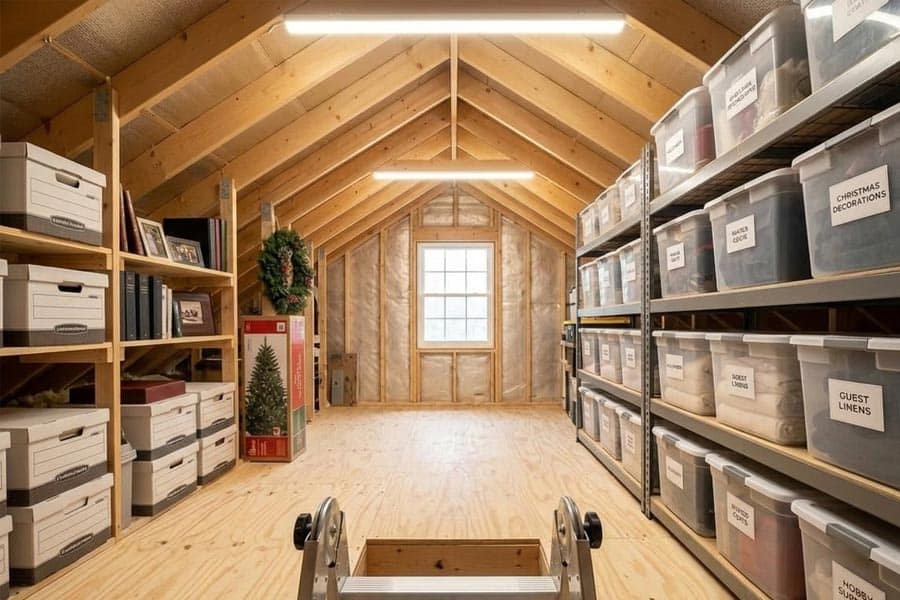
Good intentions often surrender to a dark, overcrowded environment that nobody wants to enter because getting in and out is exhausting.
These practical attic storage ideas require no contractor or massive budget, letting you sequence straightforward upgrades that make the space genuinely usable.
1. Add Safe, Walkable Flooring
Stable footing fundamentally changes how you interact with your storage space.
Once it’s safe to stand, organizing actually happens.
The primary safety risk is navigating exposed joists over fragile drywall, which turns retrieval into a dangerous balancing act.
For a straightforward upgrade, cut 3/4-inch tongue-and-groove OSB into manageable 2×4-foot panels that easily fit through standard hatch openings.
Fasten these directly to the joists with structural screws to eliminate squeaks, leaving breathing gaps around soffit vents and avoiding compressing the insulation runs beneath the decking.
You don’t need a massive budget for wall-to-wall flooring.
Creating a central walking aisle and a clear entry zone is enough to establish safe attic access for routine use.
Putting a solid floor underfoot is the foundational change that makes every subsequent upgrade on this list significantly easier to execute.
When moving heavy flooring panels upstairs, a temporary block-and-tackle hoist or a basic manual winch can help, though the process is completely streamlined with a high-strength attic lift from Inventive Garage.
2. Organize Seasonal Storage Bins Into a Rotation System
Cardboard boxes are the enemy of upper-level storage because they hide their contents, absorb ambient moisture, and turn every retrieval trip into a guessing game.
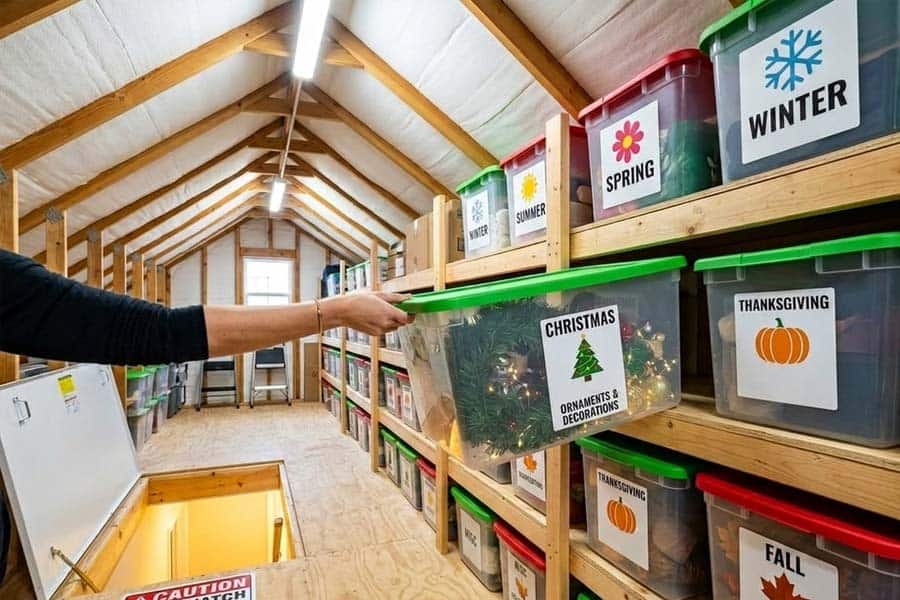
The solution is switching to uniform, transparent, stackable plastic bins kept under a strict 20-pound limit, ensuring they stay light enough to carry safely on a ladder.
Once standardized, implement a rotation system that prioritizes the items you access most frequently.
Establish a “hot zone” near the hatch for frequently swapped seasonal items, using deeper perimeter shelves for long-term archives.
Keeping bins light and organized by category saves countless hours of searching through poorly labeled cardboard during the holiday season.
| Pro Tip: Use color-coded lid tape, green for warm-season gear and red for winter items, to instantly distinguish bin contents without label-reading. Keep each bin under 20 lbs for safe ladder carry. |
3. Improve Lighting to Eliminate the Shadow Spiral
A dark attic inherently feels unusable and unwelcoming, while a properly lit space feels like a natural extension of your home.
The critical difference is visibility, and the most transformative upgrade you can make is installing linkable LED shop lights mounted securely to the upper rafters.
Aim for an even wash of coverage across all storage zones rather than relying on a single harsh central fixture.
This upgrade aligns nicely with general safety standards, which dictate that active storerooms require illumination.
If your space lacks existing electrical outlets, battery-powered motion-sensor LED light bars are a brilliant alternative that require no wiring or electrician.
Position these lights to wash across your bin labels rather than shining directly into your eyes when emerging from the entry hatch.
Clear light makes every subsequent trip shorter, less frustrating, and much safer when navigating around floor joists.
4. Create Labeled Zones and Stop Trusting Your Memory
The most effective organizational systems are designed for a tired, distracted version of yourself returning six months later, not the motivated version who initially set things up.
I’d recommend implementing a labeled framework with clearly defined functional categories, such as Holiday and Decor, Camping and Sports, and Home Maintenance.
You can execute these attic storage ideas across any budget level using dry-erase boards screwed directly to the rafters, laminated tags zip-tied to wire shelving, or simply painter’s tape and a Sharpie.
Applying this system effectively means enforcing one strict discipline rule: always keep a clear walking path in front of every zone.
A “one in, one out” policy for seasonal items also helps prevent the space from becoming permanently overstuffed.
This creates a self-policing environment where clear markers ensure nobody needs a guided tour and nothing gets deposited in the wrong place.
5. Upgrade Your Access Method and Remove the Heavy Lifting
Every improvement on this list ultimately depends on your willingness to go up and come back down safely.
If the access method stays broken, the space stays avoided regardless of how well it’s organized.
The conventional pull-down ladder presents a persistent problem due to its steep pitch and awkward angle.
Research shows that steep attic stairs are particularly hazardous because a significant portion of older people fall.
This design forces you to choose between maintaining balance and managing heavy storage cargo on a precarious incline.
A large percentage of climbing injuries occur when the ladder base slides out unexpectedly due to an incorrect setup angle.
An immediate first-tier upgrade is installing a wider ladder with deeper treads and a fold-out handrail, which is an affordable weekend project.
For anyone moving seasonal bins or heavy gear regularly, a powered platform or a robust mechanical hoist changes the entire dynamic.
| Warning: The standard pull-down ladder forces a dangerous choice between maintaining balance and carrying cargo. Narrow treads make it nearly impossible to safely move loaded bins up and down. |
Your Attic Is More Functional Than You Think
Adding flooring, sorting bins, installing lights, defining zones, and upgrading your entry method work together to transform a forgotten void into premium storage.
Access truly is the universal unlock.
Once getting in and out stops feeling like a physical negotiation, every organizational system functions the way it was designed to.
I’d encourage you to treat this as your weekend challenge: pick just one tip, start this Saturday, and build your momentum from there.
You’ll quickly discover that the upper space you already own is far more functional than it currently looks.
By focusing on safe attic access first, you eliminate the friction that made this area feel impossible.
Remove that friction, and the space practically takes care of itself.

Leave a comment