
Gray sofas are everywhere, and honestly, for good reason.
They’re practical, they hide a surprising amount of daily life, and they go with just about everything.
At least, that’s the theory.
In practice, a lot of people bring home a gray sofa, get it into the living room, and then stand there wondering why nothing feels quite right.
The walls feel bland. The rug looks like it landed there by accident.
The whole room is technically decorated but somehow doesn’t feel pulled together.
The good news is that this is a very fixable problem.
It usually comes down to two things: what you put around the sofa, and where you put the rug.
Get those right and the rest falls into place.
Start Here: Your Gray Sofa Is Not Just Gray
Here’s the thing nobody tells you when you buy a gray sofa: warm gray and cool gray are basically different colors when it comes to decorating around them.
Pair the wrong tones with the wrong gray and the room ends up looking muddy or cold in a way that’s hard to pin down.
Pair the right ones and everything clicks.
Cool gray has blue or green undertones.
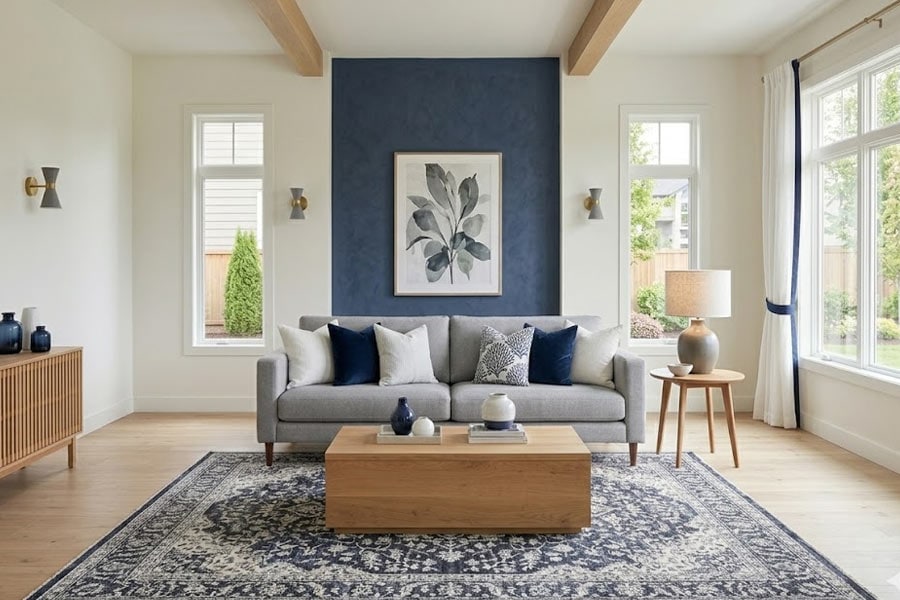
It works beautifully with crisp whites, navy, sage, and other cool tones.
Pair it with warm earth tones like terracotta, mustard, or burnt orange, and there’s often an uneasy tension between the undertones that’s hard to shake.
Warm gray has brown or beige undertones.
It pairs naturally with cream, camel, wood tones, rust, and olive green.
Pair it with cool blues or stark whites and the sofa can start to look a little dingy.
Here’s a quick way to check which one you have: hold a piece of plain white paper next to your sofa in natural daylight and compare.
If your sofa looks slightly blue or green against the white, it’s cool-toned.
If it reads slightly brown, beige, or taupe, it’s warm.
That one check will save you a lot of trial and error when it comes to choosing everything else.
Color Combinations That Actually Work
Once you know your gray’s undertone, picking a color direction gets a lot easier.
Here are three reliable palettes for each:
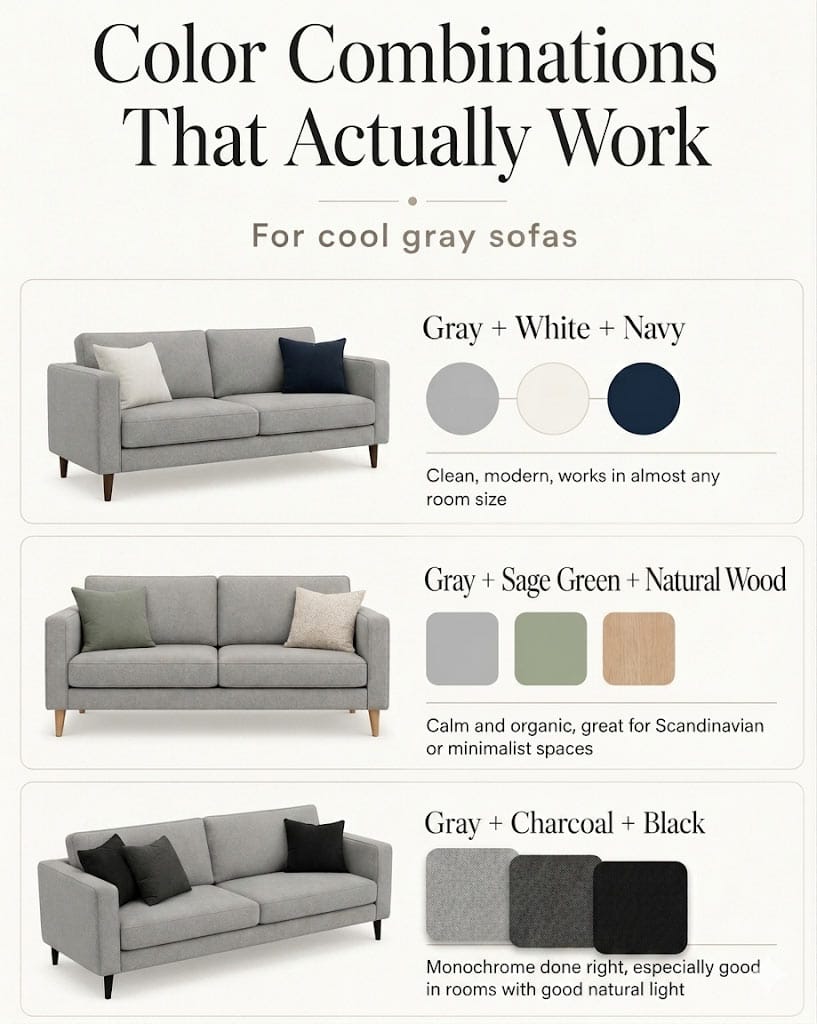
For cool gray sofas:
- Gray + white + navy: clean, modern, works in almost any room size
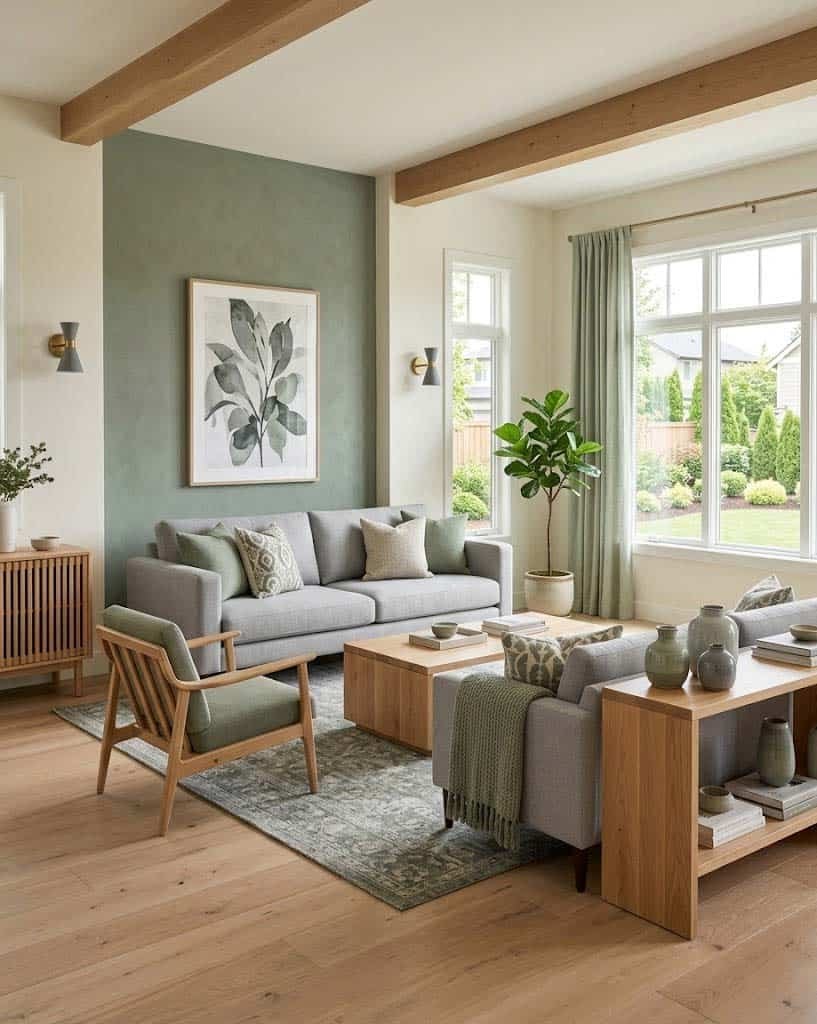
- Gray + sage green + natural wood: calm and organic, great for Scandinavian or minimalist spaces
- Gray + charcoal + black: monochrome done right, especially good in rooms with good natural light
For warm gray sofas:
- Gray + cream + mustard: cozy and welcoming, especially in living rooms that get a lot of use
- Gray + terracotta + warm wood: earthy and grounded, works beautifully in rooms with wood floors
- Gray + olive green + rust: warm and layered, perfect for fall-inspired or boho-adjacent spaces
A simple rule that helps keep things from getting overwhelming is the 60-30-10 formula.
Use 60% of the room in your main neutral: the walls, large furniture, and the sofa itself.
Use 30% in a secondary tone like the rug, curtains, or a larger accent chair.
Save 10% for a true accent color like throw pillows, a vase, or a blanket.
It keeps the room feeling balanced without everything blending into the same gray blur.
One more thing worth knowing: texture matters just as much as color when you have a gray sofa.
A gray sofa surrounded by nothing but smooth surfaces reads as cold and flat regardless of the color palette.
I always recommend adding at least two different textures in your soft furnishings, like linen and chunky knit, bouclé (that loopy, textured fabric) and jute, or velvet and woven cotton.
That layering is what makes a gray room feel warm and lived-in rather than like a showroom floor.
For more specific color combinations and how they play out with different shades of gray, including a closer look at warm versus cool pairings, gray sofa decor ideas goes deeper into the options — from earthy palettes to monochrome styling to blush and soft green combinations.
The Rug Is Where Most Gray Sofa Rooms Fall Apart
If the color palette is what makes a gray sofa room look good, the rug is what makes it feel finished.
And this is where a surprising number of otherwise nicely decorated rooms go wrong.
The most common mistake I see is a rug that’s too small.
A rug that doesn’t reach at least the front legs of the sofa looks like it’s floating in the middle of the floor.
It disconnects the seating area from everything around it and makes the whole room feel like the furniture hasn’t quite landed yet.
As a general rule, an 8×10 rug is the starting point for a standard living room.
For larger rooms or sectionals, go 9×12.
When in doubt, go bigger: a rug that’s slightly too large is almost always better than one that’s slightly too small.
The second question people run into is whether the rug should extend toward the TV stand or stop at the seating area.
The honest answer is that it depends on your room.
In an open-plan space or a larger living room, a rug that anchors both the seating area and the TV zone creates a sense of cohesion.
It tells the eye that both zones belong to the same room.
In a smaller room, having the front legs of the sofa on the rug is often enough to ground the space without making things feel cramped.
What you want to avoid is a rug that clearly doesn’t reach the sofa at all.
That’s the version that makes a room feel unfinished no matter how good everything else looks.
For the full breakdown of placement options, including exactly when it makes sense to extend the rug toward the TV stand and when it doesn’t, living room rug placement covers the rules clearly with practical guidance for different room layouts.
A Quick Checklist Before You Shop
If you’re about to start buying things to pull your room together, run through these five steps first:
- Identify your gray’s undertone: warm or cool. This one step determines everything else.
- Pick a palette using 60-30-10: one main neutral, one supporting tone, one accent. Commit to it before you buy anything.
- Add at least two textures: one smooth, one chunky or woven. This is what keeps the room from feeling cold.
- Size the rug correctly: 8×10 minimum for most living rooms, front legs of the sofa on the rug at minimum.
- Decide on the rug-to-TV relationship based on your room layout before you order.
If you’re still in the market for the sofa itself, Povison’s gray sofa range is worth a look: warm gray upholstery, modular configurations, removable washable covers, and fully assembled delivery so you can skip straight to the part you actually want to do.
Gray sofas are genuinely one of the easiest starting points for a beautiful living room.
It’s everything around them that makes the difference, and now you know exactly where to start.

Leave a comment